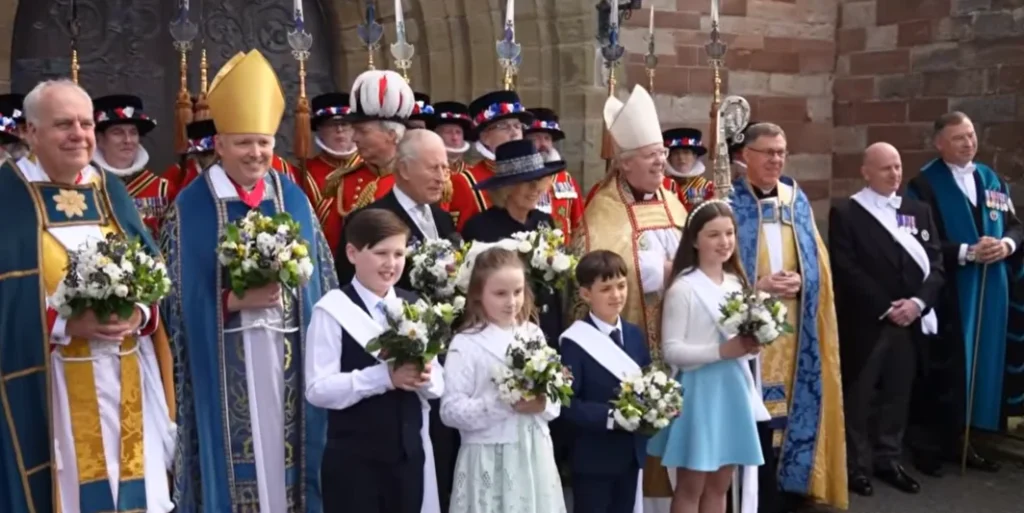

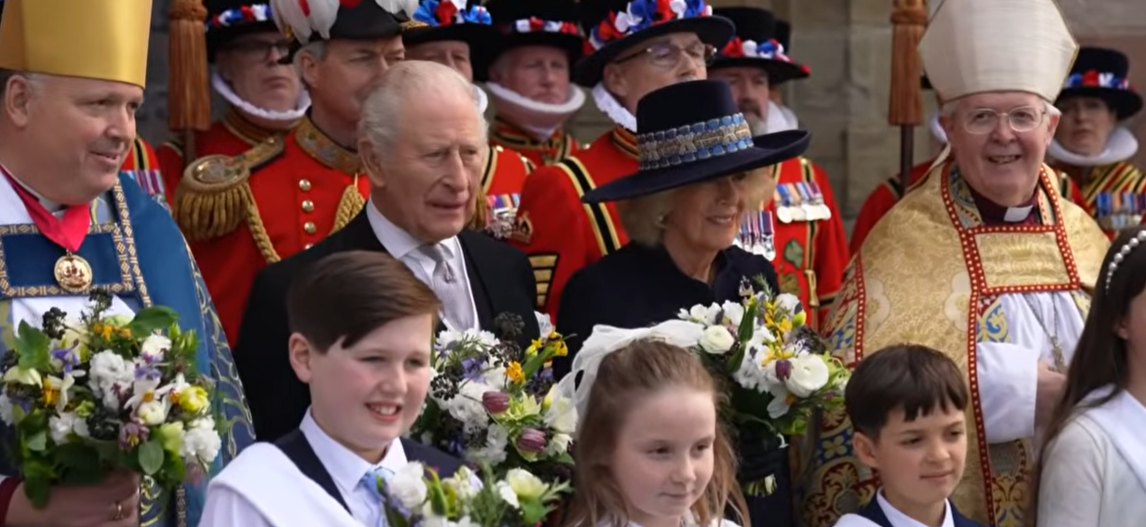
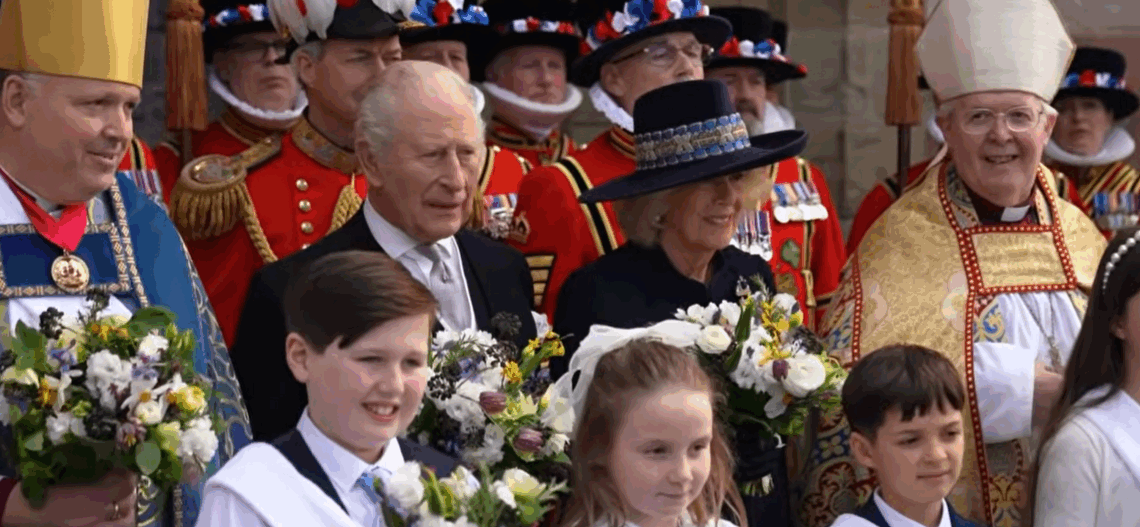
King Charles III received a posy of spring flowers as he departed St. Asaph Cathedral following the traditional Maundy Service, a gesture that, while typically reserved for royal women, is extended to all leading figures at the ceremony. This significant occasion marked the first time the Maundy Service has been held in North Wales and only the second time it has taken place in Wales since its inception, underscoring the historical and regional importance of the event. The King, carrying the vibrant bouquet of purple and yellow blooms, participated in the centuries-old tradition, highlighting his commitment to royal customs and his engagement with communities across the United Kingdom.
The Significance of the Maundy Service and the Posy Tradition
The Maundy Service, a Christian ceremony observed on Maundy Thursday, holds deep historical and religious roots. It commemorates Jesus Christ’s washing of his disciples’ feet at the Last Supper, an act of humility and service. Historically, monarchs would perform this ritual themselves as a symbol of their own humility and devotion. While the literal foot-washing by the monarch has long since ceased, the ceremony continues to honour individuals who have demonstrated exceptional service to their churches and communities.
The presentation of posies, or nosegays, to the leading figures at the service, including the monarch, has a fascinating historical context. Originating in medieval times, these small bouquets of flowers and herbs served a practical purpose: to ward off unpleasant odours. Over centuries, the tradition evolved, with the posies becoming symbolic of the herbs and flowers associated with the washing of feet, further linking the ceremony to its biblical origins. While often associated with royal women, the inclusion of King Charles in this floral presentation reflects the evolving nature of royal ceremonies and the recognition of the monarch’s central role in the service. The posy presented to the King comprised bright spring flowers, including purple and yellow blooms, arranged within the traditional white fringed surrounds, a visual representation of renewal and the bounty of the season.
A Historic First for North Wales
The choice of St. Asaph Cathedral in Denbighshire for this year’s Maundy Service was a deliberate and significant one. North Wales, rich in history and cultural heritage, had not previously hosted this prestigious event. The cathedral itself, one of the smallest in the UK, boasts a history stretching back to the 6th century, making it a fitting venue for a ceremony steeped in tradition. The fact that this was only the second time the service has been held in Wales at all amplifies its historical resonance. Previous Maundy Services in Wales have included Westminster Abbey (when the monarch is also the reigning monarch of Wales), St. David’s Cathedral in Pembrokeshire in 1937, and Llandaff Cathedral in Cardiff in 1985. This year’s event, therefore, represented a notable shift in geographical focus, bringing the royal tradition directly to the communities of North Wales.
The King’s Engagement and the Maundy Money Distribution
During the service, King Charles followed in the footsteps of his predecessors by distributing Maundy Money. This year, 154 individuals—77 men and 77 women—were honoured. The number 77 corresponds to the King’s current age, a personal touch that has become a hallmark of his reign. These recipients were not chosen arbitrarily; they were selected for their outstanding contributions to their local communities and their service to the Church. This act of recognition is a cornerstone of the Maundy tradition, ensuring that those who dedicate themselves to the betterment of society are acknowledged and celebrated at the highest level.
Each recipient received two specially minted purses: one white purse containing specially minted silver coins, and one red purse containing coins of the realm, typically up to the value of the monarch’s age in pence. This distribution of Maundy Money is a tangible representation of the King’s appreciation and a reminder of the enduring values of charity and service. The ceremony, therefore, serves a dual purpose: a deeply religious observance and a public acknowledgement of the dedication of ordinary citizens.
Royal Walkabout and Public Engagement
Following the formal proceedings within St. Asaph Cathedral, King Charles and Queen Camilla engaged with the public during a walkabout. This informal interaction allowed the King and Queen to connect with the crowds that had gathered to witness the historic event. Such walkabouts are a vital part of royal duties, providing an opportunity for the public to see and interact with the Royal Family, fostering a sense of connection and national unity. The presence of the King and Queen in North Wales was a clear demonstration of their commitment to visiting and engaging with all regions of the United Kingdom, reinforcing their role as heads of state for the entire nation.
Preparations for Easter and Royal Family Movements
The Maundy Service marked a significant engagement for the King and Queen before their Easter celebrations. The couple was set to travel to Windsor where they would spend the Easter period. It is anticipated that they will lead the Royal Family at the traditional Easter Sunday service, an event that typically draws significant public attention and often sees the wider family in attendance. Reports suggest that the Prince and Princess of Wales are expected to join them at Windsor for the Easter service, a potential sign of their return to public duties following their recent health announcements.
However, the absence of Princess Beatrice and Princess Eugenie from the Easter festivities has been noted. Their decision to spend Easter elsewhere follows renewed controversy surrounding their father, Prince Andrew, and their mother, Sarah Ferguson, and their past associations with the convicted sex offender Jeffrey Epstein. This aspect of royal family movements highlights the ongoing scrutiny and public interest in the personal lives and associations of its members, even during periods of religious observance. The contrast between the public recognition of community service at the Maundy Service and the personal controversies affecting other members of the Royal Family underscores the multifaceted nature of their public and private lives.
Broader Implications and Analysis
The choice of St. Asaph Cathedral for the Maundy Service can be interpreted as a strategic move to emphasize inclusivity and to bring significant royal occasions to regions that may not frequently host them. This decentralization of major royal events can foster a stronger sense of national identity and connection between the monarchy and communities outside of traditional centres of power. For North Wales, hosting such a prominent service is a significant honour and a boost to regional pride.
The King’s active participation in traditions like the Maundy Service, while adapting them to his own reign, demonstrates a commitment to continuity and evolution within the monarchy. His age-related distribution of Maundy Money is a personal touch that resonates with the public, humanizing the institution and emphasizing his connection to the people he serves. The symbolic presentation of the posy to the King, a gesture traditionally associated with royal women, further illustrates this blend of tradition and contemporary adaptation.
The forthcoming Easter celebrations at Windsor, and the anticipated presence of key members of the Royal Family, will continue to be a focal point of public and media interest. The differing Easter plans of various family members also reflect the complex dynamics and individual choices within the extended Royal Family, all of which are subject to public observation. As King Charles continues to define his reign, events like the Maundy Service provide valuable insights into his approach to tradition, service, and his relationship with the nation.