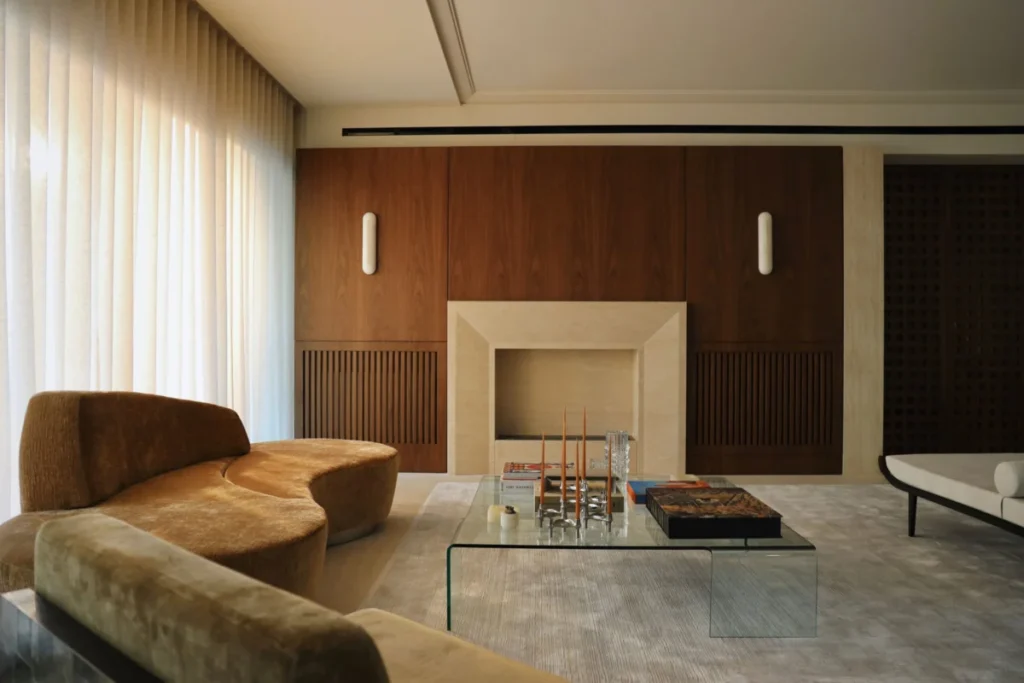

In the heart of Beirut’s historic Clemenceau district, a neighborhood characterized by its dense tapestry of Ottoman-era villas and mid-century modern high-rises, a newly renovated four-bedroom apartment stands as a masterclass in the delicate negotiation between light and shadow. Designed by the Beirut- and London-based architect Elie Riachi, the residence serves as a pied-à-terre for a high-level executive in the oil industry whose professional life necessitates constant global travel. The project, which Riachi describes as a sophisticated "facelift," avoids the common architectural impulse to flood every corner with artificial brilliance, instead embracing a chiaroscuro aesthetic that honors the cultural heritage of the Levant while catering to the eclectic tastes of a modern art collector.

The Clemenceau district itself provides a vital backdrop to the project. Situated near the city’s famous Corniche waterfront, the area has long been an intellectual and cultural hub, home to the American University of Beirut and numerous medical centers. The apartment, located on the first floor of a building dating back to the early 2000s, overlooks lush gardens that offer a rare sense of verdant tranquility in the bustling Mediterranean capital. According to Riachi, the residence acts as a permeable membrane between the private sanctuary of the home and the vibrant pulse of the city, which he describes as passing in front of the windows "like a TV screen."
A Strategic Renovation: The Philosophy of the Facelift
The client, who had owned the property for several years, sought a renovation that would modernize the space without fundamentally altering its existing floor plan. The objective was to create a layered, lived-in environment that could showcase a significant collection of regional and international artworks. Riachi’s intervention began with a rigorous process of subtraction. His team stripped away dated joinery, overhauled the bathrooms, and removed false ceilings that had previously stifled the apartment’s vertical proportions.

One notable element that remained was the limestone tiled flooring. Riachi recognized that the neutral, stone-clad foundation provided an ideal canvas for his vision of materiality. By retaining the original floors, the project established an immediate connection to the local vernacular of Lebanese interiors, where stone is prized for its thermal properties and timeless elegance. This decision also aligned with a broader trend in sustainable luxury design: the preservation of high-quality existing materials to reduce the carbon footprint of domestic renovations.
Riachi’s background in architecture informs his approach to interior design, which he views through the lens of structural layering. He cites the influence of Brutalism and mid-century modernism—movements that prioritize the "essence" of materials and the honesty of form. In this Beirut residence, that philosophy manifests in a palette of earthy neutrals, where the richness of the textures compensates for the restraint in color.

The Mashrabiya: Bridging Tradition and Modernity
The defining architectural feature of the renovation is the contemporary interpretation of the mashrabiya. Traditionally, the mashrabiya is a type of oriel window enclosed with carved wood latticework, common in Arabic architecture since the Middle Ages. Its historical purpose was twofold: to provide privacy and to facilitate natural ventilation while diffusing the harsh Mediterranean sun.
In Riachi’s design, the mashrabiya is reimagined as a series of perforated screens and wall paneling crafted from American walnut. These screens are strategically placed in the entrance hall, a space that is intentionally dark and enclosed. By lowering the ceiling in the foyer relative to the rest of the apartment, Riachi creates a sense of compression that makes the transition into the expansive, light-filled living area feel more dramatic.

The walnut screens are edged in travertine, creating a sophisticated interplay between the warmth of the wood and the cool, porous texture of the stone. As sunlight filters through the square apertures of the lattice, it creates a "dance" of dappled light across the limestone floors. This creates an atmosphere of intrigue, suggesting the depth of the spaces beyond without fully revealing them. The use of American walnut was a deliberate choice; the timber’s deep grain and durability ensure that the intervention feels integrated into the home’s permanent structure rather than appearing as a decorative afterthought.
Materiality and the Living Space
Moving from the entrance into the primary living area, the design language remains consistent but expands in scale. The centerpiece of the room is a custom-designed travertine fireplace, framed by a walnut surround. Riachi punctured the surround with vertical openings, echoing the geometry of the mashrabiya screens and allowing for a rhythmic play of light. Linear alabaster wall sconces are integrated into the masonry, providing a soft, diffused glow that mimics the quality of natural light during the evening hours.

The furniture selection reflects the client’s identity as a global traveler and collector. Riachi sourced rare pieces from galleries and flea markets in London and Paris, blending mid-century treasures with contemporary avant-garde designs. Notable pieces include:
- The Cleopatra Daybed (1950s): Designed by Dick Cordemeijer for Auping, this minimalist daybed in ivory upholstery serves as a sculptural element in the room, representing the height of Dutch mid-century functionalism.
- The Bernini Desk (1960s): A walnut masterpiece by Silvio Coppola, which anchors the study area and reinforces the apartment’s commitment to high-quality timber.
- Contemporary Accents: A brass-and-zinc coffee table by the French-Serbian artist Marko provides a metallic counterpoint to the matte stone surfaces. Additionally, the Sedia Tonda chair by Edoardo Lietti features circular cut-outs that subtly reference the geometric motifs found in the walnut screens.
To ensure the apartment remains a functional home rather than a gallery, Riachi paid close attention to tactile comfort. A custom sofa, finished with a ribbed walnut base, is upholstered in ivory fabric to match the neutral tones of the Nalbandian silk-and-wool rug. The rug’s subtle striated pattern adds a layer of visual interest without competing with the artworks on the walls.

Chronology of Design and Cultural Context
The renovation of this Clemenceau apartment occurs at a significant moment in Beirut’s architectural history. Since the late 19th century, the city has been a laboratory for stylistic experimentation, from the "Central Hall" houses of the Mandate period to the high-modernism of the 1960s—often referred to as Beirut’s "Golden Age."
The early 2000s building that houses this apartment represents a more contemporary chapter, often criticized for a lack of character compared to the city’s older fabric. Riachi’s intervention can be seen as a corrective measure, injecting a sense of soul and historical continuity into a modern shell. By utilizing the mashrabiya concept, he anchors the apartment in a regional identity that transcends the "international style" often found in luxury real estate.

The project timeline spanned several months, involving meticulous coordination with local craftsmen. In Beirut, a city known for its highly skilled artisans in woodworking and stonemasonry, Riachi was able to achieve a level of bespoke detail that is increasingly rare in Western markets. Each panel of the walnut screens was hand-finished to achieve a matte texture, emphasizing the natural beauty of the wood over a high-gloss synthetic look.
Color Theory and Private Sanctuaries
While the public areas of the apartment adhere to a strict palette of "greige," ivory, brown, and black, the private quarters introduce subtle shifts in tone and texture. The four bedrooms were designed to be "comfortable and easy," moving away from the more rigorous architectural lines of the living room.

In the bedrooms, Riachi drew inspiration from the apartment’s external environment. The bespoke curved headboards were designed to mimic the organic shapes of the foliage on the balconies, bringing a sense of the garden indoors. To soften the acoustics and the visual weight of the rooms, wardrobe doors were covered in French linen. This choice of material adds a rustic, tactile quality that contrasts with the precision of the travertine and walnut found elsewhere.
The bathrooms were completely reimagined, stripped of their original fixtures to make way for a more minimalist, spa-like atmosphere. Here, the use of stone continues, but with a focus on seamless surfaces and hidden lighting that enhances the "chiaroscuro" effect, creating a sense of calm and seclusion.

Broader Impact and Implications
The success of the Clemenceau apartment renovation offers several insights into the current state of high-end interior design in the Middle East. First, it demonstrates a move away from "bling" and toward "quiet luxury." The value of the home is not found in gold leaf or ostentatious displays of wealth, but in the rarity of the vintage furniture, the quality of the raw materials, and the sophistication of the light play.
Second, the project highlights the importance of the "collector’s home" as a specific typology. For clients with extensive art collections, the architect’s role shifts from creating a finished "look" to creating a flexible "environment." By choosing matte finishes and a neutral palette, Riachi ensures that the apartment can evolve as the homeowner rotates his collection of regional artworks, such as Leo Pacha’s patinated metal sculpture, The Hiker.

Finally, the project serves as a testament to the resilience of Beirut’s creative economy. Despite the economic and political challenges facing Lebanon, the city continues to produce world-class design that honors its complex history while looking toward a global future. Riachi’s work in Clemenceau is a reminder that architecture is most powerful when it leans into the specificities of its location—balancing the light of the Mediterranean with the shadows of a storied past.
Through the strategic use of the mashrabiya, the careful curation of mid-century design, and a deep respect for materiality, Elie Riachi has transformed a standard luxury apartment into a timeless sanctuary. It is a space that does not just house a collection of objects, but tells a story of travel, culture, and the enduring beauty of light and shade.