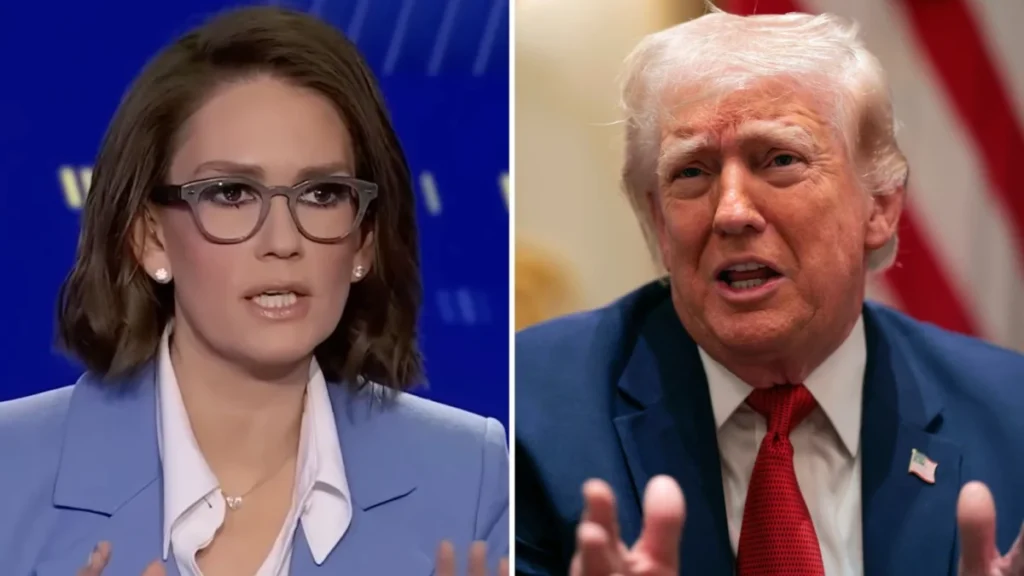

Former President Donald Trump ignited a public exchange on Thursday night, March 26, 2026, by directly questioning the presence of Fox News host Jessica Tarlov on the popular panel show The Five. During a call-in appearance, Trump stated that the program "would be better without her," a remark that Tarlov later addressed on social media platform X. The incident highlights a recurring tension between the former president and the liberal co-host, underscoring the often-contentious nature of political commentary on cable news.
The Exchange on ‘The Five’
The exchange unfolded when President Trump joined the Thursday, March 26, 2026, broadcast of The Five via phone. In a candid moment, as reported, Trump expressed his viewership habits and offered a critique of the show’s lineup. "I like all of your shows," Trump reportedly began. "I’m glad Jessica’s not there. No, actually, I think your show would be better without her. But who am I to say that? I think it would be a lot better."
Host Jesse Watters, a conservative co-host on the program, seized on Trump’s comment, posing a direct challenge: "Mr. President, the next time you do this on The Five, can we have you on set? Because we really want you to sit next to Jessica. I think you’d be a good influence on her. Can you do that?"
Trump responded by elaborating on his perceived issues with Tarlov’s on-air contributions. "I watch Jessica, and I’m not a fan," he stated. "And she uses fake numbers. She’ll give, ‘Well, he’s only polling 42%.’ That’s not right. Polling very high, actually." He continued to criticize what he termed "bad journalists" who publish "fake stories," before adding, with a seemingly conciliatory tone, "I’m sure I’d like her. I’m sure she’s a lovely person." Watters, in turn, playfully acknowledged Trump’s sentiment, replying, "She’s a lovely person. We’re working on her. Don’t worry."
The former president then inquired about Tarlov’s absence from that specific episode, asking, "Tell me, did she not want to do it, or did you kick her off the show?" Watters clarified that Tarlov had a prior, unchangeable commitment. "No, we didn’t kick her off," Watters said. "She had a previous schedule that she couldn’t change."
Tarlov’s Retort and the Context of Poll Numbers
Jessica Tarlov, a Democratic Party political strategist and a rotating co-host on The Five, did not let Trump’s remarks go unanswered. She took to her X (formerly Twitter) account to respond to a clip of Trump’s comments, which had been shared by a user named Eric Daugherty.
Tarlov posted, "Was so bummed to miss the show today! But I definitely would’ve said he’s even inflating his numbers to 42%!" This directly addressed Trump’s criticism of her use of poll data, specifically his assertion that she misrepresented his polling figures.
The timing of Tarlov’s retort is significant, as a Fox News poll released on Tuesday, March 25, 2026, indicated that Donald Trump held a 41% approval rating. Tarlov’s statement suggests she would have pointed out this figure, implicitly challenging Trump’s claim that his polling numbers are higher than she presented. Her comment implies a belief that Trump’s assertion of "polling very high, actually" was itself an exaggeration, or that the 42% figure she might have cited was a more accurate reflection of the available data at that moment.
A History of Antagonism
This is not the first instance of public friction between Donald Trump and Jessica Tarlov. Their adversarial relationship has been evident on multiple occasions, particularly concerning their differing political viewpoints and interpretations of events.
Last July, following a shooting incident in New York City, Tarlov advocated for stricter gun control measures on The Five. This stance drew a strong reaction from Trump, who took to his Truth Social platform to criticize her directly. On July 19, 2025, Trump posted, "I can’t stand Jessica Tarlov of THE FIVE. A real loser!!! DJT." This public denouncement underscored the deep ideological divide and personal animosity that has developed between the two figures. Tarlov’s role as a liberal voice on a show that often features conservative perspectives inherently places her in a position to challenge figures like Trump, leading to these pointed exchanges.
Broader Implications and Political Commentary Landscape
The incident involving Donald Trump and Jessica Tarlov offers a microcosm of the broader dynamics within contemporary political discourse, particularly as it plays out on cable news. The Five, as one of Fox News’s highest-rated programs, provides a prominent platform for political debate. The show’s format, featuring co-hosts with diverse viewpoints, often leads to spirited discussions and, at times, direct confrontations.
Trump’s willingness to call into a show and directly critique a specific host reflects his continued engagement with media narratives and his strategic use of platforms to shape public perception. His comments about Tarlov’s use of "fake numbers" are indicative of a broader trend where political figures frequently challenge the accuracy of polling data and media reporting when it doesn’t align with their desired narrative. This tactic is often employed to discredit critics and bolster support among their base.
Tarlov’s response, swiftly delivered on X, demonstrates the evolving nature of political communication, where social media platforms serve as immediate channels for retort and engagement. Her ability to leverage her own platform to counter Trump’s criticisms, while also reinforcing her own political arguments, highlights the interconnectedness of television and social media in shaping public opinion.
The fact that The Five has a rotating panel, with Tarlov appearing on specific days, adds another layer to the dynamic. Trump’s comment about her absence suggests a level of awareness of the show’s schedule and a deliberate attempt to target a specific commentator.
The Role of Polls in Political Discourse
Trump’s specific criticism of Tarlov’s use of poll numbers brings into focus the often-contested nature of polling data in political campaigns and commentary. Polls are frequently cited as indicators of public sentiment, but their interpretation can be subject to bias, methodological differences, and the specific timing of their release.
In the context of the March 25, 2026, Fox News poll showing Trump at 41% approval, Tarlov’s assertion that she would have stated he was "even inflating his numbers to 42%" suggests a perceived discrepancy between Trump’s claims and the published data. This type of debate over numbers is a common feature of political discussions, where campaigns and commentators often highlight favorable data points while downplaying or questioning unfavorable ones.
The reliability and interpretation of polls can significantly influence public perception of a candidate’s strength and viability. When a prominent political figure like Trump publicly disputes poll numbers presented by a commentator, it can sow doubt among his supporters and amplify the perception of media bias. Conversely, for those who agree with Tarlov’s assessment, it reinforces the idea that Trump is attempting to manipulate public perception through inflated claims.
Future Implications and the 2026 Election Cycle
As the United States moves closer to the 2026 election cycle, these kinds of public exchanges between political figures and media personalities are likely to intensify. The interplay between traditional media, like Fox News’s The Five, and social media platforms like X, will continue to be a crucial battleground for shaping narratives and mobilizing voters.
Donald Trump’s continued public presence and his willingness to engage directly with media criticism suggest he remains a central figure in political discourse. His ability to generate headlines and rally support through provocative statements remains a key characteristic of his political brand.
Jessica Tarlov’s position as a liberal voice on a prominent conservative-leaning network makes her a frequent target for those on the right, while also positioning her as a key commentator for those on the left. Her ability to articulate her views and respond effectively to criticism will be important in her ongoing role as a political analyst.
The dynamic between figures like Trump and Tarlov underscores the polarization of the American political landscape and the ways in which media platforms are utilized to advance political agendas. The debate over poll numbers, the use of "fake news" accusations, and direct personal critiques are all elements that contribute to the highly charged environment of contemporary political commentary. The ongoing interactions between these prominent voices will undoubtedly continue to be a subject of interest and analysis as the political climate evolves.
Conclusion
The verbal sparring between Donald Trump and Jessica Tarlov on Thursday night, March 26, 2026, serves as a vivid illustration of the often-confrontational nature of political commentary on cable news. Trump’s direct challenge to Tarlov’s presence on The Five and his criticism of her use of poll data have been met with a firm retort from Tarlov, highlighting the deep-seated political disagreements and personal animosity that can characterize these public exchanges. As the political landscape continues to be shaped by such interactions, the roles of television and social media in facilitating and amplifying these debates remain central to understanding contemporary American politics. The recurring friction between Trump and Tarlov suggests that their public disagreements are likely to persist, reflecting the broader ideological divisions within the nation.