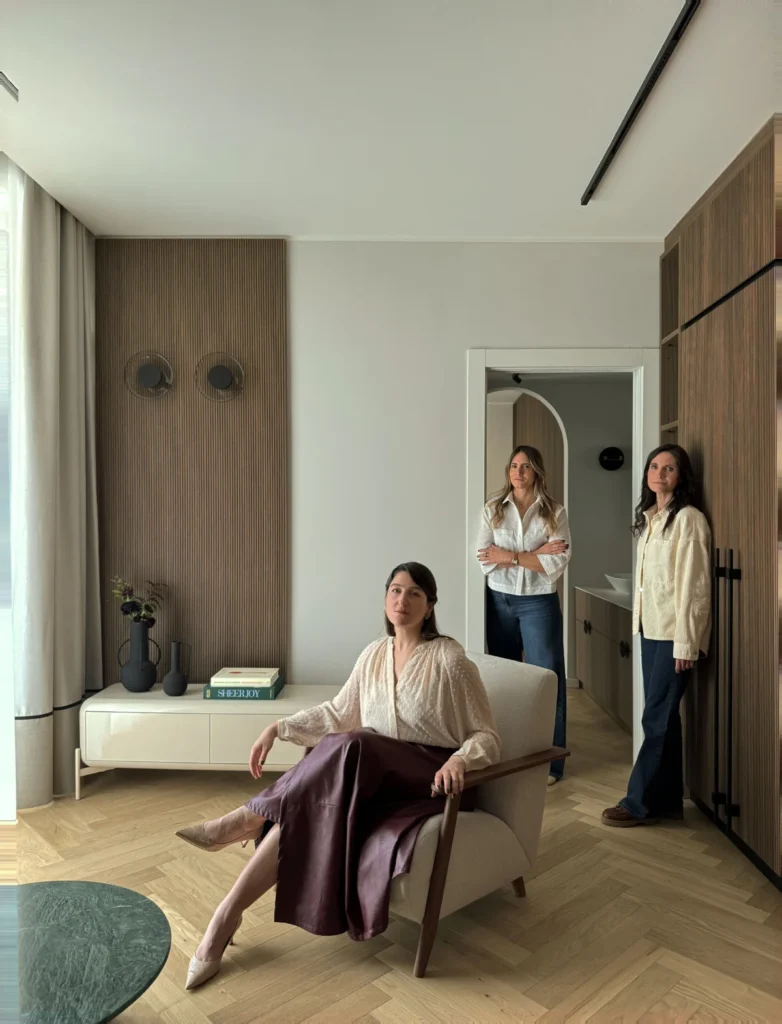

Located in the prestigious heart of Milan, just steps from the historic Basilica of Santa Maria delle Grazie—home to Leonardo da Vinci’s "The Last Supper"—a 484-square-foot apartment on Corso Magenta has been reimagined as a sophisticated urban sanctuary. This meticulously crafted residence serves as a secondary home for a family of Sicilian entrepreneurs whose lives are defined by international mobility. While their summers are anchored in a seaside estate near Syracuse, their professional and personal obligations draw them between the global hubs of London, New York, and Milan. The challenge presented to the design team was to synthesize these diverse lifestyles into a compact footprint that reflects both their Mediterranean roots and their cosmopolitan outlook.

The project was spearheaded by Danielle Cohen, Chiara Confalonieri, and Iris Capra of Studio dxp architetti. Having maintained a long-standing professional relationship with the family, the designers were entrusted with the complete interior overhaul of a space within a historic building that had recently undergone a structural redevelopment. While the building’s neoclassical facade was preserved to maintain the architectural integrity of Corso Magenta, the interior was a blank slate, stripped to its core. Over a three-year period, the architects worked in close coordination with the clients and specialized contractors to execute a vision that prioritizes functional efficiency without sacrificing the aesthetic rigor expected of a high-end Milanese residence.
Strategic Spatial Engineering and the Main Axis
The primary architectural objective was to overcome the inherent limitations of the apartment’s 45-square-meter (484-square-foot) footprint. In high-density urban markets like Milan, where real estate prices in the Magenta district can exceed €12,000 per square meter, the efficient use of space is not merely an aesthetic choice but an economic imperative. To achieve this, Studio dxp architetti implemented a design strategy centered on a "main axis" that serves as the backbone of the home.

This axis is physically manifested through a continuous corridor that links the living area, the central hallway, and the private sleeping quarters. The use of traditional herringbone parquet flooring throughout this passage creates a sense of visual continuity, drawing the eye from the entrance to the furthest reaches of the apartment. This linear progression is reinforced by a sophisticated ceiling track lighting system provided by Wever & Ducré. The lighting is more than a technical necessity; it serves a narrative function, emphasizing the depth of the apartment and amplifying the perception of volume in a confined space.
To further maximize the available square footage, the design team utilized the concept of "thick walls." One side of the central axis consists of a continuous wall of custom-built cabinetry. These wooden built-ins serve a dual purpose: they provide concentrated storage solutions—essential for a family that travels frequently—and they conceal technical functions, such as climate control systems and electrical panels, behind a seamless aesthetic of Canaletto walnut.

Materiality and the Logic of Yacht Design
The interior philosophy of the Corso Magenta apartment draws significant inspiration from the logic of boat design. In maritime architecture, every millimeter is scrutinized for its functional potential, and furniture often serves multiple roles. This "nautical" approach is evident in the apartment’s bespoke furniture, much of which was custom-designed by the architects and manufactured by the artisanal firm Zero Otto Arredi.
Canaletto walnut was selected as the primary material for the millwork, chosen for its warm tones and durability. This wood creates a unifying thread that runs from the entrance vestibule to the bedroom. In the kitchen, the walnut cabinetry is paired with recessed black metal handles and a Dekton countertop featuring a travertine-effect marble finish. Dekton, a sophisticated blend of raw materials used in glass, porcelain, and quartz surfaces, was selected for its high resistance to heat, scratches, and stains—qualities that ensure the longevity of the compact workspace.

The integration of furniture is perhaps most evident in the dining area, where a custom-designed bench wraps around a Westwing Menorca table. This corner seating arrangement optimizes the footprint of the convivial zone, allowing for comfortable dining without the spatial intrusion of multiple freestanding chairs. Above the table, a Gravity 2 lamp by Forestier provides a focal point, while Lali chairs by Sklum offer additional seating.
Chronology of a Three-Year Collaboration
The transformation of the apartment was a multi-stage process that began with the acquisition of the property following its structural redevelopment. The timeline of the project reflects the meticulous nature of the design and the logistical complexity of custom fabrication:

- Acquisition and Concept Development (Year 1): The clients purchased the unit within the redeveloped Corso Magenta building. Studio dxp architetti was commissioned to translate the family’s international needs into a coherent interior plan. This phase involved extensive spatial mapping to ensure the 484-square-foot space could accommodate a living room, kitchen, bedroom, and full bathroom.
- Custom Design and Prototyping (Year 2): Given the unique dimensions of the apartment, the majority of the furniture had to be designed from scratch. The architects collaborated with Zero Otto Arredi to develop prototypes for the fluted walnut wardrobes and the integrated headboard-storage unit in the bedroom.
- Construction and Installation (Year 3): The final year focused on the installation of the technical systems and the bespoke millwork. The precision required for the "boat logic" storage meant that tolerances were minimal. The final phase involved the curation of decorative elements and textiles, including the selection of Carlucci fabrics for the custom chaise longue and headboard.
Integrating Milanese Heritage with Unexpected Graphics
While the apartment is a modern exercise in efficiency, it remains deeply rooted in its Milanese context. The city’s historic buildings are known for their ornate surfaces and hidden courtyards, a theme that the designers channeled through the use of textured wallcoverings and high-quality stone.
The entrance vestibule sets a bold tone with the application of Dedar’s QB Wall wallpaper. The woven graphic element provides an immediate sense of character, signaling that despite its size, the apartment does not shy away from decorative expression. This is balanced by a palette of warm white tones and natural stone.

In the bathroom, the designers utilized Marazzi’s Marble Look Verde Aver tiles to frame the shower. This choice of green marble is a nod to the classic Lombardy aesthetic, where dark, veined stones are frequently used in the foyers and bathrooms of grand 19th-century apartments. The bathroom also features Rubinetterie Tortona fixtures by Gessi and custom-designed doors by Zero Otto Arredi, ensuring that even the most utilitarian spaces adhere to the project’s high standards of craftsmanship.
Supporting Data: The Rise of the Luxury Pied-à-Terre in Milan
The Corso Magenta project reflects a broader trend in the Milanese real estate market. Data from the 2023-2024 residential market reports indicates a surge in demand for high-end, small-format apartments in the city’s historic center (Zone 1). Several factors contribute to this phenomenon:

- International Mobility: Like the Sicilian entrepreneurs in this case, a growing number of high-net-worth individuals require "landing pads" in major European cities. These buyers prioritize location and design quality over raw square footage.
- The "Hotelization" of Home: There is an increasing desire for residences that offer the bespoke feel of a luxury boutique hotel. This is achieved through the use of premium materials like Canaletto walnut and integrated technology.
- Yield on Investment: Small, expertly designed apartments in prime districts like Magenta maintain high resale value and offer significant rental yields if placed on the short-term luxury market.
In the Magenta district specifically, the proximity to cultural landmarks and the presence of high-end retail and dining make it one of the most resilient micro-markets in Italy. The 484-square-foot apartment, therefore, represents a strategic asset as much as a personal retreat.
Broader Impact and Design Implications
The success of the Corso Magenta apartment lies in its ability to prove that luxury is not synonymous with scale. By focusing on "formal and functional consistency," Studio dxp architetti has created a template for modern urban living. The project demonstrates that the limitations of a small floor plan can be neutralized through the use of bespoke millwork, strategic lighting, and a disciplined material palette.

The owners have expressed that the sleeping area is the most successful realization of their needs. Here, the bespoke headboard—upholstered in Sophistication fabric by Carlucci—is not merely a decorative element but a functional storage unit integrated directly into the closet system. This seamless blend of rest and utility epitomizes the project’s philosophy.
As urban centers become more crowded and real estate more expensive, the "yacht-inspired" approach to interior design is likely to become more prevalent. The Corso Magenta apartment serves as a faithful portrait of its owners: a family with deep Sicilian roots, an international lifestyle, and an appreciation for the precision of Milanese design. It stands as a testament to the idea that a home, regardless of its size, can be a profound reflection of identity and a masterclass in architectural ingenuity.