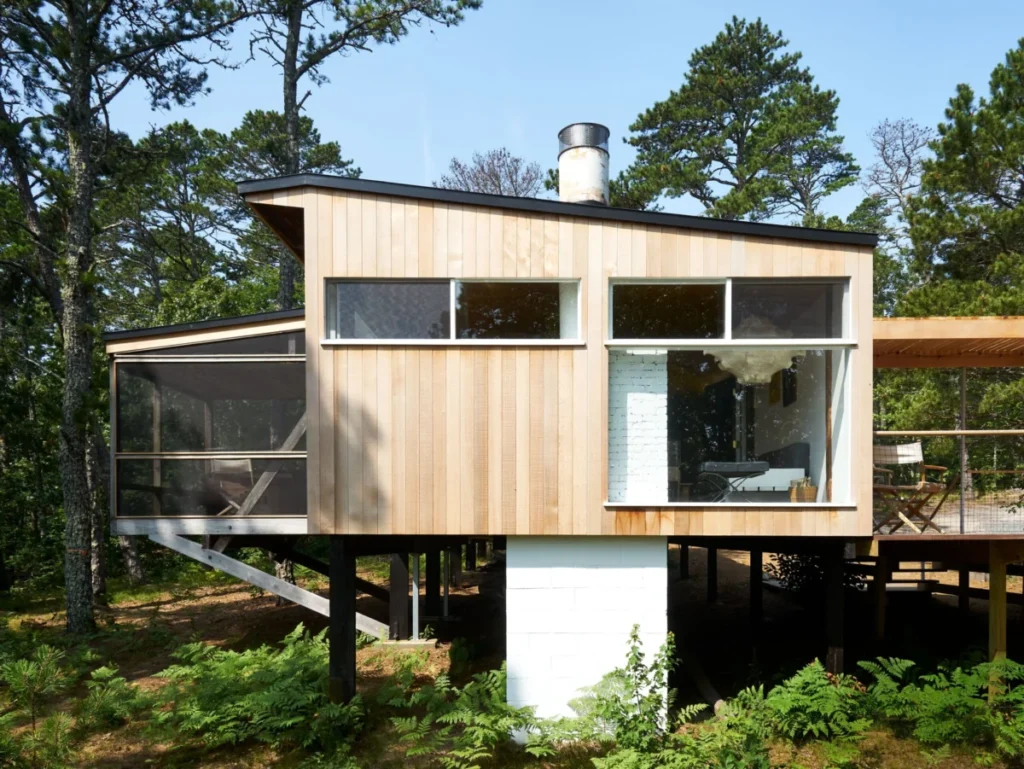

In the annals of American architectural history, the year 1949 stands as a pivotal moment for the democratization of modern design. It was during this year that Marcel Breuer, the Hungarian-born, Bauhaus-trained visionary, erected a two-bedroom model home in the sculpture garden of the Museum of Modern Art (MoMA) in New York. This structure, celebrated for its innovative butterfly roof and expansive glass walls, was presented as a sophisticated yet affordable blueprint for the burgeoning suburban housing market. However, while the MoMA house captured the public imagination, Breuer was simultaneously crafting a far more intimate and experimental expression of mid-century modernism deep within the secluded woods of Wellfleet, Massachusetts. This private sanctuary, which served as the architect’s personal beach retreat for decades, has recently emerged from a state of advanced decay to its former glory, following a meticulous restoration spearheaded by the Cape Cod Modern House Trust (CCMHT).

The restoration of the Breuer House marks a significant victory for architectural preservationists who have long argued that the residential legacy of the Outer Cape is as culturally significant as the historic colonial structures of New England. Purchased by the CCMHT in 2024 after a high-profile fundraising campaign, the property represents a physical manifestation of Breuer’s "Long House" concept—a design philosophy that sought to harmonize the clean, industrial lines of European modernism with the rugged, vernacular traditions of the American Northeast.
The Genesis of a Modernist Colony on the Cape
Marcel Breuer’s arrival in Wellfleet in the early 1940s was not an isolated event but part of a broader migration of European intellectuals and avant-garde designers to the shores of Cape Cod. Breuer was initially drawn to the area to visit his colleague Serge Chermayeff, who had established a family home in a wooded plot near the Atlantic coastline. The landscape—characterized by its kettle ponds, sandy soil, and resilient pitch pines—offered a stark contrast to the urban density of Cambridge, where Breuer and his mentor Walter Gropius were then teaching at the Harvard Graduate School of Design.

Captivated by the "placid swimming holes" and the raw natural beauty of the National Seashore, Breuer acquired 24 acres of land overlooking Williams Pond. The site was intentionally difficult to access; the architect famously carved his own rudimentary driveway through the dense forest, a task that resulted in the frequent scratching of his sports car’s chassis. On this remote precipice, Breuer constructed a prototype of modern living that challenged the conventions of the era. Built for less than $5,000 and initially devoid of both electricity and telephone service, the house was a study in minimalist functionality.
Architectural Significance and the Philosophy of Heavy Lightness
The Breuer House is architecturally defined by its "binuclear" plan, a signature Breuer layout that separates the living and sleeping quarters into distinct zones. The structure sits on stilts, elevated above a steep embankment to minimize its footprint on the delicate ecosystem. This elevation, combined with gently sloped shed roofs and ribbon windows, creates what CCMHT founder Peter McMahon describes as a "feeling of levitation."

The house embodies the concept of "heavy lightness," a term coined by the distinguished Breuer scholar Barry Bergdoll. This duality is evident in the contrast between the home’s timber-framed volumes and its more industrial elements. The cantilevered screened porch, which juts out toward Williams Pond, serves as the centerpiece of this architectural tension. While it appears to float among the trees, it was originally anchored by a massive stone-topped dining table, a heavy feature that eventually contributed to the structural sagging of the porch over the decades.
Breuer used the Wellfleet house as a laboratory for his evolving ideas. Over thirty years, he expanded the original footprint, adding a dedicated studio in 1961 and an additional apartment in 1969. These layers of construction reflected his changing family needs and his ongoing experimentation with color and material. Throughout his residency, which lasted until his death in 1981, Breuer frequently repainted the interior and exterior surfaces in a palette of bold, primary hues, creating a living archive of mid-century aesthetic preferences.

The Challenge of Preservation in a Maritime Climate
By the time the Cape Cod Modern House Trust took ownership of the property in 2024, the house was in a state of critical distress. The climate of the Outer Cape—characterized by high humidity, salt-laden air, and the seasonal threat of hurricanes—is notoriously unforgiving to modern materials like plywood and unsealed cedar. Decades of deferred maintenance had allowed moisture to infiltrate the building envelope, leading to the rot of birch ceiling panels and the degradation of the structural plywood walls.
The restoration process, led by McMahon and a team of specialized contractors, required a forensic approach to architecture. Because Breuer had updated the house multiple times without comprehensive documentation, the restoration team had to "peel down layers" of paint and material to determine which historical iteration to preserve. This resulted in a curated "mixed and matched" approach:

- The Kitchen: Reconstructed using speckled black linoleum and a specific shade of blue discovered during the demolition of later additions.
- The Bedroom: A wall was repainted in a deep chocolate brown after a hidden section was discovered behind a later-installed closet.
- Structural Reinforcement: The cantilevered porch was stabilized to ensure it could once again support the weight of the dining area, though the original slate table top was replaced with a lighter mahogany version to prevent future sagging.
- Flooring: The original oak floors were ebonized to match historical photographs from the mid-1960s.
Archival Discoveries and Cultural Treasures
Beyond the structural restoration, the CCMHT project unearthed a remarkable collection of artifacts that provide a rare glimpse into the private life of one of the 20th century’s most influential architects. During the cleanup and cataloging of the site, workers discovered:
- Original blueprints and architectural sketches hand-drawn by Breuer.
- A lithograph by Paul Klee and a painting by Alexander Calder, both of whom were close associates of Breuer from his Bauhaus days.
- Over 1,000 rolls of undeveloped or unorganized family photographs.
These photographs, currently being digitized by the Trust, document the social life of the Wellfleet modernist colony. They depict a world of intellectual bonfires, summer parties attended by the era’s leading designers, and the quiet domesticity of a family that saw the Cape as their spiritual home. These images are essential for understanding how the house was intended to be used—not as a static museum piece, but as a flexible, vibrant space for creativity and social exchange.

The Broader Impact of the Cape Cod Modern House Trust
The Breuer House is the fifth major restoration completed by the CCMHT, joining a portfolio that includes homes designed by Jack Hall, Paul Weidlinger, Charlie Zehnder, and Luther Crowell. The Trust’s mission is to combat the "cynicism of the market," which often sees these modest modernist homes as "teardowns" intended to be replaced by contemporary "McMansions."
The CCMHT employs a unique sustainability model to ensure the long-term survival of these structures. By making the restored homes available for weekly rentals between May and September, the Trust generates the revenue necessary for ongoing maintenance. Additionally, the Breuer House will host an artist residency program during the autumn months, maintaining the property’s legacy as a site of creative production.

The successful preservation of the Breuer House serves as a case study in "grassroots, low-tech" conservation. It demonstrates that with sufficient community support and architectural expertise, even the most fragile mid-century structures can be saved. The project has also sparked a renewed interest in the "Seven Architects" of the Cape—a group that included Breuer, Gropius, and Chermayeff—who fundamentally reshaped the American vacation home.
Implications for Modernist Heritage
The restoration of Marcel Breuer’s Wellfleet retreat arrives at a time of heightened awareness regarding the vulnerability of mid-century modern heritage. As these structures reach the 75-year mark, they face existential threats from both environmental decay and real estate speculation. The CCMHT’s work provides a template for how non-profit organizations can intervene to save historically significant residences that fall outside the protection of traditional landmark status.

For the public, the reopening of the Breuer House offers an opportunity to experience "high modernism" in its intended context: immersed in nature, stripped of pretension, and focused on the essentials of light, space, and view. As Peter McMahon notes, the house remains a tribute to the power of simple forms. While the journey to reach the site remains a challenge—McMahon advises visitors to use four-wheel drive or, preferably, a bicycle—the effort is rewarded by the sight of a masterwork that once again "levitates" above the Massachusetts woods.
The Breuer House restoration is more than a refurbishment of wood and glass; it is the reclamation of a philosophy that argued for a better, more thoughtful way of living. In the quiet of Williams Pond, the "heavy lightness" of Marcel Breuer’s vision has finally found its balance once again.