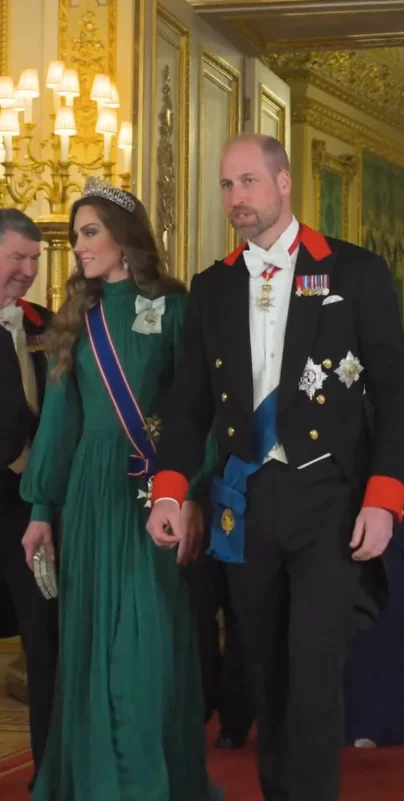

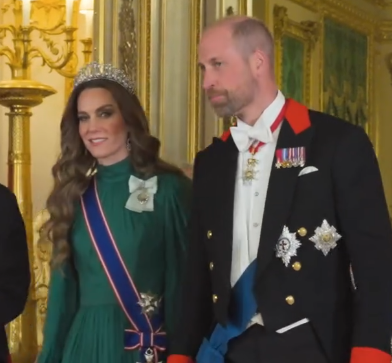
The Princess of Wales captivated attendees at a grand State Banquet held at Windsor Castle, opting for a striking emerald green gown that paid a subtle yet significant tribute to the colours of the Nigerian flag. The elegant ensemble, worn alongside a cherished diamond and pearl tiara, marked a notable fashion moment during the first day of the State Visit by Nigeria’s President Bola Ahmed Tinubu and his wife, Oluremi Tinubu.
The sartorial choice by Catherine, Princess of Wales, was a masterclass in diplomatic dressing. The deep green of her gown directly mirrored the vibrant green of the Nigerian flag, a national symbol that also features a white stripe. Complementing this, her favoured Lover’s Knot Tiara, a historical piece once worn by Queen Mary and Princess Diana, features intricate diamond arches adorned with lustrous pearl drops, subtly echoing the cream and white elements of the Nigerian national colours. This thoughtful selection underscored the significance of the occasion and demonstrated a keen awareness of international relations through the medium of fashion.
Prince William, Prince of Wales, also attended the prestigious gala dinner, standing by his wife’s side. The banquet, hosted by King Charles III and Queen Camilla, was the centrepiece of the initial day of President Tinubu’s State Visit, a high-profile event aimed at strengthening diplomatic and economic ties between the United Kingdom and Nigeria.
A Night of Royal Splendour and Diplomatic Significance
The State Banquet at Windsor Castle was a lavish affair, attended by senior members of the Royal Family, including the Duke of Edinburgh, the Princess Royal, and the Duke of Gloucester, alongside distinguished guests from Nigeria and the United Kingdom. The event serves as a cornerstone of diplomatic engagement, offering a platform for dialogue and the reaffirmation of bilateral relationships.
The presence of the Prince and Princess of Wales at such a significant event highlights their evolving roles within the monarchy. Their participation in welcoming President Tinubu and his wife earlier in the day, and their attendance at the State Banquet, signals their commitment to representing the Crown on the international stage and fostering connections with key global partners.
Fashion as a Diplomatic Tool: The Princess of Wales’s Ensemble
The Princess of Wales has consistently demonstrated a nuanced approach to her public attire, often incorporating subtle nods to the countries or occasions she is representing. Her choice of a green gown for the Nigerian State Banquet was a particularly poignant example of this. The Nigerian flag, adopted in 1960, consists of three vertical bands: two green bands flanking a white band. The green represents Nigeria’s rich agricultural land and natural wealth, while the white signifies peace and unity.
The Lover’s Knot Tiara, a piece with immense historical significance, adds another layer to the Princess’s ensemble. Originally commissioned by Queen Mary from Garrard & Co. in 1913, it features a large central diamond and is set with 19 graduated pearl drops. It was famously a favourite of Diana, Princess of Wales, and has since become a signature piece for Catherine. Its combination of diamonds and pearls, when paired with the green gown, created a harmonious visual dialogue with the Nigerian flag’s colour palette.
In addition to the tiara, the Princess of Wales also wore a pair of exquisite diamond earrings that once belonged to her late grandmother-in-law, Queen Elizabeth II. These earrings, often seen on the late Queen, add a personal touch and a sense of continuity to the royal lineage, linking past and present monarchs through shared adornments.
Royal Jewels and Their Historical Resonance
The State Banquet also showcased the magnificent jewellery collections of other senior royals, each piece carrying its own historical narrative. Queen Camilla chose to wear the Sapphire Tiara, a significant piece from the George VI Suite. This suite of jewels, comprising a necklace and earrings, was originally gifted to Queen Elizabeth II by her father, King George VI, as a birthday present. The Queen later commissioned a sapphire and diamond necklace to complement the set, which was then transformed into the striking tiara.
The sapphire suite has been a favourite of Queen Camilla’s since the accession of King Charles III, and she notably wore them for her first gala event following her husband’s ascension to the throne. This choice not only highlights her personal style but also pays homage to the historical lineage of the Crown Jewels and the enduring significance of these precious stones. Queen Camilla’s gown was an elegant embroidered white creation by one of her preferred couturiers, Fiona Clare, a choice that complemented the regal sparkle of her jewellery.
The State Visit: A Chronology of Events
The State Visit of President Bola Ahmed Tinubu commenced with a formal ceremonial welcome at Windsor Castle. King Charles and Queen Camilla led the official reception, which included the playing of both the United Kingdom and Nigerian national anthems, followed by a ceremonial carriage procession through Windsor.
The Prince and Princess of Wales were instrumental in the initial welcome, accompanying President Tinubu and Mrs. Tinubu to the royal dais in Windsor Great Park for the formal reception. This early engagement underscored the importance placed on the visit and the personal involvement of key members of the Royal Family.
A departure from the traditional State Visit protocol was observed when King Charles held a private audience with President Tinubu instead of the customary State Banquet luncheon. This adjustment was reportedly made to accommodate President Tinubu’s observance of Ramadan, during which he adheres to fasting between sunset and sunrise. This thoughtful consideration demonstrates a commitment to respecting cultural and religious practices while facilitating important diplomatic discussions.
The State Visit was scheduled to continue through March 19th, with further engagements planned to deepen the bilateral relationship between the two nations.
Background and Broader Implications
Nigeria, a vibrant and populous nation in West Africa, holds significant economic and geopolitical importance. It is Africa’s largest economy and a major oil producer, making its relationship with the United Kingdom a key component of British foreign policy and trade interests. State Visits are formal occasions designed to foster goodwill, strengthen diplomatic ties, and explore avenues for cooperation on issues ranging from trade and investment to security and climate change.
The timing of this State Visit is particularly noteworthy. It comes at a time when both nations are navigating complex global challenges. For the UK, strengthening relationships with Commonwealth nations and key emerging economies is crucial for its post-Brexit foreign policy strategy. For Nigeria, such visits offer opportunities to attract foreign investment, enhance its international standing, and address domestic economic and security concerns.
The presence of the Royal Family, particularly the Prince and Princess of Wales, in such a prominent role, signifies the enduring importance of the Commonwealth and the UK’s commitment to its members. Their engagement with President Tinubu and Mrs. Tinubu serves to reinforce the historical links between the two countries while looking towards future collaboration.
Analysis of Diplomatic Engagement
The choice of Windsor Castle as the venue for the State Banquet offers a historic and majestic backdrop for diplomatic discourse. The traditional ceremonies, including the carriage procession and the playing of national anthems, are designed to create a sense of occasion and reinforce the solemnity of the diplomatic exchange.
The inclusion of the Prince and Princess of Wales in key welcoming duties and their attendance at the State Banquet highlights their growing prominence as senior working royals. Their ability to connect with international leaders and represent the Crown with grace and poise is a valuable asset to the monarchy’s diplomatic efforts. Their sartorial choices, as demonstrated by the Princess of Wales’s tribute to Nigeria, often contribute to the narrative of the visit, conveying respect and a deeper understanding of the partner nation.
The adjustment to the schedule to accommodate President Tinubu’s Ramadan observance is a subtle yet significant gesture of cultural sensitivity. In an increasingly interconnected world, such considerations are vital for building trust and fostering genuine diplomatic relationships.
The State Visit is expected to cover a range of bilateral issues, including trade and investment opportunities, security cooperation, and development aid. Nigeria’s economic potential, coupled with its strategic position in Africa, makes it a crucial partner for the UK. Discussions are likely to focus on how to enhance trade flows, encourage British investment in key Nigerian sectors such as technology and infrastructure, and collaborate on regional security challenges.
Official Responses and Public Reaction (Inferred)
While direct statements from President Tinubu and his delegation following the initial events would be part of the ongoing visit, the general tenor of State Visits is one of mutual respect and a desire for strengthened partnership. Reports from such events typically highlight positive interactions and a commitment to continued dialogue.
Public reaction to royal engagements, particularly fashion choices, is often a topic of interest. The Princess of Wales’s ability to subtly incorporate symbolic elements into her attire is frequently praised for its thoughtfulness and diplomatic finesse. Such choices resonate with the public, demonstrating that even in the grandest of settings, attention to detail and cultural awareness are highly valued.
The enduring legacy of the jewels worn by Queen Camilla also speaks to the historical depth of the British monarchy. These pieces are not merely adornments; they are tangible links to past monarchs and a symbol of continuity and tradition. Their use in significant diplomatic events reinforces the historical weight and enduring relevance of the Crown.
Looking Ahead: The Future of UK-Nigeria Relations
The successful conclusion of President Tinubu’s State Visit will be measured by tangible outcomes in terms of new agreements, strengthened economic ties, and a deepened understanding between the two nations. The careful planning and execution of such visits, from the sartorial diplomacy of the Princess of Wales to the considerate scheduling by King Charles, underscore the multifaceted nature of modern statecraft.
As the UK continues to forge its path on the global stage, its relationships with key Commonwealth nations like Nigeria remain paramount. State Visits offer a vital platform for reaffirming these connections and charting a course for future cooperation, ensuring mutual prosperity and shared security in an ever-evolving world. The elegance and thoughtfulness displayed at the State Banquet served as a fitting prelude to the important discussions and collaborations that are expected to emerge from this significant diplomatic engagement.