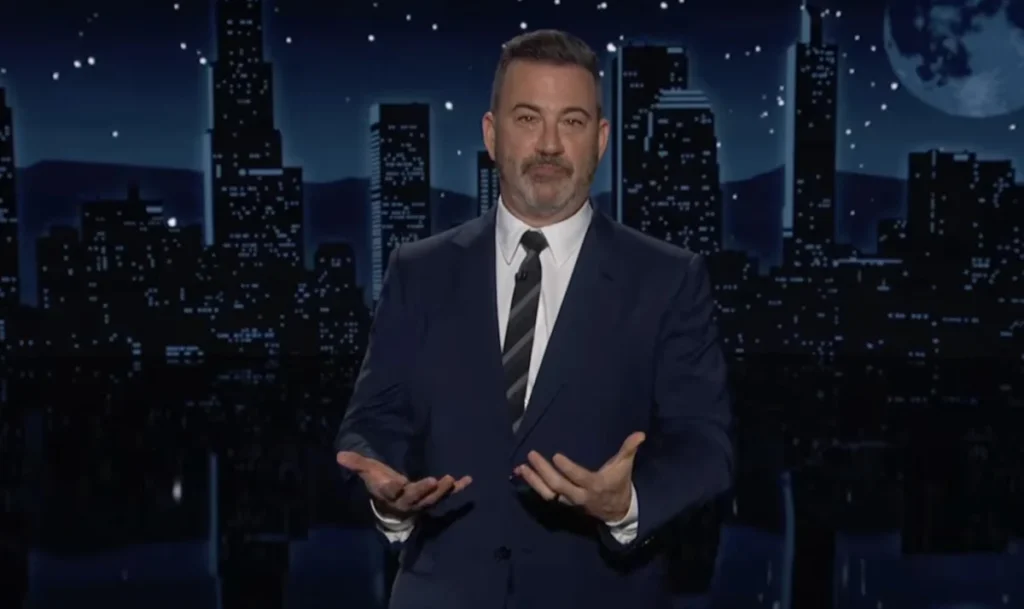

Late-night television host Jimmy Kimmel expressed considerable discomfort and incredulity during his Thursday night monologue, reacting to a recent statement made by former President Donald Trump during a meeting with Japanese Prime Minister Sanae Takaichi. The contentious remark, which drew parallels between a present-day U.S. military action and the historical attack on Pearl Harbor, became the focal point of Kimmel’s comedic critique, highlighting what he perceived as a significant lapse in diplomatic sensitivity and historical awareness.
The incident occurred on Thursday, March 19, during a discussion about U.S. foreign policy and military engagements. According to reports, Trump was seeking military assistance from Japan for ongoing operations in the Middle East. However, the Prime Minister presented him with a gift of 250 cherry trees, intended to commemorate the 250th anniversary of the United States. Kimmel seized upon this exchange, framing it as a comedic juxtaposition of diplomatic intent and perceived presidential misinterpretation.
Kimmel opened his segment by humorously remarking on the perceived mismatch between Trump’s strategic objectives and the symbolic nature of the gift. "Trump is hoping Japan will offer military assistance for his war in the Middle East, but instead the prime minister brought him 250 cherry trees to commemorate our 250th anniversary," Kimmel stated on Jimmy Kimmel Live!. He continued to satirize the situation, questioning Trump’s appreciation for such a gift, given his previous actions. "This is a guy who paved over the rose garden. What is he going to do with 250 cherry trees? Probably use them to build a Waffle House or something," he quipped, referencing a widely reported incident during Trump’s presidency.
The late-night host further elaborated on Trump’s desire for Japanese support in his military endeavors. In a satirical jab, Kimmel exaggerated Trump’s request: "He asked the prime minister to send us a Godzilla, and she said no." This exaggerated scenario underscored Kimmel’s perception of Trump’s approach to international relations as being out of step with conventional diplomacy.
The crux of Kimmel’s critique, however, revolved around Trump’s response to a reporter’s question regarding the lack of warning provided to allies, including Japan, about the U.S. strike on Iran. The reporter inquired why allies were not informed, to which Trump responded by invoking the memory of Pearl Harbor. "We went in very hard and we didn’t tell anybody about it because we wanted surprise. Who knows better about surprise than Japan? Okay, why didn’t you tell me about Pearl Harbor?" Trump reportedly stated.
This comparison immediately drew sharp reactions, both in the studio audience and on social media, and was the primary source of Kimmel’s astonishment. Kimmel pointed out the historical significance of the Pearl Harbor attack, which occurred on December 7, 1941, when Japan launched a surprise military strike against the United States naval base in Hawaii. This unprovoked attack was a pivotal moment that led directly to the United States’ entry into World War II, a conflict that concluded five years before Trump’s birth. The attack resulted in the deaths of over 2,400 Americans and significant damage to the U.S. Pacific Fleet.
Kimmel’s reaction to Trump’s statement was one of profound disbelief. "I guess we should be grateful he didn’t do an accent? What is going on through that orange head of his?" he asked the audience, his tone reflecting a mixture of shock and exasperation. The reference to an "orange head" is a common jab at Trump’s distinct complexion.
The comedian then offered a sarcastic interpretation of Trump’s historical knowledge, suggesting that the former president’s understanding of such a significant event might be superficial. "Let me tell you, there’s no doubt in my mind that everything he knows about Pearl Harbor begins and ends with a movie starring Ben Affleck," Kimmel posited. This remark alluded to the 2001 film "Pearl Harbor," a dramatic retelling of the attack, implying that Trump’s grasp of history might be limited to popular culture depictions rather than a deep understanding of its complex realities and devastating human cost.
Beyond the immediate reaction to the Pearl Harbor remark, Kimmel’s monologue also touched upon the broader context of U.S. military spending and foreign policy. He referenced the Pentagon’s request for $200 billion to fund the conflict in the Middle East, using this as a springboard for further satirical commentary on the allocation of national resources.
Kimmel proposed an alternative, albeit facetious, use for such substantial funds. "I think instead of spending all this money on weapons to drop on people, why don’t we just offer Trump a hundred billion of it to go away?" he suggested. This proposal was framed as a pragmatic, albeit humorous, solution to perceived political stalemates and distractions. He continued his satirical offer, directly addressing the former president: "Listen, Mr. President, you don’t have to sell any more hats, any more Bibles. It’s cash up front. Just go back to Florida." This comment referenced Trump’s previous merchandising ventures and his residence in Florida, suggesting a desire for him to retreat from public political life.
The comedic framing of these serious geopolitical and historical issues serves as a common tactic in late-night comedy, allowing hosts to address complex topics through satire and critique, often highlighting perceived absurdities or hypocrisies in public discourse. Kimmel’s monologue aimed to draw attention to what he and many observers viewed as a profoundly inappropriate and historically insensitive remark by a prominent political figure.
Background and Context of the Pearl Harbor Attack
The attack on Pearl Harbor remains one of the most significant events in American history. Launched by the Imperial Japanese Navy Air Service against the United States naval base at Pearl Harbor, Hawaii Territory, on the morning of December 7, 1941, the surprise attack was intended to cripple the U.S. Pacific Fleet and prevent American interference in Japan’s planned military actions in Southeast Asia and the Pacific.
The attack involved two waves of aircraft, which inflicted severe damage on American battleships and air facilities. Eighty-two American sailors and airmen were killed in the initial moments of the attack, and many more were wounded. In total, 2,403 Americans were killed and 1,178 were wounded. The U.S. Navy suffered catastrophic losses, including the sinking of four battleships and the damage of many other vessels.
The following day, December 8, 1941, the United States officially declared war on Japan, marking its formal entry into World War II. The attack galvanized American public opinion and united the nation in a common cause, fundamentally altering the course of the global conflict and shaping the post-war world order. The historical memory of Pearl Harbor is deeply ingrained in the American psyche, representing a profound betrayal and a moment of national trauma that led to a massive mobilization and sacrifice.
Trump’s Foreign Policy and Diplomatic Style
Donald Trump’s presidency was characterized by a distinctive approach to foreign policy, often described as "America First." This doctrine prioritized national interests above multilateral agreements and international cooperation. His administration frequently engaged in direct diplomacy, often bypassing traditional channels and utilizing rallies and social media to communicate with both domestic and international audiences.
Trump’s interactions with foreign leaders were often unpredictable, marked by a transactional style that sought to renegotiate existing alliances and trade agreements. While his supporters lauded this approach as a departure from outdated diplomatic norms and a reflection of a strong leader, critics often pointed to instances of perceived insensitivity, a lack of respect for protocol, and a tendency to provoke rather than build consensus.
The meeting with Prime Minister Takaichi, and specifically Trump’s remark about Pearl Harbor, can be seen within this broader pattern of his communication style. The former president has often employed bold, attention-grabbing statements, sometimes drawing on historical events in ways that have been met with criticism for their accuracy or appropriateness. His comments on international relations have frequently been a source of debate, with supporters viewing them as direct and effective, and detractors seeing them as undiplomatic and potentially damaging to U.S. standing on the global stage.
Broader Implications and Reactions
Kimmel’s commentary on Trump’s Pearl Harbor remark reflects a wider societal concern about the tenor of political discourse and the responsibility of public figures, particularly former presidents, to engage with history in a sensitive and informed manner. The use of historical tragedies for rhetorical effect, especially in a diplomatic context, can be seen as trivializing the suffering and sacrifices associated with those events.
The comparison of a strategic decision to strike Iran with the unprovoked attack on Pearl Harbor is particularly fraught. The former was a targeted action in response to perceived threats, while the latter was a surprise act of war that drew a superpower into a global conflict. Drawing parallels between these vastly different historical circumstances risks misrepresenting the nature of both events and diminishing the historical gravity of the Pearl Harbor attack.
The entertainment industry, particularly late-night television, often serves as a platform for social and political commentary. Hosts like Jimmy Kimmel use their monologues to process current events, offer critiques, and engage audiences on issues of public concern. By highlighting Trump’s statement, Kimmel aimed to underscore what he perceived as a significant misstep in public communication, prompting viewers to reflect on the importance of historical accuracy and diplomatic decorum.
While direct official responses from Donald Trump or the Japanese government regarding Kimmel’s monologue are unlikely, the host’s critique contributes to the ongoing public conversation about Trump’s legacy and his approach to foreign policy. The incident serves as a reminder of the power of language in shaping perceptions of historical events and the delicate balance required in international diplomacy. The financial request from the Pentagon, meanwhile, highlights the persistent realities of global security challenges and the ongoing debate over national defense spending, a topic that continues to be a significant issue in political discourse.