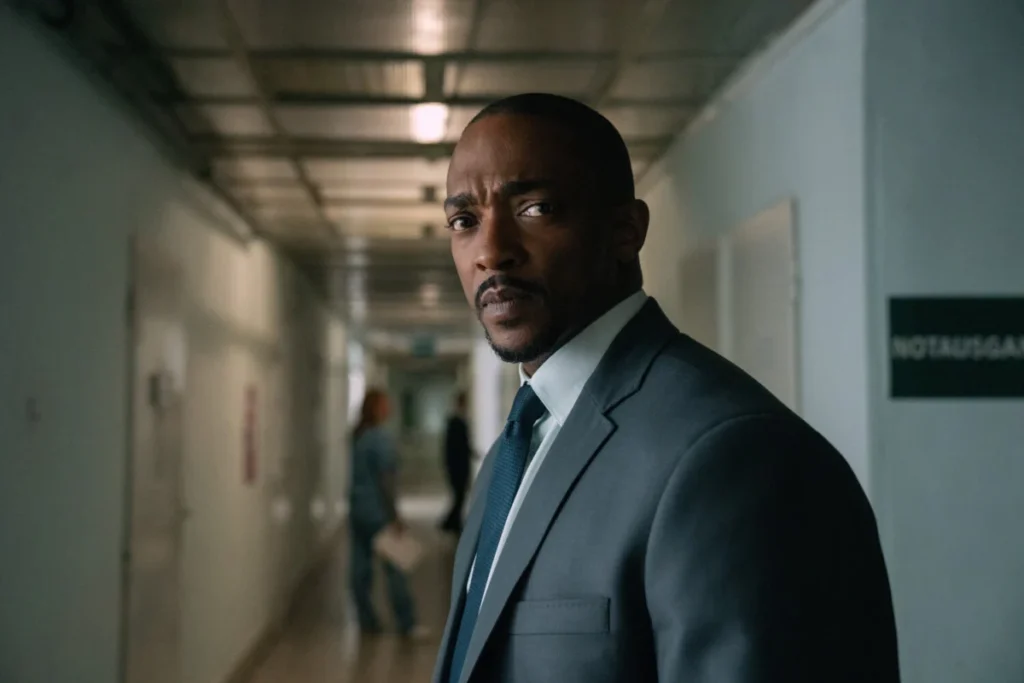

Apple TV Plus continues to expand its vast catalog of original prestige television with
12 12 12, an ambitious eight-episode thriller that applies a fragmented, multi-timeline approach to the well-worn heist genre. Created by writing partners Jim Keeble and Dudi Appleton, the series premiered globally on Friday, November 13, boasting a recognizable ensemble cast led by Anthony Mackie and Jamie Dornan. Despite initial stylistic flair and a high-concept premise rooted in meticulous logistical planning, the series struggles to maintain momentum, ultimately dissolving into an implausible and unsatisfying conclusion that fails to advance or redefine the genre it attempts to inhabit.
The Anatomy of a Heist: Premise and Structure
At the center of 12 12 12 is a narrative philosophy articulated repeatedly by its protagonist, FBI agent Jack Strickland, played by Anthony Mackie. As Strickland explains at the top of each episode, the series operates under a rigid chronological triad: "A high-asset robbery, professionally conceived, is 12 months in planning, 12 hours in execution. A bank robber who is not caught within 12 days is not caught at all."
This mathematical framework dictates the series’ overarching structural design, splitting the narrative across three distinct, interlocking timelines. The first narrative stream, "The Heist," offers an hour-by-hour breakdown of the execution phase, following master thief Paul Galvin (Jamie Dornan), his volatile brother Bobby (Jack Kesy), and a colorful crew of criminal specialists as they infiltrate a heavily fortified bank in Zurich, Switzerland. Their objective is to extract approximately $1 billion in newly deposited cash belonging to a faction of powerful Russian oligarchs.
The second narrative strand, "The Planning," unfolds on a month-by-month basis, exploring the complex web of preparation that draws Galvin out of a quiet retirement alongside his pregnant partner, Severine (Agathe Rousselle). Finally, "The Takedown" tracks the investigation day-by-day, following Strickland and Swiss law enforcement officer Lena (Sallie Harmsen) as they attempt to anticipate the crew’s moves while testing the boundaries of Strickland’s growing obsession.
Talent Behind and In Front of the Camera
The series benefits from high-profile talent both behind the scenes and in front of the lens. Directing duties for crucial episodes are handled by Kari Skogland, a veteran of prestige streaming television known for her visually polished work on projects like The Falcon and the Winter Soldier and The Handmaid’s Tale. Skogland brings a steady hand to the production’s opening hours, establishing a clean, professional aesthetic that elevates the material beyond standard procedural fare.
The ensemble cast features several notable names, including Kali Reis, who recently garnered widespread acclaim for her performance in HBO’s True Detective: Night Country, alongside Jose Garcia, Julius Feldmeier, Hildegard Schroedter, and Patrick Fabian. However, despite the pedigree of the cast and crew, the execution of the central conflict between Mackie’s relentless federal agent and Dornan’s calculating mastermind proves to be one of the production’s most significant hurdles.
Chronology of a Declining Narrative Arc
The trajectory of 12 12 12 over its eight-episode run can be divided into three distinct phases, reflecting a gradual degradation of narrative discipline and logical consistency.
In the initial two episodes, directed by Skogland, the series demonstrates genuine potential. The premiere wastes little time establishing stakes, introducing key players, and deploying efficient exposition. A standout sequence features the contortionist character Alberich folding his body to emerge from a safe deposit box inside a locked vault. While derivative of classic cinematic capers like Ocean’s Eleven, the sequence is executed with competence, accompanied by a slickly edited dual chase scene through European locations standing in for Zurich.
The middle stretch of the season, spanning episodes three through six, reveals the limitations of the core premise. Narrative friction begins to dissipate as the central adversaries fail to generate compelling tension. Furthermore, logical inconsistencies begin to accumulate. A notable turning point occurs in the fourth episode, during which a character survives an artificially induced avalanche capable of burying an entire cabin—a getaway mechanism that defies both the show’s established internal logic and its prior emphasis on meticulous, grounded planning. This sequence relies heavily on unconvincing computer-generated visual effects that jar with the series’ otherwise restrained aesthetic.
The final two episodes abandon narrative coherence entirely. Despite returning to direct the finale, Skogland struggles with a script that devolves into an increasingly bizarre sequence of events, including an ill-conceived nighttime confrontation involving wildlife that prompted unintended laughter during early critical screenings. The resolution sidesteps the careful structural rules established in the opening hours, substituting unearned narrative twists for a cohesive payoff.
Character Dynamics and Performance Analysis
The friction between Mackie’s Strickland and Dornan’s Galvin forms the thematic backbone of the series, yet both central performances lack the necessary intensity to sustain an eight-hour cat-and-mouse game.
Anthony Mackie portrays Strickland as a law enforcement officer driven by a personal vendetta to avenge the death of a partner allegedly murdered by Galvin. While Mackie is effective at playing simmering, low-intensity characters, he struggles to convey the all-consuming compulsion required for a modern-day Ahab pursuing his white whale. An eleventh-hour attempt to contextualize Strickland’s mania through brief references to his racial identity feels tacked on rather than organically integrated into the character’s psychological profile, ultimately failing to add meaningful dimension.
Jamie Dornan faces similar constraints with the character of Paul Galvin. Known for his ability to portray either deeply unsettling villains—as seen in the BBC thriller The Fall—or deliberately eccentric comedic figures, Dornan here is saddled with a protagonist who has been sanded down of any sharp edges. Galvin emerges as a humorless and largely passive figure, rendering his chess-master intellect more a narrative convenience than a believable character trait.
Supporting characters fare little better within the sprawling three-timeline structure. Jack Kesy’s portrayal of the erratic brother Bobby functions primarily as a predictable red herring without establishing a genuine sense of physical or psychological danger. Meanwhile, established performers like Kali Reis and Ólafur Darri Ólafsson are underutilized, appearing sporadically without clear narrative purpose or sufficient screen time to leave a lasting impression. Sallie Harmsen’s Lena, introduced as a vital counterweight to Strickland’s obsession in the opening and closing hours, vanishes for multi-episode stretches, weakening the investigative anchor of the story.
Broader Implications for the Heist Genre in Longform Television
The release of 12 12 12 highlights a broader trend within contemporary television production. Streaming platforms frequently attempt to revitalize established genres by applying high-concept structural gimmicks—such as fragmented timelines, non-linear viewing options, or multi-perspective breakdowns.
While television has historically proven capable of housing sophisticated longform variations of the heist narrative—ranging from the intricate corporate maneuvering of AMC’s Mad Men and Better Call Saul to FX’s focused miniseries Thief—recent attempts to commercialize the formula have yielded mixed results. Projects like Netflix’s Kaleidoscope experimented with non-linear viewing orders, while Hulu’s Culprits pursued a post-heist perspective. Yet, many of these entries struggle to achieve the cultural permanence or narrative satisfaction of traditional cinematic capers.
In the case of 12 12 12, the three-timeline framework ultimately serves as an organizational crutch rather than a thematic necessity. By dividing the narrative into distinct temporal compartments, the series restricts the organic development of its characters and defuses the immediate tension inherent in high-stakes crime drama.
Conclusion and Industry Reception
Apple TV Plus has established a reputation for backing lavishly produced genre exercises, ranging from high-concept science fiction to grounded political thrillers. However, 12 12 12 demonstrates the persistent challenge of translating cinematic momentum into an extended eight-episode television format without sacrificing narrative economy.
While the production benefits from polished cinematography, competent direction in its early chapters, and a recognizable cast, the project remains a derivative entry in the modern streaming landscape. Much like experimental variations of classic consumer products that alter a trusted formula without improving upon it, 12 12 12 offers a temporary diversion for enthusiasts of the genre while failing to secure a lasting place in the contemporary television firmament.