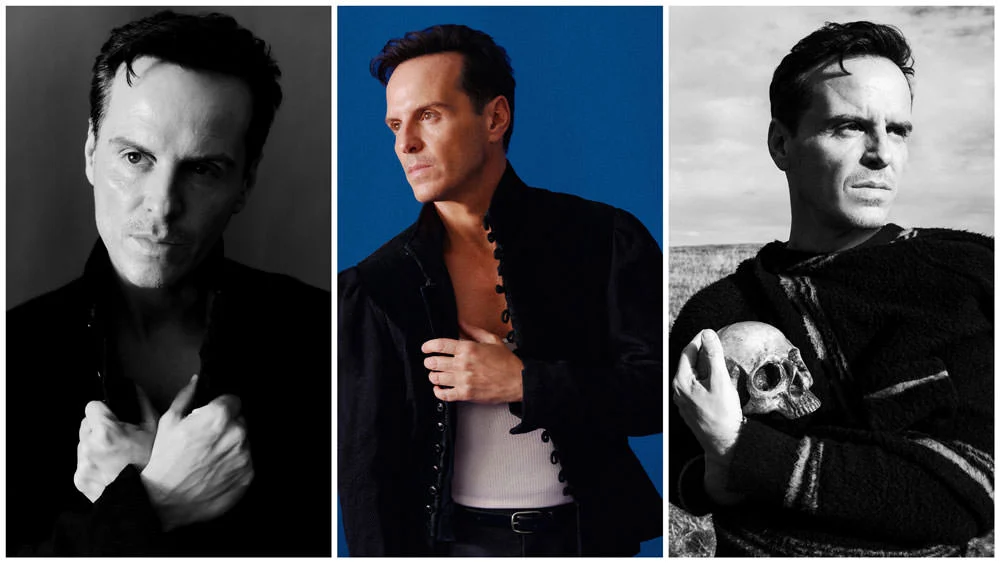

Irish actor Andrew Scott, fresh from celebrating his landmark fiftieth birthday and firmly established at the pinnacle of his professional career, has spoken candidly about his artistic evolution, queer visibility, and the historical burdens carried by previous generations of performers. The comprehensive profile, written by Rob Haskell with photography by William Waterworth and styling by Harry Lambert, anchors the December issue of British Vogue, arriving on newsstands and digital platforms this November.
Scott’s latest career milestone is driven by his commanding performance in director Simon Stone’s forthcoming feature film, Elsinore. In the movie, Scott portrays the legendary Scottish actor Ian Charleson, best remembered internationally for his star-making turn as Eric Liddell in the 1981 Academy Award-winning film Chariots of Fire. Charleson famously returned to the stage to play Hamlet at the Royal National Theatre in 1989, executing the demanding Shakespearean role while privately battling an AIDS diagnosis. Scott’s performance in Elsinore has already ignited substantial Academy Award speculation, positioning the versatile actor as a major contender for the upcoming awards season.
Main Facts and the Genesis of Elsinore
Elsinore chronicles the final, intensely courageous chapter of Ian Charleson’s life. In 1989, when the medical establishment offered limited therapeutic interventions and social stigma surrounding HIV and AIDS was at its peak, Charleson stepped into the role of the Danish prince at the National Theatre. He had taken over the production from Daniel Day-Lewis, who withdrew from the run during previews. Charleson performed the physically grueling role for several weeks before his health forced him to withdraw permanently. He passed away in January 1990 at the age of 40.
For Scott, approaching a figure of such historical and cultural significance required a delicate touch, prioritizing Charleson’s artistic agency and profound vitality over a purely tragic narrative. Speaking from a quiet corner of a West Hollywood hotel restaurant, Scott emphasized the importance of framing Charleson’s final months through the lens of passion rather than victimhood.
"In some ways my fear was that we would fetishise Ian’s death rather than celebrate his life," Scott told British Vogue. "And actually his decision to play Hamlet at the very end of his life, to nail his colours to the mast in that way, when time was running out, is so life-loving."

Scott underscored Charleson’s fierce appetite for existence, quoting the late actor’s defiant attitude toward his illness: "As he says, I’d rather die of Hamlet than of Aids. That’s somebody who wants to live. That’s important for me to say."
Chronology of a Distinguished Career
To understand Andrew Scott’s current gravitas, one must trace a career spanning three decades across Dublin, London, and Hollywood. Born in Dublin in October 1976, Scott began his professional acting journey in the 1990s, cutting his teeth in Irish theatre and independent cinema before achieving international recognition on stage and screen.
His breakthrough came through a diverse array of projects, ranging from his Olivier Award-winning stage performances at London’s Royal Court and Almeida theatres to his unforgettable portrayal of the sociopathic villain Jim Moriarty in the BBC television series Sherlock, which earned him a BAFTA Award in 2012.
Global superstardom arrived in 2019 when Scott appeared in the second season of Phoebe Waller-Bridge’s critically acclaimed comedy-drama Fleabag. Dubbed the "Hot Priest" by millions of viewers worldwide, Scott captured the cultural zeitgeist with his nuanced portrayal of a celibate clergyman experiencing a crisis of faith and romance. Subsequent high-profile roles, including his haunting performance in Andrew Haigh’s critically lauded 2023 psychological drama All of Us Strangers—for which he received a Golden Globe nomination—cemented his status as one of the preeminent dramatic actors of his generation.
Reflecting on his craft during his interview with British Vogue, Scott articulated a deeply psychological view of acting, moving away from simple impersonation toward profound self-interrogation.
"The more I act […] the more I see it not as pretending to be someone else but as exploring different parts of myself," Scott reflected. "Who would I be if I were born in this era or in this body or in this set of circumstances? A great actor once said that acting is an escape from acting, I think there’s a lot of sense in that."

Systemic Silence and the Evolution of Queer Visibility
Turning fifty has given Scott a unique vantage point from which to evaluate the historical treatment of LGBTQ+ artists within the entertainment industry. Reflecting on the predecessors who paved the way for contemporary actors, Scott addressed the invisible, systemic compromises demanded of gay performers during eras defined by institutional prejudice and the devastation of the AIDS epidemic.
"What was so insidious was that Ian and his predecessors had something to contribute to the film and television industry but weren’t given the opportunities in the same way, or else they were given the opportunities but they were also given a sort of silent choice: you can have that, but you have to conceal a huge part of your identity in return," Scott observed. He contrasted this historical reality with the experiences of straight counterparts, whose personal lives were frequently celebrated rather than scrutinized or derided.
The actor also addressed the chilling effect of the institutional silence that characterized the height of the AIDS crisis in the 1980s and 1990s. The lack of medical information, combined with societal condemnation, created an atmosphere of pervasive terror that, in Scott’s view, represents the true tragedy of the period.
"Because there was no information, no help, all this silence," Scott stated. "The terror of that silence is the thing that offends. That should be where the shame lies."
Broader Impact and Implications for the Industry
Despite the hardships faced by previous generations, Scott expressed profound optimism regarding the current landscape for young performers. Observing the cultural shift in attitudes toward queer identity, he noted that younger generations of actors operate with a level of freedom and authenticity that was largely unimaginable at the outset of his own career.

"The fact that the current generation of young gay people feels a freedom from that is wonderful," Scott said, adding that he believes the playing field within Hollywood and the broader entertainment sector is finally beginning to level out.
Furthermore, Scott connected individual visibility to the erosion of systemic bigotry, invoking a fundamental sociological truth during his conversation with Haskell.
"There’s that great expression that prejudice doesn’t survive proximity," Scott noted. "If you see people, you become less frightened of them."
Cultural Analysis and Awards Season Outlook
As Elsinore moves closer to its wide release and the subsequent awards season campaigning intensifies, industry analysts view Scott’s role as Ian Charleson as a career-defining pivot. By choosing to highlight the agency and resilience of a historical figure who navigated terminal illness while at the zenith of his artistic powers, Scott bridges the gap between historical remembrance and contemporary queer liberation.
The December 2026 issue of British Vogue serves not only as a high-fashion showcase—highlighting Harry Lambert’s distinctive styling against William Waterworth’s evocative photography—but also as a vital intellectual platform for one of contemporary cinema’s most thoughtful artists. Through his reflections on Ian Charleson, Andrew Scott continues to advocate for a cultural memory that honors vitality over tragedy, ensuring that the sacrifices and triumphs of the past inform a more equitable and expressive future for the performing arts.