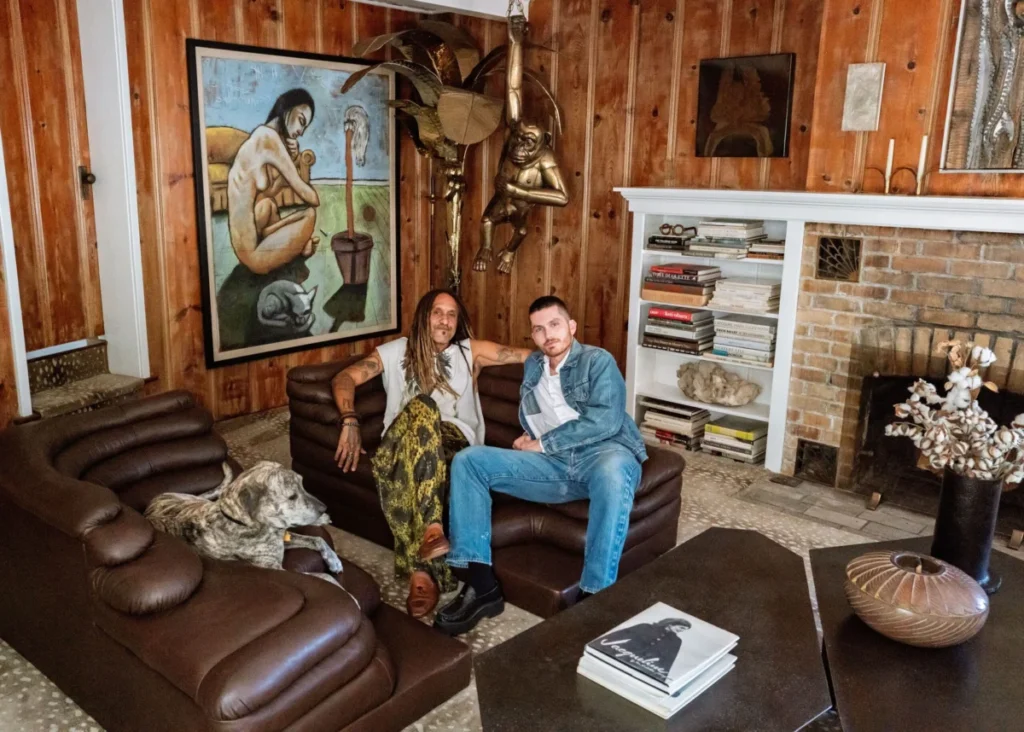

Five years ago, interior designer Harrison Soll was firmly entrenched in a life defined by professional focus and a deliberate avoidance of personal distractions. His trajectory, however, was irrevocably altered when he crossed paths with Rodney Burns, a stylist and the proprietor of Church Boutique, the storied Los Angeles vintage gallery. What began as an autumn meeting quickly blossomed; by the following New Year, the two had solidified a partnership. While Soll admits that a relationship was not initially on his horizon, he notes that their mutual design sensibilities provided the foundational throughline for their connection. Today, the couple resides in a 1,400-square-foot 1925 Craftsman-style home in Laurel Canyon, serving as a testament to the synthesis of two distinct aesthetic philosophies.

The Architectural Foundation and Creative Evolution
The Laurel Canyon residence, built during the mid-1920s, presented a unique canvas characterized by the area’s hallmark bohemian architecture and unconventional geometry. For Soll and Burns, the challenge lay not only in the physical limitations of the space—some of which was subject to the constraints of a rental agreement—but in the reconciliation of their diametrically opposed design ideologies. Soll, a practitioner of bold, minimalist modernism, found himself cohabitating with Burns, a self-described maximalist who draws from an extensive, eclectic collection of vintage art, furniture, and sculpture.
The transformation of the space was a gradual, collaborative process. Because the home is a rental, the couple faced specific hurdles regarding structural modifications. Soll, however, successfully navigated these constraints by negotiating with their landladies, securing permission to renovate a bathroom with new tile and a modern vanity. In a move that underscored his commitment to the home’s aesthetic, Soll also installed wall-to-wall carpeting in a distinctive doe pattern. While the choice initially sparked lengthy discussions between the partners, the final result ultimately garnered approval from both the residents and the property owners.

Chronology of a Design Partnership
The evolution of their shared home follows a clear timeline of discovery and negotiation. The early stages of their relationship were marked by the integration of Burns’s extensive archives, which he has curated over a 15-year career as a stylist and creative collaborator for figures including Lenny Kravitz. This period involved intense curation, as the couple sifted through thousands of vintage pieces to determine which items would define their new environment.
Notable milestones in their design process include the "covert" acquisition of a nail art piece found in a Santa Monica vintage shop. After Burns expressed regret over not purchasing the item, Soll returned to the store and secured it as a Valentine’s Day gift, marking a significant moment of shared taste. Conversely, the placement of a large Sergio Bustamante giraffe bust in the foyer became a point of contention. The piece, while prized for its rarity and scale, proved physically problematic, as it sits in the direct path of the front door. The resolution of this debate—a compromise on positioning—reflects the ongoing nature of their collaborative process.

Integrating Divergent Design Philosophies
The resulting interior is a study in "bricolage," where early- to mid-century pieces, ethnic expression, and minimalist structures coexist. The living room serves as the primary arena for this contrast. Two major seating pieces anchor the space: a Joseph D’Urso for Knoll sofa, reupholstered in leopard fabric, and a leather De Sede Terrazza. The room is further accented by a trio of fiberglass shell art pieces sourced through Kelly Wearstler and a manipulated canvas garment bag by Roosevelt "Rip" Woods, the first Black artist to hold a solo exhibition at the Phoenix Art Museum.
Lenny Kravitz, whose long-term professional relationship with Burns provides a unique perspective on his creative evolution, recently commented on the couple’s home. "The mix of Rodney’s early- to midcentury style mixed with ethnic expression next to Harrison’s bold minimalist modern approach seamlessly blend together," Kravitz observed. He further noted that Burns’s ability to "mix a vast stew of eras and genres" while remaining "soulful, expressive, and elegant" is the hallmark of his design language. For Burns, the act of designing a room is an extension of his work in fashion: "Building an outfit, building a room: same thing in my opinion."

Data and Spatial Analysis
The 1,400-square-foot floor plan is utilized to maximize the narrative potential of each room. In the dining area, a Sergio Bustamante table is positioned on a diagonal to facilitate flow, surrounded by chairs by Paul Evans and a Chinese Art Deco rug. The bedroom highlights the structure’s inherent quirks, where a stainless steel bed from TTMM appears to be angled intentionally, though it is actually conforming to the room’s non-square geometry.
The couple’s approach to collecting is data-driven in terms of provenance and rarity. The office features a 1970s tapestry—a piece so significant to the couple’s early relationship that Soll once worried about his ability to replace it should their partnership end. Meanwhile, the backyard has been repurposed to serve functional, aesthetic, and storage needs, including the conversion of a shed into a dedicated closet space for Burns.

Implications for Modern Residential Design
The collaboration between Soll and Burns offers a case study in the contemporary movement toward "curated maximalism" tempered by "restrained minimalism." Industry analysts suggest that this trend reflects a shift away from uniform interior design toward highly personalized, eclectic spaces that emphasize the biography of the residents. By blending items of high-art value with vintage finds and personalized décor, the couple has managed to create an environment that defies categorization.
The implications for the broader design community are significant. As younger demographics increasingly prioritize sustainability and the reuse of vintage materials, the success of the Soll-Burns home demonstrates that limited space and rental restrictions do not preclude sophisticated design. The couple’s willingness to experiment—even at the risk of creative disagreement—has resulted in a residence that feels both intentional and organic.

Official Perspectives and Future Directions
While the home is largely "complete" in its current iteration, both Soll and Burns acknowledge that the process of habitation is continuous. They currently remain in a light-hearted impasse regarding the selection of a blanket basket, illustrating that even after years of successful collaboration, the dialogue remains open.
Reflecting on the change in his personal and professional life, Soll credits the relationship with expanding his design vocabulary. Burns, in turn, acknowledges that the partnership has encouraged him to exercise a degree of restraint he might not have otherwise achieved. "He has made me be able to take a pause and then also make me a little less attached to some of the things that I’ve collected," Burns states.

The Laurel Canyon home stands as a reflection of a union that prioritized the "throughline" of design. It serves as a reminder that the most successful living spaces are not merely collections of furniture, but carefully negotiated narratives that reflect the histories and evolving identities of their inhabitants. As the couple continues to refine their environment, the home remains a living record of their shared journey—an Afrocentric-inspired, Ralph Lauren-adjacent, and distinctly personal sanctuary that proves opposing styles can, with enough patience and conversation, find a balance.