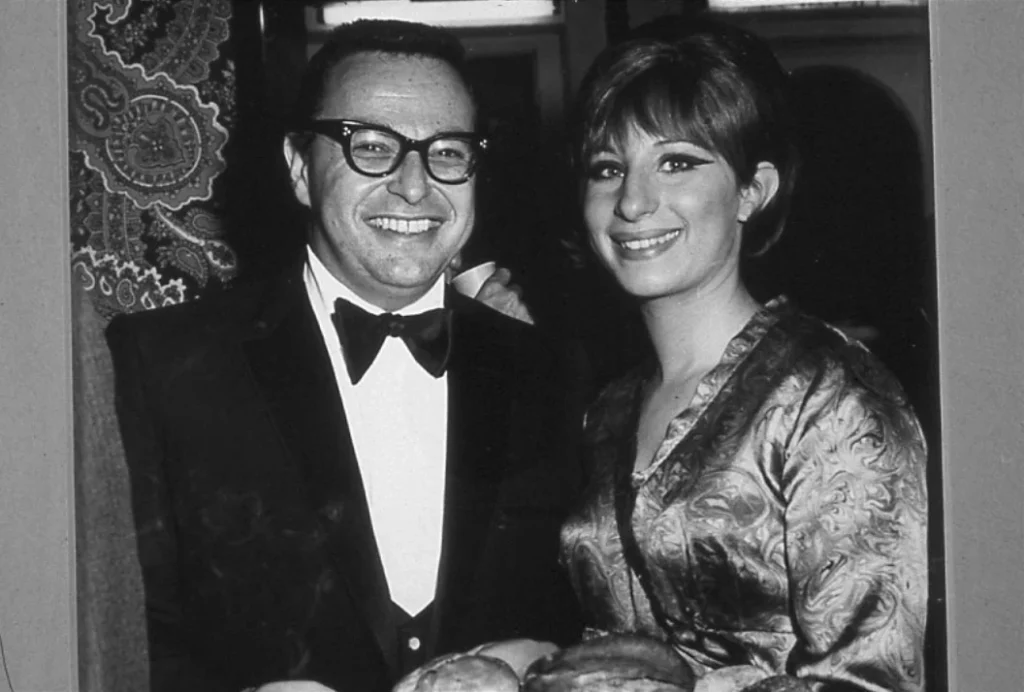

The entertainment industry is mourning the loss of Marty Erlichman, a towering figure in Hollywood talent management who famously discovered a 19-year-old Barbra Streisand and steered her career across stage, screen, and recording studios for more than sixty years. Erlichman passed away on Saturday at the age of 97 due to age-related causes, according to an official statement released by his representatives.
His death marks the end of an extraordinary era in American show business. Erlichman was not merely a manager; he was a strategic architect, a steadfast protector of artistic integrity, and a confidant who operated on little more than mutual trust and a handshake. Throughout a career that spanned over half a century, he left an indelible mark on the entertainment landscape, shaping the trajectories of legendary musical acts, pioneering folk musicians, heavyweight sports icons, and defining cinematic projects.
A Life of Devotion and Industry Impact
In a joint statement, Erlichman’s family reflected on his dual identity as a titan of the industry and a pillar of domestic life. "To the world, he was a giant of Hollywood; to us, he was a deeply devoted and loving father, husband, grandfather, and rock," the family shared. "We feel his loss deeply but are endlessly proud of the life he lived and the indelible mark he left on the world."
The sentiment was echoed by Streisand herself, whose career became inextricably linked with Erlichman’s business acumen and visionary instincts. "Although Marty lived a long and full life, nothing can prepare you for the reality of losing someone so dear," Streisand said. "I truly thought he would live forever. In my eyes, he was simply indestructible — always by my side, through everything. And we never even had a contract. Marty can never be replaced, and I will be forever grateful for his friendship, loyalty, and unwavering support."
Born on September 13, 1929, in Brooklyn, New York, Erlichman developed an early appreciation for performance and enterprise. After completing his education at Drake University in Des Moines, Iowa, he set his sights on the burgeoning cultural scenes of the East Coast. His foundational years in the industry were characterized by an uncanny ability to spot raw, unconventional talent long before it captured mainstream attention.
The Discovery of Barbra Streisand and the Legendary Handshake Agreement
Erlichman’s most famous professional partnership began serendipitously in May 1961 at the Bon Soir, a Greenwich Village nightclub. Erlichman had visited the venue to support a friend, comedian Phil Leeds. The opening act of the evening was an unknown 19-year-old named Barbra Streisand. At the time, Streisand viewed singing merely as a temporary financial stopgap while she pursued her true passion: acting.
Streisand later recalled Erlichman’s immediate conviction regarding her potential. When she expressed her reluctance to focus on a singing career, Erlichman delivered a prophetic evaluation of her capabilities. "If you’re as good an actress as you are a singer, then there’s no stopping you," he told her, according to Streisand’s recollections in her 2023 memoir, My Name Is Barbra. "I just saw you do comedy, drama. You made me laugh, you made me cry. I think you have a big career ahead of you — records, television, theater, movies." He famously added that she would eventually sweep the highest accolades in the industry: the Grammy, the Emmy, the Tony, and the Oscar.
Though Streisand already had representation, Erlichman handed her his business card—which at the time directed callers to a public telephone booth on 53rd Street—inviting her to reach out if she ever needed advice. That opportunity arose when her current manager failed to secure her a pay raise for a club engagement in Detroit. When Erlichman’s direct intervention with the venue failed, he quietly subsidized the difference out of his own pocket to ensure she received her desired weekly salary. Impressed by his dedication, Streisand hired him.
Erlichman subsequently bought out her existing management contract for $750 using a loan provided by Streisand herself. From that moment forward, the duo maintained a strictly non-contractual working relationship. Relying entirely on mutual respect, Erlichman secured Streisand a landmark recording contract with Columbia Records. Crucially, he negotiated unprecedented creative conditions that granted her absolute control over her musical repertoire and the design of her album covers—a level of autonomy virtually unheard of for a new artist in the early 1960s.
Guiding a Global Icon: Tours, Television, and Film
As Streisand transitioned from a Greenwich Village sensation into an international superstar, Erlichman orchestrated every facet of her business operations. He negotiated multi-platform agreements spanning records, Broadway theater, feature films, television specials, global concert tours, and extensive merchandising licensing.
Erlichman conceptualized and executive produced many of Streisand’s most celebrated live concert appearances, including her landmark 2000 Millennium Concert and her extensive 2006–2007 world tour. His mastery of television production was equally distinguished. He served as the executive producer of the critically acclaimed 1994 HBO special Barbra: The Concert, a milestone broadcast that earned him both an Emmy Award and a Peabody Award.
Beyond his work with Streisand, Erlichman established himself as a versatile film producer. His cinematic portfolio included Streisand’s 1974 comedy For Pete’s Sake; the 1978 psychological medical thriller Coma, written and directed by Michael Crichton and starring Michael Douglas; and the 1983 romantic thriller Breathless, starring Richard Gere, which served as a contemporary American reimagining of Jean-Luc Godard’s foundational 1960 French New Wave film À bout de souffle. Additionally, he executive-produced four theatrical films centered on the comedic character Ernest, created and portrayed by actor and filmmaker John R. Cherry III.
Early Successes and Diverse Roster
Long before cementing his legacy with Streisand, Erlichman made waves in the burgeoning folk music revival of the early 1960s. In 1960, he began managing The Clancy Brothers and Tommy Makem, a pioneering traditional Irish folk group whose energetic performances profoundly influenced a young Bob Dylan upon his arrival in New York City.
In 1961, Erlichman orchestrated a career-defining break for the group by securing them an appearance on The Ed Sullivan Show. Originally booked to perform only two songs, the group received an unexpected twenty-minute performance slot when fellow scheduled guest Pearl Bailey failed to appear. The extended national exposure captivated television audiences and directly catalyzed a major recording contract with Columbia Records.
Erlichman’s managerial repertoire extended across diverse entertainment sectors, encompassing athletes, comedians, and pop musicians. Among his notable clients were heavyweight boxing champion George Foreman; record producer and songwriter Bob Crewe, best known for his foundational work with The Four Seasons; 1960s pop sensation Gary Puckett & The Union Gap; and acclaimed comedian and actor Chevy Chase. His capacity to manage talents across such disparate fields underscored his adaptability, business acumen, and deep understanding of public appeal.
Legacy and Personal Life
In his personal life, Erlichman maintained a steadfast commitment to his family. He was married to Miko Mayama Erlichman for 52 years. He is survived by his wife; their son, J.J. Erlichman, who followed his father into the entertainment industry as a tour and production manager; his daughter-in-law, Talia; and his four grandchildren: Mia, Sarah, Olivia, and Jack.
In accordance with the family’s wishes, a private service will be held to honor his memory. Rather than traditional floral tributes, the family has requested that memorial contributions be directed in his name to St. Jude Children’s Research Hospital or the National Kidney Foundation.
The passing of Marty Erlichman closes a significant chapter in the history of twentieth-century entertainment. In an industry frequently characterized by transient alliances and rigorous legal bindings, Erlichman’s six-decade, contract-free partnership with Barbra Streisand remains a singular anomaly—a testament to the enduring power of trust, vision, and unwavering dedication between a manager and an artist.