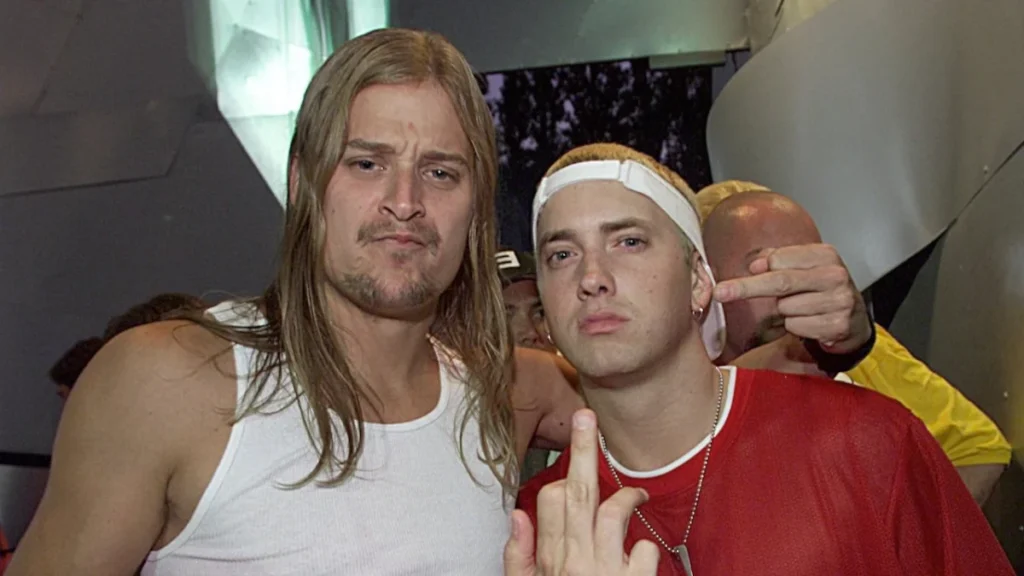

The intersection of traditional music production and emerging generative artificial intelligence has become a focal point of industry debate following a candid admission by musician Kid Rock. During a recent guest appearance on HBO’s Real Time with Bill Maher, the artist—who recently pivoted toward a Christian rock focus with his latest studio album, Halfway 2 Jesus—disclosed that he utilized AI software to synthesize the choir featured on the chorus of his collaborative track with Eminem, titled “Heal My Faith.”
This disclosure has reignited a broader conversation regarding the ethical implications of using synthetic media in professional musical compositions, particularly as high-profile artists begin to normalize the practice. While Kid Rock defended his creative decision as a matter of efficiency and time management, the revelation prompted an immediate, sharp rebuttal from host Bill Maher, framing the issue as a direct displacement of human laborers within the creative arts.
A Chronology of the Controversy
The creative process for “Heal My Faith” serves as a case study for the current state of music production. Kid Rock, whose real name is Robert James Ritchie, released his latest record, Halfway 2 Jesus, on October 17, 2026. The album was positioned as a significant departure from his earlier genre-blending career, leaning heavily into gospel and contemporary Christian themes.
During the production phase of the track “Heal My Faith,” which features long-time collaborator and Detroit rap icon Eminem, Kid Rock opted to bypass the logistical complexities of hiring and recording a live Southern gospel choir. Instead, he employed AI-driven software to generate the vocal arrangements. This choice stands in contrast to another track on the same album, “7 Sins,” where the artist utilized human vocalists for the choir segments.
The public acknowledgement of this process occurred on the October 31, 2026, episode of Real Time with Bill Maher. When questioned about his stance on the rapidly evolving technology, Kid Rock initially expressed apprehension, acknowledging the potential risks AI poses to the industry. However, he quickly pivoted to his personal justification for its use, citing a desire for expediency in his workflow.
The Debate on Labor and Automation
The exchange between Kid Rock and Bill Maher quickly descended into a spirited, if contentious, debate regarding the displacement of human workers. Maher, noting the historical significance of the choir as a vital element in music production, questioned the necessity of the AI shortcut. “A lot of people in a choir, and we put them all out of work. Isn’t that what really happened?” Maher asked.
Kid Rock’s defense relied on historical precedent, drawing an analogy to the introduction of the drum machine. He argued that the invention of automated percussion did not eradicate the role of the drummer but rather provided musicians with new tools. “Did we put drummers out of work when the drum machine was invented?” he posited.
Maher was quick to distinguish between the two, noting that the barrier to entry for early electronic instrumentation was vastly different from the total simulation of human vocal performance. Maher insisted that the logistical effort of hiring a choir—a standard practice for legendary groups like The Beatles—was a component of the artistic craft that should not be discarded in favor of software-generated convenience.
The Industry Context: AI in Music Production
The music industry has been grappling with the encroachment of AI for several years. From deepfake vocal models that mimic deceased artists to generative software capable of writing melodies and lyrics, the technology has transitioned from a novelty to a practical tool.
According to a 2026 report by the International Federation of the Phonographic Industry (IFPI), nearly 30% of independent music producers have experimented with generative AI tools in their workflows. Proponents argue that these tools democratize production for artists with limited budgets. Conversely, critics, including various labor unions and guilds, argue that the technology relies on the unauthorized training of models using copyrighted material, effectively cannibalizing the very artists it claims to support.
The use of AI in “Heal My Faith” raises specific questions about the role of the human performer in gospel music, a genre traditionally rooted in the collective, physical experience of communal singing. By replacing the human element with a facsimile, the production raises concerns about the potential erosion of authenticity in genres that rely on emotional resonance and lived experience.
Political Undertones and Public Reception
The discussion on AI occurred against the backdrop of a larger, often polarized, public discourse surrounding the two artists. Kid Rock and Eminem, despite their disparate political alignments—with Kid Rock being an outspoken supporter of Donald Trump and Eminem having spent much of his career as a vocal critic of the same—have maintained a long-standing personal friendship.
“Heal My Faith” was marketed by both artists as a demonstration that personal relationships can transcend the intense political divisions currently characterizing American society. However, the release of the song and the album has met with a tepid response from the mainstream market. Industry analysts have noted that the album failed to generate significant traction on major streaming platforms or the Billboard charts, suggesting that the novelty of the collaboration—or the aesthetic shift—may not have resonated with a broad audience.
Furthermore, the Real Time appearance was marked by additional controversy, as Kid Rock compared Michigan Democratic Senate candidate Abdul El-Sayed to the 9/11 hijackers. This commentary, combined with the admission of AI usage, dominated the post-show conversation, overshadowing the musical intent behind the album.
Implications for Future Regulation
Kid Rock himself acknowledged the necessity of oversight, stating, “I one thousand percent believe it needs to be regulated at the highest levels.” This sentiment aligns with current legislative efforts in the United States and abroad to create guardrails for generative AI.
The primary legal concerns center on three pillars: copyright infringement, likeness rights, and labor protection. As AI becomes more sophisticated, the distinction between a “tool” and a “replacement” becomes increasingly blurred. If a major artist can synthesize a choir to save time, it sets a precedent that could ripple downward, impacting session singers, background vocalists, and small-scale choral ensembles who rely on such work for their livelihood.
Analytical Outlook
The incident underscores a fundamental shift in the economics of music production. When an artist of Kid Rock’s stature, who possesses the resources to hire any choir in the world, chooses to use an AI generator, it signals a significant change in the value proposition of human labor.
For the listener, the question remains whether the quality of the AI-generated output is indistinguishable from the real thing. If the audience cannot perceive the difference, the market incentive to pay for human performers diminishes. However, as Maher’s critique highlighted, there is a qualitative difference between a technological aid that enhances a performance and a technological replacement that removes the performer entirely.
As the industry moves toward 2027, the debate surrounding “Heal My Faith” will likely serve as a focal point for upcoming contract negotiations within the American Federation of Musicians (AFM) and other creative guilds. The tension between the desire for rapid, cost-effective production and the preservation of human-centric art forms remains unresolved. For now, the track stands as a testament to the willingness of established artists to embrace the efficiency of the digital age, regardless of the cultural or labor-related pushback it may generate.