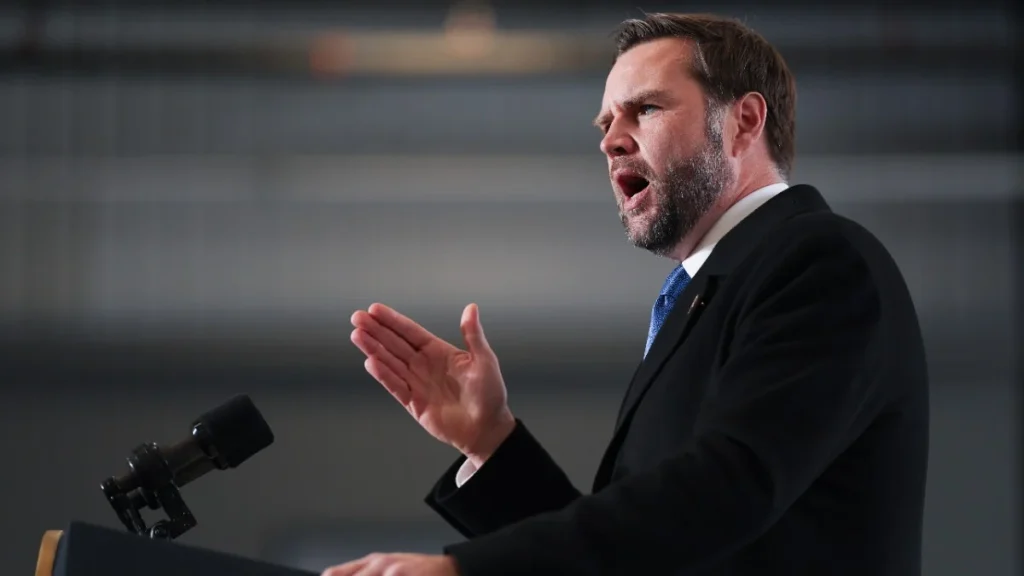

The political and legal landscape surrounding the 2026 midterm elections intensified significantly on Tuesday as Vice President JD Vance publicly defended a controversial Department of Justice preemptive lawsuit targeting Alaska’s high-stakes U.S. Senate race. The legal challenge, which seeks to halt the certification of election results should incumbent Republican Senator Dan Sullivan be defeated by Democratic challenger Mary Peltola, has drawn sharp national scrutiny. The controversy deepened further after President Donald Trump publicly stated that he personally directed the filing of the federal lawsuit, injecting executive branch authority directly into a state-managed electoral contest.
The core of the federal government’s argument centers on ballot composition and potential voter confusion. Specifically, the Justice Department’s lawsuit asserts that Alaska voters could easily mistake the incumbent Republican senator for another candidate on the ballot, Daniel J. Sullivan, who shares the exact same name and is running with no listed political party affiliation. While the incumbent Senator Dan Sullivan clearly carries the official "incumbent" designation on the ballot, federal prosecutors and administration officials argue that the presence of a similarly named candidate creates an unfair electoral environment that compromises the integrity of the vote.
The lawsuit has triggered immediate pushback from multiple fronts, including Alaska state election officials, legal experts, and Democratic leaders, setting up a high-stakes constitutional and procedural showdown in the federal court system.
Vance Defends the Administration Position Amid Press Scrutiny
During a press briefing on Tuesday, Vice President Vance faced probing questions regarding the administration’s legal strategy. A reporter challenged the rationale behind the lawsuit, pointing out that the administration’s position seemingly implies that Alaskan voters lack the basic reading comprehension required to distinguish the word "incumbent" next to Senator Dan Sullivan’s name and cast their ballots accurately.
Vance firmly rejected the premise of the question, stating that it "presumes quite a bit." He argued that while many Alaskans would undoubtedly read their ballots correctly, the situation as a whole would lead many voters to conclude that the ballot arrangement itself was "all a big fraud."
Shifting his focus to the realities of voter behavior, the vice president emphasized the time constraints and daily pressures faced by ordinary citizens. "People are busy. People have lives. People have jobs. And when you put a person on the ballot explicitly to try to confuse voters, I think that’s the definition of electoral fraud. And I don’t think that we should endorse it," Vance told reporters.
The vice president also directed criticism toward the media corps in attendance, suggesting a double standard in how the situation is being covered. He contended that if the political roles were reversed and a similar ballot complication affected a Democratic candidate, reporters would immediately label it election fraud. "So I think you guys should actually do your job and ask some difficult questions of the Democratic Party. Why are they trying to confuse people?" Vance asked.
Chronology of the Alaska Ballot Dispute
The events leading up to the Department of Justice’s intervention are rooted in months of pre-election legal maneuvers within Alaska’s state courts. The chronology of the dispute highlights the friction between state-level administration and federal intervention:
- Initial Candidate Filing: Independent candidate Daniel J. Sullivan filed to run for the U.S. Senate seat, sharing a name with the incumbent Republican Senator Dan Sullivan.
- State Election Division Action: The Alaska Division of Elections initially attempted to keep Daniel J. Sullivan off the ballot, citing potential voter confusion and concerns over ballot integrity.
- State Supreme Court Ruling: Following a legal challenge, the Alaska Supreme Court ultimately ruled that both candidates bearing the name Dan Sullivan were legally qualified and must appear side-by-side on the Election Day ballot. The court’s decision established that the names would be listed with the incumbent holding the official designation, while Daniel J. Sullivan would appear without a party affiliation.
- Department of Justice Intervention: Following the state court’s final determination, the federal Department of Justice filed a preemptive lawsuit seeking to block the certification of the Senate race if the incumbent Republican senator loses. President Donald Trump later confirmed that he personally ordered the filing.
- Recent Court Proceedings: U.S. District Judge Sharon Gleason, an appointee of President Barack Obama, expedited the schedule for Democratic candidate Mary Peltola’s formal request to dismiss the federal lawsuit. Concurrently, Alaska’s elections division—overseen by state Republicans—formally asked the federal court to throw out the case entirely.
Institutional Pushback and State Resistance
Despite the Department of Justice aligning its actions with the concerns raised by the national Republican leadership, the state’s own election apparatus is actively pushing back against the federal lawsuit. In a striking display of state-versus-federal friction, the Alaska Division of Elections—which is managed by Republicans—petitioned the federal court to dismiss the administration’s case.
State election officials argue that the federal lawsuit undermines local control over elections, a principle historically championed by conservative policymakers. By asking a federal judge to throw out the Trump-ordered litigation, Alaska election authorities have signaled a desire to maintain sovereignty over their certified ballot procedures, which were vetted and finalized by the state’s highest judicial authority, the Alaska Supreme Court.
Meanwhile, federal judges are moving swiftly to process the competing legal motions. U.S. District Judge Sharon Gleason’s decision to fast-track Mary Peltola’s motion to dismiss underscores the urgency of resolving the matter before ballots are fully tallied and certified in the weeks following the election. Legal scholars note that Peltola’s legal team is arguing that the DOJ lawsuit represents an unprecedented and legally meritless federal intrusion into state-run elections, designed primarily to protect a specific partisan outcome rather than uphold federal law.
Broader Implications for Election Law and Federal Oversight
The Justice Department’s involvement in the Alaska Senate race carries profound implications for the future of American election administration, the scope of executive power, and the doctrine of federalism.
Traditionally, the administration and execution of federal elections—including ballot design, candidate qualification, and vote tabulation—have been jealously guarded by state governments under the Elections Clause of the U.S. Constitution. While Congress possesses the authority to regulate certain aspects of federal elections, and the Department of Justice routinely intervenes to enforce federal civil rights statutes such as the Voting Rights Act, a preemptive lawsuit designed to block the certification of a state-managed election based on presumed voter confusion is exceptionally rare.
Constitutional law experts have raised concerns that the DOJ’s strategy establishes a troubling precedent. If the executive branch can utilize the federal court system to preemptively challenge state ballot configurations and threaten non-certification based on candidate name similarities, it could open the door for future administrations of either political party to routinely interfere in local election outcomes.
Furthermore, the public confirmation by President Trump that he personally ordered the filing blurs the traditional independence of the Department of Justice, a norm designed to insulate federal law enforcement and prosecutorial decisions from direct partisan directives. While modern presidents have occasionally set general policy priorities for the DOJ, direct presidential ordering of specific civil litigation in a political contest elevates the debate from a technical legal dispute to a major constitutional controversy over the separation of powers.
As the litigation proceeds before Judge Gleason, all eyes remain fixed on the Last Frontier. The convergence of state-level judicial rulings, a federal district court expedited review, an unprecedented Department of Justice lawsuit, and intense national political rhetoric ensures that the outcome of the Alaska Senate race will be felt far beyond the state’s borders, shaping election law debates for years to come.