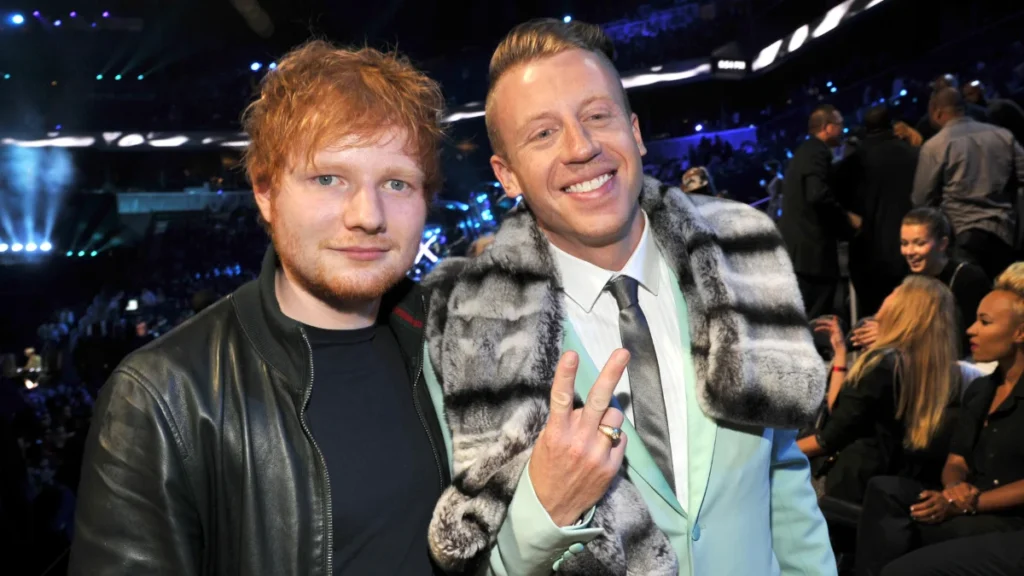

Grammy-winning rapper Macklemore has firmly reaffirmed his public advocacy for Palestine during his first live concert appearance since being removed as an opening act from pop singer Ed Sheeran’s international tour. Performing against the striking backdrop of Colorado’s iconic Red Rocks Amphitheatre on October 22, the 43-year-old artist addressed the controversy head-on, signaling to fans and industry observers alike that professional repercussions will not deter his humanitarian messaging. The performance marked a pivotal moment in an ongoing cultural and political debate that intersects the worlds of mainstream pop music, international diplomacy, and the limits of artistic free speech.
Macklemore Stands Firm Amid Tour Fallout
During the October 22 set at Red Rocks, Macklemore took a deliberate moment to address the audience regarding his socio-political stances. Rather than backing down from the controversy that led to his removal from Ed Sheeran’s Loop Tour roughly a month prior, the rapper leaned heavily into his convictions. He articulated to the crowd that his activism stems from a foundational sense of empathy rather than partisan politics.
"It is not political. It is human to have a heart," Macklemore told the attentive Colorado audience, before once again leading them in a chant to "free Palestine."
Expanding the scope of his humanitarian address, Macklemore used his platform to draw attention to multiple global crises and marginalized populations. He spoke candidly about ongoing humanitarian suffering and displacement in Sudan, the Democratic Republic of Congo, Lebanon, and Haiti. Furthermore, the rapper addressed domestic concerns, explicitly referencing individuals and families impacted by United States immigration enforcement policies. Throughout his remarks, Macklemore maintained that his overarching message remains anchored in universal compassion, community care, and human rights.
Chronology of the Controversy
The tension surrounding Macklemore’s tour status erupted in the late summer and early autumn months, creating a ripple effect across the music industry. The sequence of events highlights the delicate balance major touring acts must navigate when geopolitical issues bleed into commercial entertainment.
In September, Macklemore made high-profile pro-Palestinian remarks during a live performance, a move that triggered intense public debate, digital petitions, and subsequent industry pressure. Shortly thereafter, it was announced that the rapper had been removed from the lineup of Ed Sheeran’s Loop Tour, where he had been slated as a primary supporting act.
Rather than fading from the spotlight, Macklemore responded swiftly to the removal. He announced the formation of a targeted, three-date initiative dubbed the Free Palestine Tour. The artist stated publicly that all proceeds generated from these specific benefit concerts would be funneled directly to established humanitarian organizations providing aid and relief to Palestinians. In promotional materials and statements surrounding these benefit shows, Macklemore issued a broader challenge to his peers in the entertainment industry, urging fellow artists to leverage their vast public platforms to address pressing global humanitarian crises and actively push back against institutional efforts to suppress dialogue concerning Palestinian rights.
The Response from Ed Sheeran and Industry Dynamics
As the public discourse surrounding the tour removal intensified, Ed Sheeran found himself drawn into a cultural firestorm regarding artistic accountability and contractual obligations. Addressing the situation during a concert in Philadelphia on September 19, Sheeran attempted to clarify his role in the decision-making process.
The British pop star asserted that he did not personally make the executive decision to remove Macklemore from the tour. Sheeran explained to the audience that Macklemore’s contractual agreement was established directly with the tour’s third-party promoters rather than through Sheeran’s personal management team.
Nevertheless, Sheeran acknowledged the immense complexity of the situation, noting that the controversy thrust him unwillingly into the center of a polarized global debate concerning free speech, censorship, and the Israel-Gaza conflict. While maintaining his general preference to remain an entertainer rather than an explicit activist musician, Sheeran used the moment to offer a nuanced condemnation of violence. He formally condemned the October 7, 2023, attacks carried out at the Nova music festival in Israel, while simultaneously describing the subsequent humanitarian catastrophe and military operations in Gaza as "catastrophic and unjustifiable and disproportionate."
Broader Impact and Industry Implications
Macklemore’s persistence at Red Rocks Amphitheatre underscores a growing trend within the contemporary music landscape: artists are increasingly refusing to separate their personal ethics from their commercial art, despite the risk of professional alienation. The intersection of pop music and geopolitical advocacy is fraught with financial and reputational hazards, yet performers like Macklemore view silence as an unacceptable compromise.
The incident highlights a widening ideological divide within the global entertainment industry. On one side are promoters and corporate entities cautious of brand safety, sponsor alienation, and political polarization. On the other side are artists empowered by direct-to-consumer digital platforms, fan bases that demand moral clarity, and a conviction that international human rights supersede commercial agreements.
As Macklemore prepares for his upcoming benefit performances and continues to integrate global humanitarian appeals into his standard stage show, the broader implications of the Ed Sheeran tour fallout will likely linger. The episode serves as a case study in how modern artists navigate the friction between global geopolitics and the commercial machinery of stadium tours, proving that for some performers, the mic is as much a tool for political expression as it is an instrument for entertainment.