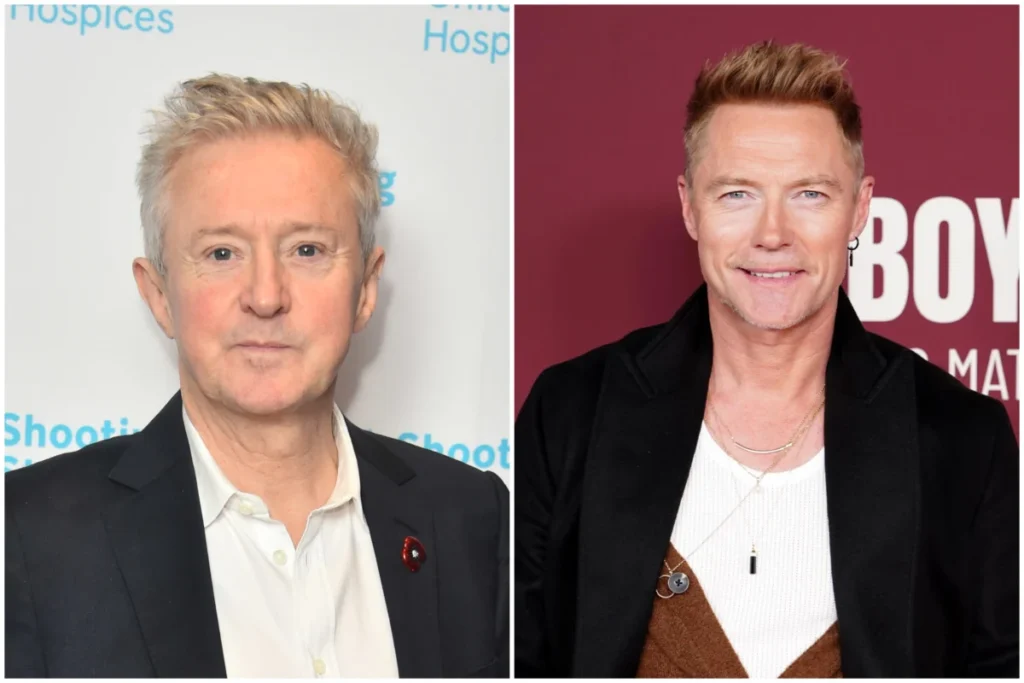

The Irish music industry has been stirred by a candid and acerbic assessment of a long-standing professional partnership, as veteran manager Louis Walsh publicly dismissed the future musical prospects of his former protégé, Ronan Keating. In a recent appearance on the Irish documentary series The Big Interview, the 74-year-old talent manager characterized Keating’s solo career as effectively concluded, leveling sharp criticisms at the singer’s artistic autonomy and past creative choices.
Walsh, who was instrumental in the formation of Boyzone in 1993, oversaw the rise of one of the most successful boy bands in European pop history. Alongside bandmates Keith Duffy, Shane Lynch, Mikey Graham, and the late Stephen Gately, Keating became a household name. However, the professional relationship between the manager and his star performer fractured significantly in 2009. Walsh’s recent remarks underscore the enduring nature of this fallout, as he framed their separation as a deeply acrimonious "bad divorce" that has left a permanent mark on their personal and professional dynamic.

A Chronology of the Walsh-Keating Partnership
The trajectory of the Walsh-Keating relationship spans over three decades, marked by meteoric highs and a protracted period of public estrangement.
- 1993: Louis Walsh organizes auditions in Dublin to form an Irish answer to Take That. Boyzone is established, with Ronan Keating emerging as the primary lead vocalist.
- 1994–1999: Under Walsh’s management, Boyzone achieves massive commercial success, securing 16 consecutive top-five singles in the UK charts and selling millions of albums globally.
- 1999: Ronan Keating launches his solo career with the single "When You Say Nothing at All," which reaches number one in the UK and Ireland.
- 2009: The professional partnership between Walsh and Keating officially terminates amid reports of creative and contractual disagreements.
- 2009: Tragically, founding member Stephen Gately passes away, temporarily reuniting the remaining band members for public tributes and commemorative projects.
- 2010–2024: Both parties remain active in the entertainment industry. Keating transitions into broadcasting and acting, while Walsh continues his work in television and music management.
- 2024: Walsh makes his comments on The Big Interview, reigniting public interest in the nature of their original split.
The Anatomy of the Critique: Artistic Autonomy and "Karaoke" Labels
At the core of Walsh’s recent commentary is a fundamental disagreement regarding the creative direction of Keating’s solo work. Walsh asserts that while he was responsible for selecting the material that fueled Keating’s initial solo success, the singer eventually sought greater control, a transition that Walsh views as the catalyst for his professional decline.
Walsh recounted an interaction at the Four Seasons hotel during which Keating allegedly expressed a desire to move away from being viewed as a "karaoke artist"—a term Walsh used to describe performers who rely on established hits or covers rather than original, innovative compositions. Walsh’s blunt retort—"But that’s what he is!"—highlights his belief that Keating’s commercial viability was inextricably linked to the management style and song-selection process that defined the Boyzone era.

According to Walsh, the shift in Keating’s attitude was a direct result of his rising fame. He suggested that the singer began to "believe his own publicity," leading to the creative divergence that prompted their split. Walsh further posited that Keating has failed to secure a significant hit since they ceased working together, arguing that the singer is now forced to rely on legacy material from his earlier career to maintain his profile.
Allegations Concerning George Michael and Industry Context
In a particularly controversial segment of the interview, Walsh addressed Keating’s admiration for the late British pop icon George Michael. Walsh claimed that during his tenure as manager, Keating frequently attempted to emulate Michael, spending time in London in an effort to get closer to the Wham! star.
Walsh offered a starkly different interpretation of these interactions. He alleged that George Michael’s willingness to befriend Keating was motivated by a desire to gain access to Stephen Gately. "What he didn’t know is that George Michael fancied Stephen," Walsh claimed, adding that the interactions were, in his view, centered around Gately rather than a burgeoning mentorship between Keating and Michael. This allegation adds a layer of complexity to the public narrative surrounding the band’s internal dynamics and their interactions with high-profile industry peers.

Implications for the Irish Pop Legacy
The criticism extends beyond the individual to the legacy of the band itself. Walsh claimed credit for the bulk of the work required to build Boyzone, describing the band members as "puppets for Westlife"—referencing his subsequent success in managing the boy band Westlife, which many industry analysts view as the spiritual successor to Boyzone’s commercial formula.
From a music industry perspective, Walsh’s comments reflect a long-standing debate regarding the power dynamics between artist and manager. In the 1990s and early 2000s, the "Svengali" style of management, characterized by total control over branding, song selection, and public image, was the industry standard. As artists matured, the desire for autonomy often led to conflicts with the architects of their early success.
While Walsh’s comments are pointed, industry observers note that Ronan Keating has successfully transitioned into a diverse media career. His work as a presenter on shows such as The One Show and his tenure as a judge on The Voice Australia suggest that, regardless of his current status in the record charts, he has successfully diversified his brand. Walsh acknowledged this, noting that Keating is "always going to be working" and that he is likely "happy enough in his life" despite the absence of new pop chart success.

Public Reaction and Official Stances
As of the time of writing, there has been no formal statement from Ronan Keating’s representatives in response to Walsh’s latest comments. The silence is consistent with the established pattern of the two men’s relationship since 2009, which has largely been characterized by intermittent public barbs followed by long periods of professional distance.
The broader implications of this public airing of grievances are minimal for the music industry, but they remain significant for the history of Irish pop culture. Walsh’s commentary serves as a reminder of the often-volatile nature of the entertainment industry, where personal histories are frequently played out in the public sphere.
For fans of Boyzone, the comments highlight the contrast between the group’s unified public image in the 1990s and the reality of the behind-the-scenes power struggles. As Walsh noted, the "bad divorce" has clearly left a lasting impression, though he maintained that he has moved on from the conflict, emphasizing that he is "happy" with his own current standing.

Ultimately, whether or not the critique of Keating’s "hit-making" ability is empirically supported by chart data is secondary to the cultural weight of the statement. The exchange serves as a case study in the lifecycle of pop stardom, the shifting nature of artistic identity, and the enduring, often uncomfortable, legacies created by those who shape the industry from behind the scenes. As The Big Interview brings these long-simmering tensions to the forefront, the public is reminded that the narrative of Boyzone is not merely one of chart-topping success, but also one of complex, human, and deeply professional fractures.