
Princess Leonor and Infanta Sofia of Spain have joyfully reunited in the northern city of Oviedo after spending an autumn defined by major academic and personal transitions. The royal sisters, whose tight bond has frequently been highlighted by European media outlets, crossed paths again following weeks of living separate lives due to demanding educational responsibilities in different countries. For twenty-year-old Princess Leonor, the heir to the Spanish throne, the past few months marked a monumental shift as she transitioned from rigorous military service into university life in Madrid. Meanwhile, nineteen-year-old Infanta Sofia, who stands second in the line of succession, has been establishing herself in Paris to pursue her higher education following a foundational year studying in Portugal.
The high-profile reunion serves a vital institutional purpose, bringing the young royals together for the prestigious Princess of Asturias Awards. These internationally renowned accolades, which have celebrated excellence for more than four decades, recognize extraordinary achievements across a broad spectrum of disciplines, including the arts, scientific research, international cooperation, social sciences, sports, and humanities. The multi-day celebration kicked off with its customary cultural events in Oviedo, drawing not only the two sisters but also their parents, King Felipe VI and Queen Letizia, alongside extended family members who gathered to support the laureates and honor the cultural significance of the occasion.
A Historic Milestone: The Princess of Asturias Awards
Established in 1981 by the then-Prince of Asturias Foundation—now bearing the title of the Princess of Asturias Foundation—the awards were created to consolidate ties between the Spanish Crown and the Principality of Asturias, while simultaneously honoring worldwide contributions to human progress, science, and culture. Over the last forty years, the prizes have evolved into one of the most distinguished intellectual events on the global calendar, often referred to by commentators as the "Nobel Prizes of the Hispanic world."
Laureates throughout history have included global icons across various industries, ranging from legendary writers and scientists to groundbreaking human rights activists and international organizations. The ceremony itself is held annually in October at the Campoamor Theater in Oviedo, drawing global attention to the region. For Princess Leonor, presiding over these awards holds profound symbolic weight. As she steps further into her royal duties, her leadership role during the festivities underscores her preparation for eventual accession to the throne, marking a generational shift within the Spanish monarchy.
The Chronology of the Reunion and Autumn Festivities
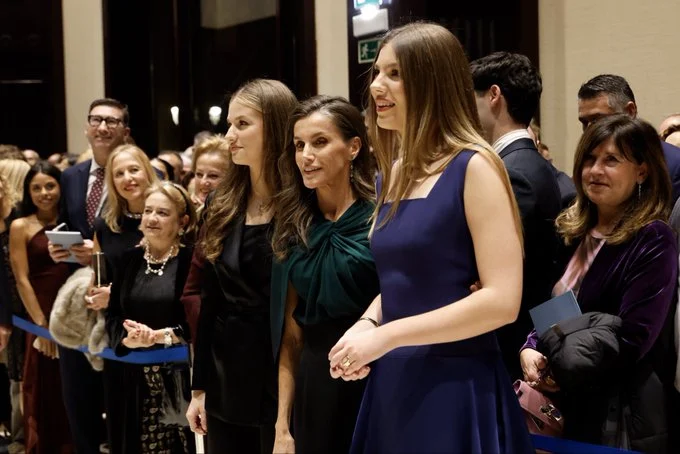
The three-day celebration commenced in Oviedo with the traditional inaugural concert held on the eve of the main prize-giving ceremony. This year’s musical program paid special tribute to the life and work of the iconic nineteenth-century composer Felix Mendelssohn, offering an evening of classical reflection for the royal family and attendees. Princess Leonor made her entrance wearing a sophisticated black evening suit, while Infanta Sofia opted for a striking midnight blue dress. Observers noted that the sisters appeared visibly delighted to be reunited after navigating the initial hurdles of their respective university terms.
The following morning set a new precedent for the young heir apparent. The day of the prize-giving traditionally begins with a series of formal audiences, where the royal family greets the year’s distinguished laureates, jury members, and institutional representatives. In a significant departure from previous years, Princess Leonor independently led a portion of these official audiences without the immediate presence of King Felipe and Queen Letizia, signaling a deliberate and measured expansion of her constitutional responsibilities.
Later in the program, the family was further augmented by the arrival of Queen Sofia, the former Queen of Spain and grandmother to Leonor and Sofia. While King Felipe, Queen Letizia, Princess Leonor, and Infanta Sofia took their places of honor on the dais within the main auditorium, Queen Sofia observed the proceedings from a traditional private box overlooking the hall, maintaining a proud and supportive presence throughout the ceremonies.
Academic Transitions: Military Service to University Halls
The reunion in Oviedo brings a temporary pause to an autumn that has completely transformed the daily routines of Spain’s royal youth. Princess Leonor’s journey to this point has been marked by an intense multi-year military training regimen designed to prepare her for her future constitutional role as Supreme Commander of the Spanish Armed Forces. Having completed comprehensive stints across the Army, Navy, and Air Force—including training aboard the historic naval training ship Juan Sebastián de Elcano—the twenty-year-old heir officially matriculated at a university in Madrid to pursue her civilian higher education.
Infanta Sofia’s path has similarly taken her beyond the traditional royal bubble. After completing her international baccalaureate studies in Wales and spending a formative academic year in Portugal, the nineteen-year-old relocated to the French capital. Settling into her new student accommodation in Paris, Sofia is continuing her specialized academic pursuits while experiencing life as an independent young adult in one of Europe’s most vibrant cultural epicenters.
Despite the geographic distance and demanding syllabi, sources close to the royal household have consistently emphasized that the sisters maintain a remarkably close relationship. Their public interactions in Oviedo—marked by shared smiles, whispered conversations, and synchronized engagements—underscored the enduring strength of their sibling bond despite the pressures of public life and individual growth.
Institutional Implications and Future Outlook
The convergence of the Princess of Asturias Awards with this milestone period in the lives of the royal princesses highlights a broader modernization strategy for the Spanish monarchy. King Felipe VI and Queen Letizia have meticulously orchestrated their daughters’ upbringing and education to balance traditional royal decorum with contemporary realities. By ensuring that both Leonor and Sofia gain exposure to military discipline, international academic environments, and rigorous public service, the institution is proactively shaping a sustainable future.
For Princess Leonor, the autumn of 2026 carries even broader significance. Beyond her expanding institutional portfolio at the Asturias Awards, the royal household is preparing to celebrate her upcoming twenty-first birthday on October 31. Having served as heir to the throne for twelve years—since her father’s ascension in 2014—Leonor stands on the cusp of full adulthood with her constitutional duties more clearly defined than ever before.
As the Oviedo ceremonies conclude and the princesses return to their respective universities in Madrid and Paris, the events of this week will undoubtedly serve as a crucial stepping stone in their public evolution. The seamless transition from private student life back into the intense spotlight of international statecraft demonstrates a poise and maturity that reassures monarchists and observers alike regarding the stable future trajectory of the Spanish Crown.