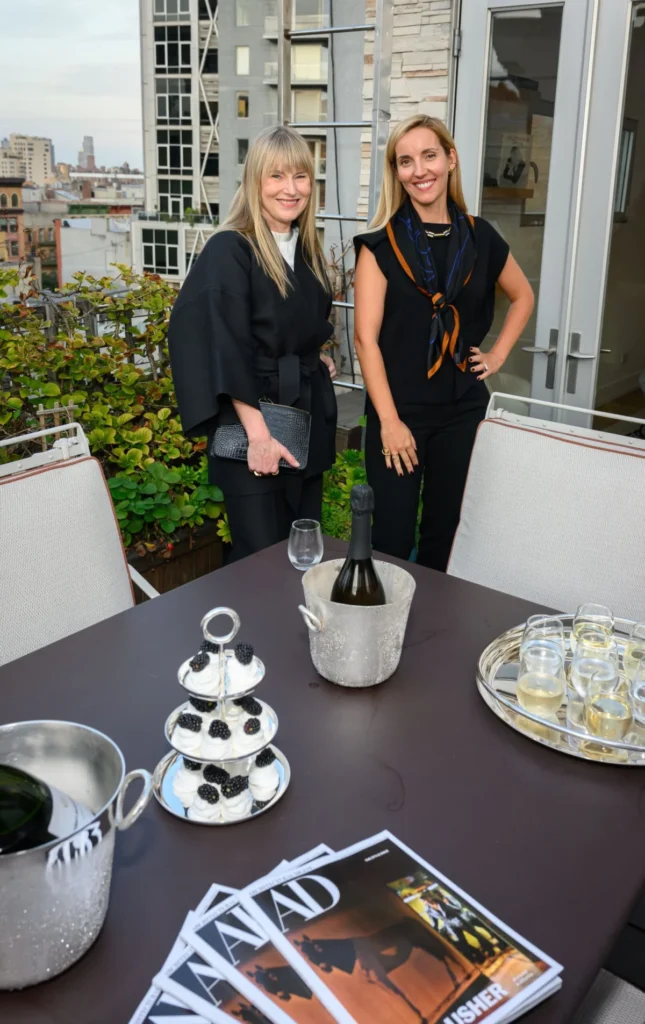

The intersection of legacy design and contemporary innovation was on full display this September 16, as the industry’s most influential figures gathered in a sprawling, three-story penthouse on the Bowery. The occasion served as the official evening reception following the AD PRO Design Dialogues, a premier summit that brings together architects, interior designers, and brand leaders to dissect the evolving landscape of global design. The event at the Andrée Putman Studio served not merely as a networking opportunity, but as a symbolic bridge between the storied history of one of the 20th century’s most significant designers and the forward-looking trajectory of her eponymous brand.

A Legacy of Discipline and Restraint
To understand the weight of the gathering at the Bowery showroom, one must first consider the magnitude of Andrée Putman’s influence on modern aesthetics. Renowned for her ability to strip away the superfluous in favor of structural integrity and balanced proportions, Putman remains a touchstone for minimalism. During the summit earlier that day, CEO Aurélie Laure provided a framework for how the studio currently approaches this heavy mantle. Citing the insights of renowned designer Ralph Pucci, Laure noted that Putman’s philosophy was anchored in the belief that elegance is a discipline, modernity requires integrity, and true luxury is defined by profound restraint.
This philosophy is not being treated as a static relic. Under the leadership of Olivia Putman, the designer’s daughter, and Aurélie Laure, the studio has embarked on a strategic revival that seeks to honor the past while avoiding the pitfalls of simple mimicry. As Laure emphasized, the brand views Putman’s vast archive as an "alphabet"—a foundational language that allows the current team to write their own creative narrative in the contemporary context. This approach is critical for heritage brands that risk becoming stagnant; by treating design history as a living, breathing tool rather than a museum piece, the studio remains relevant to a modern audience that prizes both history and functionality.

Chronology of the Day’s Proceedings
The day began in the early morning hours with the AD PRO Design Dialogues, which hosted a series of panels featuring industry veterans, rising stars, and critics. These dialogues addressed the logistical and aesthetic challenges currently facing the design industry, including supply chain shifts, the integration of smart-home technology, and the imperative for sustainable sourcing.
Following the conclusion of the summit, attendees transitioned to the Bowery district. The selection of the Bowery for the showroom is significant; historically, it was a hub for local artisans and industrial suppliers, and it has long served as a source of creative energy for New York designers, including Putman herself. The move to this multi-story space—which includes two expansive rooftop terraces—represents a strategic expansion for the studio, allowing for a more immersive, residential-style experience for visitors.

From 6:00 PM to sunset, the showroom transformed into a high-level social environment. The architecture of the space, which balances high-ceilinged galleries with intimate, lounge-like vignettes, allowed for organic movement among attendees. Guests were invited to interact with a curated selection of furniture that spanned from historical re-editions to pieces recently developed by the studio. This spatial arrangement was deliberate, fostering a physical dialogue between the vintage and the contemporary.
Data and Design: The Anatomy of the Collection
The gallery currently showcases over 150 unique design collaborations, a testament to the prolific nature of Putman’s career. Central to the display is the Voie Lactée, a wool-and-silk rug originally designed by Putman for her personal residence in 1978. Its inclusion is more than an aesthetic choice; it serves as a case study in the longevity of high-quality textiles. In an era of "fast furniture," the decision to re-edit such pieces highlights a broader shift in the luxury market toward items that possess intrinsic, long-term value.

Supporting the aesthetic experience was a culinary program designed to reflect the studio’s visual identity. Chef Noot Seear was commissioned to create a menu that paid homage to the iconic checkerboard tile bath Putman designed for the Morgans Hotel in New York—a project that arguably defined the aesthetic of the boutique hotel movement in the 1980s. The resulting black-and-white theme, featuring French crudité cups with caviar and blackberry pavlovas, functioned as a sensory extension of the brand’s graphic sensibilities. The use of Christofle’s Vertigo serveware further underscored the importance of craftsmanship, linking the event to a long-standing tradition of French metalwork.
Institutional Perspectives and Industry Impact
The presence of figures such as Jean-Gabriel Neukomm of JG Neukomm Architecture, Michael K. Chen of MKCA, and Theresa Ory of Theresa Ory Interiors highlighted the importance of the event for the architectural community. For these professionals, the ability to study the evolution of a brand like Andrée Putman is essential.

The industry’s reception of the studio’s new direction has been largely positive. By focusing on the concept of "dialogue," the studio is positioning itself as a collaborative partner rather than a closed-off design house. Aurélie Laure noted that Putman’s own career was defined by her associations with intellectual and artistic giants such as Jean-Michel Basquiat, Keith Haring, and Andy Warhol. These friendships were not merely social; they were integral to the work. Putman understood that design is a social science—that it exists within the context of the art, politics, and culture of its time.
This sentiment has clear implications for the current market. As the design industry faces increasing pressure to demonstrate cultural relevance, the strategy of "cross-disciplinary engagement" is becoming a standard for survival. The studio’s commitment to staying in conversation with the contemporary creative scene suggests that the brand is not merely resting on the success of its archival furniture but is actively seeking to influence the next generation of designers.

Broader Implications for the Global Design Landscape
The success of the evening at the Bowery showroom reflects a broader trend in the high-end interior design sector: the move away from the traditional, showroom-as-warehouse model toward experiential, salon-style environments. By hosting events that mirror the intellectual rigor of the AD PRO summit, the Andrée Putman Studio is effectively creating a space where the commercial act of purchasing furniture is secondary to the exchange of ideas.
Furthermore, the emphasis on re-editions carries significant economic weight. In the secondary market, "original" pieces by legendary designers have become increasingly scarce and prohibitively expensive. By re-issuing these designs, the studio makes the heritage accessible to a new generation of collectors and interior designers while maintaining strict quality control. This is a vital strategy for the preservation of design history, ensuring that the visual language of the 20th century remains a functional part of 21st-century interiors.

As the industry looks toward the next fiscal year, the lessons from the Andrée Putman Studio are clear: longevity is not achieved through isolation. It is achieved through the constant re-contextualization of foundational values. Whether through the meticulous restoration of a 1978 rug design or the hosting of an evening of discourse on the Bowery, the brand continues to demonstrate that it is, above all, a participant in the ongoing, global dialogue of design.
Conclusion
The event concluded with a clear consensus among attendees: the Andrée Putman Studio is successfully navigating the delicate balance of preserving a legacy while fostering new creative output. As the sun set over the Manhattan skyline, the dialogue between the past and present—a core tenet of Putman’s life work—remained the central theme of the evening. For the architects and designers in attendance, the event provided more than just a networking opportunity; it provided a blueprint for how to carry forward the torch of design excellence in a rapidly changing world. By remaining true to the principles of discipline, integrity, and restraint, the studio ensures that the "alphabet" written by Andrée Putman will continue to be used to write the future of design for years to come.