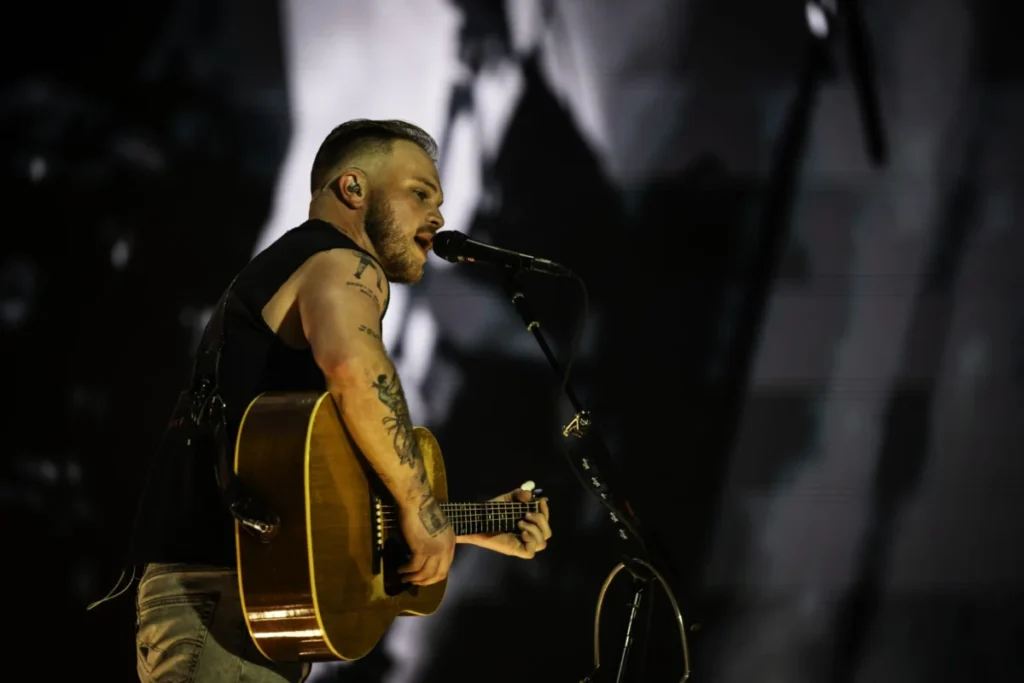

Grammy-winning country and folk artist Zach Bryan made a distinct and highly publicized sartorial statement during his performance at Gillette Stadium in Foxborough, Massachusetts. Taking the stage on Friday, October 2, for the opening night of a two-concert run on his With Heaven On Tour, Bryan wore a plain black T-shirt bearing the message "Free Palestine." Members of his backing band joined him in wearing identical apparel, capturing the attention of both the live audience and millions online as fan-shot footage circulated rapidly across social media platforms. Bryan chose not to explicitly address the political statement from the stage, allowing the apparel to speak for itself, yet the timing, messaging, and venue choice carried profound implications within the contemporary music and cultural landscape.
The venue for the demonstration added a sharp layer of intentionality to the gesture. Gillette Stadium is owned and operated by the Kraft Group, spearheaded by billionaire businessman and New England Patriots owner Robert Kraft. Just weeks prior to Bryan’s concert, Kraft played a central and highly visible role in the removal of rapper Macklemore from the remaining United States dates of Ed Sheeran’s Mathematics (Loop) Tour. The fallout from that summer tour controversy set a tense backdrop for live performances at Kraft-affiliated properties, transforming what might otherwise be viewed as a routine sartorial choice into a direct and calculated dialogue with the venue’s powerful ownership.
The Genesis of the Live Music Tour Controversy
The friction between live entertainment, corporate venue management, and political speech intensified significantly in early September. Macklemore, serving as a supporting act for Ed Sheeran, took the stage at MetLife Stadium in East Rutherford, New Jersey, on September 4 and 5. During his sets, the rapper openly declared "Free Palestine" to the assembled stadium crowds and performed his 2024 politically charged protest song, "Hind’s Hall." On the second evening of the New Jersey residency, Macklemore went further by addressing Jewish audience members directly, clarifying that his vehement criticisms of the Israeli government and military actions were not directed at Jewish people as a whole.
Despite these caveats, the statements triggered immediate and organized pushback. The Israeli-American Council launched a formal petition demanding Macklemore’s immediate removal from the remainder of the high-profile stadium tour. By September 14, the Messina Touring Group—the primary promoter for the tour—confirmed that Macklemore had been dropped from all subsequent U.S. dates. Industry reports indicated that the decision was precipitated by pressure from multiple influential NFL stadium owners who allegedly threatened to cancel scheduled shows if the rapper remained on the bill.
Robert Kraft publicly confirmed his active participation in the decision later that same day. In a carefully worded official statement, Kraft asserted that he felt a distinct personal and moral responsibility to intervene when he believed a definitive line had been crossed regarding antisemitism, while simultaneously acknowledging the profound humanitarian suffering experienced by Palestinians.
Ed Sheeran issued his own statement the following day, distancing himself from the promoter’s executive decision. Sheeran clarified that the removal of Macklemore was executed entirely by Messina Touring Group and venue stakeholders, noting that he had engaged in direct, albeit unsuccessful, discussions with Kraft in an effort to reach a mutually agreeable resolution that would keep the tour intact.
Industry Fallout and Solidarity Actions
The cancellation and subsequent removal of Macklemore catalyzed a sweeping wave of solidarity across the touring music ecosystem. Several notable supporting acts and touring personnel immediately severed ties with the production. Artists including Finneas, Aaron Rowe, and Lukas Graham officially exited the tour in protest, alongside the traditional Irish folk band Beoga, who had been performing integral instrumentation for Sheeran’s live ensemble.
Macklemore responded to the career disruption with a comprehensive statement published via Instagram, detailing the substantial financial ramifications he faced. The rapper outlined significant losses spanning merchandise revenue, corporate brand partnerships, festival bookings, and private performance offers canceled in the wake of his public advocacy.

Demonstrating resolve, Macklemore subsequently pledged $1 million of his accumulated touring proceeds directly to Palestinian humanitarian aid organizations. Furthermore, he announced and rapidly organized the Free Palestine Tour, a concentrated European concert series covering Dublin, Paris, and London between October 26 and October 30. Representatives for the artist confirmed that the specialized run sold out almost instantaneously upon release.
Ironically, the tour changes enacted to appease venue stakeholders ultimately failed to protect the schedule entirely. Ed Sheeran’s scheduled two-night stand at Gillette Stadium—the very venue whose leadership pushed for Macklemore’s exclusion—was completely canceled due to severe, hazardous weather conditions in the Foxborough region, rendering the concessions made by promoters and artists moot regarding those specific dates.
Zach Bryan’s History of Confrontation with Power
Zach Bryan’s decision to wear the "Free Palestine" shirt at Gillette Stadium aligns with a well-established pattern of defiance against institutional authority and political pressure. Unlike many mainstream commercial artists who carefully neutralize their public personas to avoid commercial fallout, Bryan has consistently courted controversy by engaging with polarizing social and political topics through his art and public platform.
In October 2025, Bryan released a brief preview teaser for his track "Bad News," a song featuring lyrical references to Immigration and Customs Enforcement (ICE) raids. The teaser immediately drew sharp, public reprimands from the White House and the United States Department of Homeland Security. Then-Homeland Security Secretary Kristi Noem publicly expressed disappointment over the song’s framing, thrusting the country singer into the center of national immigration debates.
Bryan firmly pushed back against the administration’s criticisms at the time. He defended the composition by arguing that the track accurately reflected complex human realities spanning both sides of the political aisle, while urging his expansive fan base to reject divisive social media narratives. The track ultimately secured its place on his studio album, With Heaven on Top, which released to commercial success on January 9, 2026.
Broader Implications for Live Entertainment and Free Speech
The convergence of Zach Bryan’s wardrobe choice, Robert Kraft’s ownership of Gillette Stadium, and the lingering fallout from the Macklemore tour controversy highlights a growing structural tension within the live entertainment industry. As stadium tours increasingly rely on corporate-owned mega-venues and multi-layered sponsorship ecosystems, the boundaries governing political expression for performing artists have become a central battleground.
Venue owners and corporate promoters are increasingly exercising veto power over artistic content, citing community standards, commercial risks, and potential public relations liabilities. Conversely, artists—empowered by direct-to-consumer digital connectivity and fiercely loyal fan bases—are demonstrating an increasing willingness to absorb financial and professional penalties to voice personal convictions regarding international geopolitics and human rights.
As Zach Bryan prepared for the second evening of his Foxborough engagement at Gillette Stadium, industry observers, media analysts, and concertgoers alike focused intensely on whether the "Free Palestine" statement would be repeated and how venue management would respond. Representatives for Robert Kraft and the Kraft Group declined to issue immediate statements regarding Bryan’s demonstration, leaving the long-term ramifications of the protest on future stadium bookings and corporate artist relations uncertain. The incident underscores a shifting paradigm where the concert stage functions not merely as a venue for commercial entertainment, but as an increasingly volatile forum for geopolitical discourse and ideological assertion.