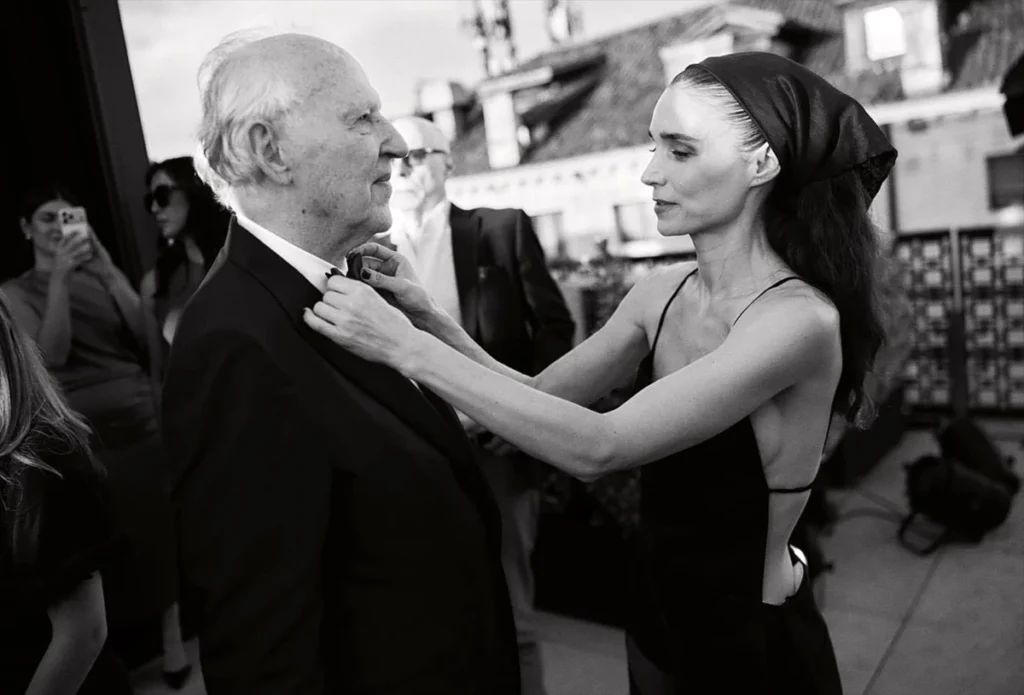

The 2026 Venice Film Festival served as the backdrop for one of the most anticipated cinematic discussions of the year, bringing together iconic German filmmaker Werner Herzog and journalist Tamara Khodova. Fresh off receiving the prestigious Lifetime Achievement Golden Lion at the preceding year’s festival, Herzog returned to the Lido in September 2026 to debut his 21st narrative feature film, Bucking Fastard. Dedicated to the late David Lynch, the picture represents a continuation of Herzog’s idiosyncratic approach to storytelling, blending surreal human dynamics with stark emotional truths.
The film stars acclaimed real-life sisters Kate Mara and Rooney Mara as Jean and Joan Holbrooke, characters loosely inspired by the real-life British identical twins Freda and Greta Chaplin. Alongside a supporting cast that includes Orlando Bloom, the project pushes the boundaries of traditional narrative cinema, incorporating surreal elements such as an unscripted, real-life animal companion—a farm-raised fox that features prominently in the second half of the movie. Amid the whirlwind of press obligations surrounding the festival, Herzog sat down for a candid conversation about the state of contemporary cinema, his distinct methodology across documentaries and fiction, and the enduring nature of human dreams.
Background Context and Festival Circuit Momentum
Bucking Fastard stands as a major milestone in Herzog’s prolific late-career output. Over a career spanning more than six decades, the 84-year-old director has continually defied categorization, moving fluidly between harrowing documentaries like Grizzly Man and Cave of Forgotten Dreams to sweeping narrative epics like Fitzcarraldo. His latest feature made its grand entrance in the Main Competition at the 2026 Venice Film Festival, immediately establishing itself as a prominent talking point among critics and cinephiles alike.
Following its debut on the Lido, the film maintained strong momentum across the autumn festival circuit, securing screenings at the Telluride Film Festival, the Toronto International Film Festival, the Zurich Film Festival, the San Sebastian International Film Festival, and the New York Film Festival. While distributors have yet to announce an official theatrical release date, industry analysts project a commercial rollout in early 2027. This narrative feature release follows hot on the heels of Herzog’s recent documentary venture, Ghost Elephants, which explored the rugged landscapes of Angola earlier in the year.

The Persistence of Dreamers in a Cynical World
At the core of Bucking Fastard lies an exploration of human obsession and idealism, themes that have permeated Herzog’s filmography since his earliest works. In the film, the Holbrooke twins chase an idealistic vision of love and a utopian society where universal kindness prevails. When asked whether such dreamers can realistically survive the harsh mechanics of the modern world, Herzog offered a characteristically philosophical response.
"Dreams are part of our makeup, of our existence," Herzog explained during the interview. "And, of course, this is even more so about love. But where do you find love? Where do you find that country? Is it an illusion, or is it on a different continent, in Arcadia or Atlantis?"
This thematic pursuit of inner landscapes manifests throughout the film, notably in references to the Orkney Islands—a remote Scottish archipelago that serves as a physical and psychological touchstone for the characters. Although Herzog admitted he had never personally visited the islands prior to production, he emphasized that the setting functions primarily as an internal geography, mirroring the soul-searching journeys undertaken by characters in past masterworks.
The narrative architecture of Bucking Fastard carefully balances vulnerability with external peril. The twin sisters encounter various obstacles, ranging from a confused forklift driver with a low IQ who accidentally alters their identities by shearing a lock of hair, to social misunderstandings at wedding receptions. Yet, Herzog takes care to install narrative counterweights. Rather than deploying traditional villains, the director populates his world with complex figures, such as the charming yet duplicitous love interest portrayed by Orlando Bloom, and various Good Samaritans who offer refuge.
Crafting Illusion: Reality Versus Digital Effects in Modern Cinema
As a filmmaker who has witnessed the digital revolution transform the medium from celluloid to high-definition bits, Herzog offered a critical assessment of the contemporary cinematic landscape. He pointed to a growing divide between technical prowess and narrative integrity in modern Hollywood.

"I think much of what you see in theaters today—the big event films—have enormous value in the special effects, with dinosaurs or dragons flying and whatever else," Herzog noted. "They have a lot of star power, but many of them have a deficit in storytelling. Storytelling was much more interesting in the 1950s, for example."
In an era dominated by green screens and computer-generated imagery, Herzog proudly bucked industry trends during the production of Bucking Fastard. A notable point of discussion during the Venice press cycle involved a mystical fox that appears in the film’s second act. Prompted by rumors circulating online regarding whether the animal was a digital artifact, Herzog confirmed the creature’s authenticity. The fox was a domestic pet raised by two young farm boys aged 10 and 12, remaining naturally attuned to the camera during production.
This commitment to tactile, grounded reality extends to Herzog’s methodology across both documentary and fiction filmmaking. Rejecting the label of "issue films" or conventional journalism, Herzog views his documentaries and narrative features as part of a singular artistic continuum. He frequently applies narrative techniques—such as deliberate casting, scripted sequences, and rhythmic repetition—to documentary subjects to elicit what he terms "illumination": a profound emotional and intellectual insight that transcends mere factual documentation.
The Role of the Artist and the Limits of Influence
Addressing broader questions regarding the sociopolitical responsibilities of artists, Herzog offered a pragmatic perspective that contrasts with creators who view cinema as an explicit tool for systemic change. Referencing animator Hayao Miyazaki’s reported sentiment of stepping away from the ambition of altering human minds through art, Herzog expressed skepticism toward creators who explicitly claim an agenda of societal salvation.
"We are storytellers. So, why should we need to change the world? I give you all the joy of storytelling," Herzog stated. "I don’t know if Miyazaki was ever really out to change the world, but it is healthy that he moved away from that idea. You see, when somebody says, ‘I’m here to make the world a better place,’ that makes me cringe. There’s something not right about that."

Instead, Herzog advocated for tangible, grassroots actions—such as supplying musical instruments to underprivileged youths—over grand artistic pronouncements. For Herzog, the primary obligation of a director is to understand human nature deeply, a skill he believes requires robust engagement with the world to effectively guide actors and captivate audiences.
Broader Implications and Outlook for 2027
The warm reception of Bucking Fastard across major international film festivals signals a vibrant continuation of Werner Herzog’s storied career well into his ninth decade. By resisting industry homogenization and maintaining a steadfast commitment to analog authenticity, original storytelling, and philosophical inquiry, Herzog remains a towering figure in global cinema.
As the film industry awaits a definitive theatrical release date for Bucking Fastard in 2027, the discourse generated at the Venice Film Festival underscores the enduring relevance of Herzog’s cinematic vision. Whether examining prehistoric cave paintings, tracking obsessive explorers in the wilderness, or exploring the shared delusions of identical twins, Herzog continues to challenge audiences to look beyond the surface of reality and seek out deeper truths of human existence.