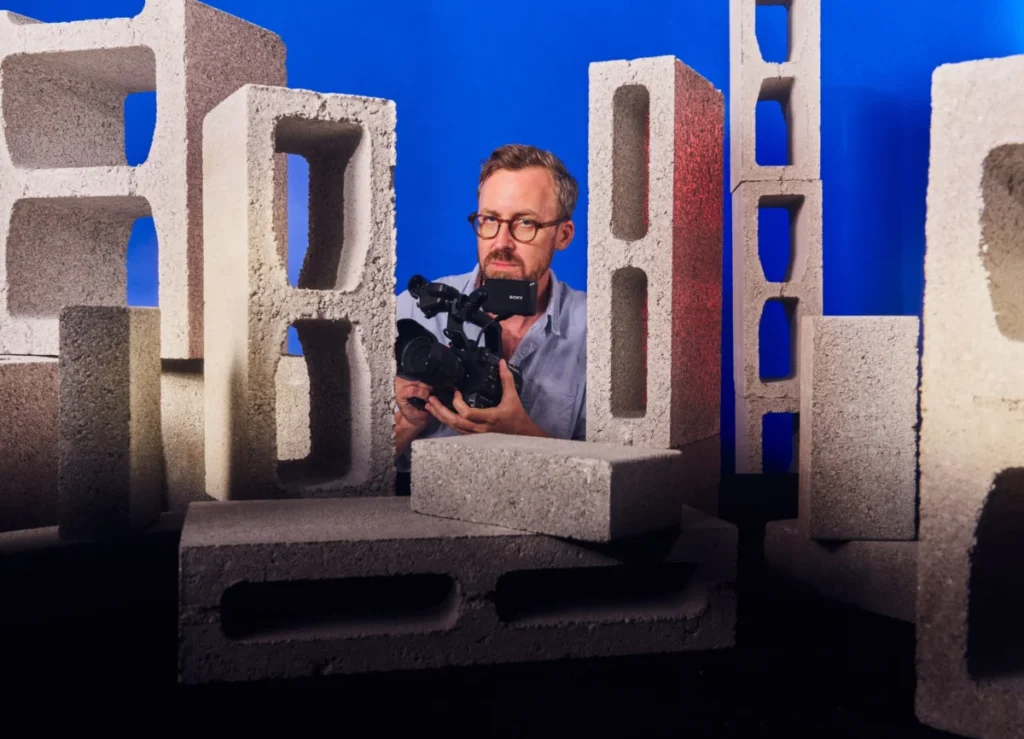

High above the bustling streets of Lower Manhattan, perched on the 35th floor of One World Trade Center, filmmaker John Wilson sits amidst the very material that defines his latest cinematic undertaking. The skyscraper, a monolith of engineering, stands as a testament to the ubiquity of concrete—a substance so fundamental to modern civilization that it is the second-most consumed material on Earth, trailing only water. In this single structure, the volume of concrete used is staggering, enough to pave over 4,000 New York City blocks. This irony is not lost on Wilson, whose first feature-length documentary, The History of Concrete, arrives in theaters on September 18, including a premiere at Low Cinema, the 40-seat venue he recently restored.
The film, which spans an hour and 40 minutes, serves as a sweeping investigation into the life cycle of the built environment. While the title suggests a dry technical exploration, the film functions as a nuanced meditation on the intersection of urban planning, capitalist pressures, and the existential impermanence of the structures we inhabit. Much like his Emmy-nominated HBO series, How to With John Wilson, the documentary uses an ostensibly mundane subject—in this case, a construction material—as a gateway to explore the structural and social complexities of modern life.

A Foundation in Disrepair: The Catalyst for Inquiry
The impetus for the film was far more personal than academic. It began in Ridgewood, Queens, where Wilson encountered a failing foundation in his own home. As stormwater began to seep through cracks in the concrete, Wilson was confronted with the physical reality of decay. Rather than simply hiring a contractor to rectify the issue, he turned to literature, seeking to understand the material on a molecular level. His research evolved into a global quest to reconcile the longevity of ancient Roman concrete—which has survived nearly two millennia—with the premature degradation of contemporary infrastructure.
This disparity between the "thousand-year city" of the past and the "50-year" lifecycle of modern construction forms the central conflict of his narrative. Wilson’s investigation moves from his own patio to the streets of New York, where he observes the city’s crumbling infrastructure, including neglected public pools and the heavily trafficked Brooklyn-Queens Expressway (BQE).
The BQE and the Crisis of Infrastructure
The Brooklyn-Queens Expressway provides a focal point for the film’s critique of urban maintenance. The triple-cantilever structure, which supports approximately 130,000 vehicles daily, has long been a symbol of New York’s deferred maintenance. Sam Schwartz, the city’s former traffic commissioner and a prominent voice in transportation engineering, appears in the film to illustrate the severity of the situation. Standing beneath the expressway, Schwartz highlights exposed rebar—a clear sign of structural compromise.

The timing of the film’s release coincides with a pivotal moment for this infrastructure. Following years of political deadlock, the municipal government announced in August 2026 a $4-billion, 10-year rehabilitation plan for the BQE. This initiative, championed by Mayor Mamdani, aims to extend the life of the expressway by another 40 years. While the film captures the apprehension regarding a potential catastrophic failure, the government’s recent commitment suggests that public discourse is finally shifting toward the long-term necessity of infrastructure investment.
The Paradox of Supertall Development
Wilson’s lens also turns toward the upper echelons of luxury real estate, specifically the troubled history of 432 Park Avenue. Despite being one of the most expensive addresses on "Billionaire’s Row," with units commanding prices exceeding $80 million, the tower has become a cautionary tale of modern construction. The building has been plagued by reports of structural instability, including significant cracking and the detachment of exterior façade elements.
This serves as a potent metaphor for the broader systemic issues Wilson highlights: that the wealthy are not immune to the consequences of rapid, profit-driven construction. When the fundamental material—the concrete core and support systems—is compromised, the social status of the occupants provides little protection against the laws of physics. The film juxtaposes these failures with the recent partial collapse of the Pfizer World Headquarters, a site intended for residential conversion. These are not merely isolated incidents, Wilson argues; they are symptomatic of a building culture that prioritizes speed and cost-cutting over long-term durability.

NIMBYism and the Stagnation of Progress
A significant portion of the film is dedicated to the politics of development. Wilson characterizes the documentary as "one of the most NIMBY movies I’ve ever seen," as he embeds his camera within the often-contentious environment of civic hearings and neighborhood meetings. The "Not In My Back Yard" phenomenon is depicted not as a mere annoyance, but as a formidable barrier to progress.
Through his observations, Wilson illustrates a recurring cycle: a broad consensus on the need for essential services—such as affordable housing or community recreation spaces like skate parks—colliding with the intense resistance of local stakeholders. This creates a paralysis in the urban landscape, where the desire to preserve the status quo prevents the necessary evolution of the city. By documenting these clashes, Wilson highlights the difficulty of achieving collective progress in a landscape dominated by individual property interests.
Influences and the Philosophy of the Derive
Wilson’s approach to filmmaking remains rooted in the concept of the dérive—a term from Situationist theory that refers to a spontaneous, aimless journey through an urban landscape, allowing the environment to reveal itself to the traveler. His influences include the works of Jane Jacobs, particularly her seminal text The Death and Life of Great American Cities, and William H. Whyte, whose observational studies of urban spaces fundamentally changed how architects design for human social needs.

By adopting this observational style, Wilson positions himself as a humble observer—a "Mr. Bean" archetype—who uses his perceived naivety to ask probing questions. This allows him to bridge the gap between complex urban theory and accessible, human-centric storytelling. He suggests that the suppression of human social needs by rigid, poorly maintained urban design is a direct result of our failure to understand the material and social environments we inhabit.
Broader Implications: The Architectural Samsara
The documentary concludes with a reflection on what Wilson describes as "architectural samsara"—a cycle of building, decay, and rebuilding. Whether this cycle is a natural process or a manufactured outcome of our economic system remains a question he leaves to the viewer. However, the film serves as a call to action: a plea for more deliberate, thoughtful planning that looks toward the next millennium rather than the next fiscal quarter.
In a meta-commentary on the difficulty of his own endeavor, Wilson includes a sequence featuring actor Michael Imperioli. When asked for advice on how to bring a project to fruition, Imperioli advises, "To make it as inexpensively as they can, and to get it done." This wisdom reflects the core tension of the entire documentary: the struggle to create something of lasting value within an environment that is increasingly ephemeral.

Conclusion
The History of Concrete is more than a documentary about a construction material; it is a profound observation on the fragility of our urban existence. By tracing the failures of our physical world—from the cracked foundations of a Queens home to the crumbling supertalls of Manhattan—John Wilson invites the audience to reconsider their relationship with the spaces they inhabit. As the city faces a new era of infrastructure investment and urban redevelopment, the film arrives as a timely reminder that the strength of our future depends on the integrity of what we build today. It is a compelling, often humorous, and deeply sobering look at the concrete reality that sustains, and occasionally threatens, the lives of millions.