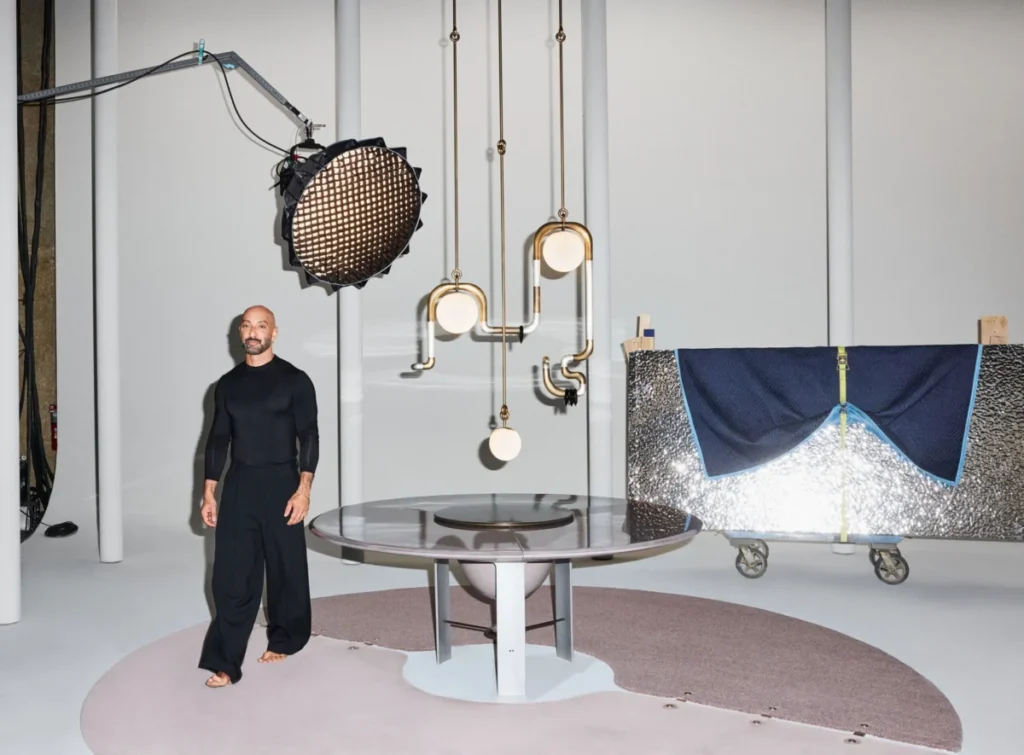

Last March, during an intimate Persian New Year celebration held in a SoHo loft, Gabriel Hendifar—the creative force behind the acclaimed design studio Apparatus—found himself at a profound crossroads of personal history and professional practice. Alongside chef Andy Baraghani, Hendifar orchestrated a night that transcended the bounds of a typical social gathering. As his mother took to singing, his sister, Nic, kept rhythmic time on the tombak, and Hendifar himself sat at the piano, the room filled with the unmistakable sonic landscape of his childhood in Los Angeles. This auditory resonance—a direct link to his mother’s life in Tehran—acted as a catalyst for a creative shift that would define the next several years of his work.
For Hendifar, the realization was visceral. The confluence of music, memory, and heritage didn’t just evoke nostalgia; it felt like a structural adjustment in his own identity. "That night shifted everything for me," Hendifar remarked. "I felt like this cornerstone in the foundation just slipped back into place." This pivotal moment became the genesis for Act V: Afsaneh, a collection that represents a departure from the studio’s previous design trajectories, pivoting toward a narrative-heavy exploration of lineage, the divine feminine, and the cultural memory of the Iranian diaspora.

The Chronology of Afsaneh: A Four-Year Evolution
The development of Afsaneh—named for both the Persian word for "fable" and his mother—did not happen in a vacuum. It was a four-year undertaking that ran parallel to the design and curation of Hendifar’s own living space. While Apparatus has spent the last 14 years establishing a reputation for sleek, industrial, and often enigmatic lighting and furniture, Afsaneh marks a maturation of the brand’s voice.
- 2020-2021: The Research Phase: Hendifar began deep-diving into historical periods characterized by "intense cultural flowering cut short." His mood boards became a repository for archival imagery from 1970s Iran, Weimar Germany, pre-revolutionary Cuba, and New York City immediately preceding the AIDS crisis.
- 2022: Material Exploration: The studio began experimenting with new mediums to reflect the fluidity of memory. Fiberglass was introduced to accommodate larger, more diaphanous lighting forms, while semiprecious stones were integrated as jewelry-like accents.
- 2023: The Synthesis: The design concepts—the Esfand seed, the Gol flower, the Rahvi serpent, and the Jahaan world—began to coalesce into tangible prototypes.
- 2024: The Unveiling: Following the "cornerstone" moment at the Persian New Year party, the final collection was finalized for public release, bridging the gap between personal fable and commercial design.
Defining the Afsaneh Aesthetic: From Folklore to Furniture
The Afsaneh collection is defined by its ability to translate abstract cultural symbols into functional design objects. Hendifar’s design language for this collection relies on a balance between universal geometry and deeply specific cultural signifiers.
The Gol pendants represent the "blooming flower." By utilizing fiberglass, Hendifar achieved a 40-inch-wide scale that remains lightweight and translucent, housing glowing orbs of cast glass that mimic the delicacy of petals. In contrast, the Rahvi lighting fixtures offer a more kinetic energy. Inspired by the curve of a friend’s braided ponytail—an observation that mirrors the "Alaïa meets Sade" aesthetic—these fixtures are segmented to appear as if they are slithering through architectural space.

The Esfand pieces, serving as both ovoid lamps and incense holders, ground the collection in ritual. Esfand, a seed traditionally burned for protection and cleansing in Persian households, is reinterpreted here as a sculptural element. The Jahaan tables, representing the world, utilize cast-glass tops that evoke the cosmos, their forms modeled after the silhouette of the tombak drum.
Technical Innovations and Materiality
The expansion of the Apparatus catalog with Afsaneh is not merely thematic; it is technical. Hendifar has utilized this collection to push the boundaries of the studio’s material capabilities.
- Custom Speckled-Lacquer: The introduction of a bespoke color palette—sky, honey, pomegranate, milk, night, and dusk—allows for a level of customization that feels artisanal rather than industrial. These finishes are applied to the Esfand sconces and Jahaan dining tables.
- Structural Adornment: The Rahvi lights distinguish themselves through the inclusion of jewelry-like amulets fashioned from semiprecious stones, a nod to the decorative traditions of the Middle East.
- Textural Depth: Wool bouclé has been integrated into the brand’s modular rug offerings, providing a sensory softness that contrasts with the hard, shimmering surfaces of the cast glass and aged aluminum tables.
The Broader Impact: Design as a Cycle of Hope
Beyond the craftsmanship, Afsaneh offers a poignant analysis of how designers process history. Hendifar rejects the notion that referencing past eras of cultural decline or transition must result in a work of mourning. Instead, he views these eras as untapped reservoirs of potential.

"It’s less about a tragic turn and more about the cycle," Hendifar explains. By situating his work within the context of periods that were interrupted, he is not presenting a collection of ruins, but rather an inquiry into what those cultures might have become had they continued to flourish. This perspective shifts the discourse around design from mere aesthetic choice to a form of historical reclamation.
The implications for the broader luxury design market are significant. As consumers move away from mass-produced minimalism, there is a growing demand for objects that possess a "soul" or a legible narrative. Afsaneh succeeds because it does not attempt to hide its influences. By explicitly centering his mother, his heritage, and the women he describes as "goddesses," Hendifar is tapping into a market appetite for authenticity.
Contextualizing the Designer’s Role
Gabriel Hendifar’s dual role as both the creative visionary of Apparatus and a student of his own heritage underscores a growing trend in high-end design: the "autobiographical" collection. In an industry often dominated by abstract trends, the move toward personal narrative allows for a deeper brand loyalty.

Industry analysts note that Apparatus has consistently defied the standard furniture cycle by releasing work in "Acts" rather than traditional seasonal collections. This pacing allows for a level of research and development that is rare in contemporary manufacturing. By allowing four years for the incubation of Afsaneh, Hendifar and his team have ensured that the collection is not just a stylistic exercise, but a cohesive argument about the importance of holding and passing on knowledge.
Conclusion: A Legacy in Development
As Hendifar settles into his new SoHo loft, surrounded by the finished pieces of the collection, the success of Afsaneh serves as a testament to his process. He describes himself as "addicted" to the cycle of creation, but his latest work suggests he is also becoming a steward of memory.
The Afsaneh collection is more than a series of lamps and tables; it is a bridge between the immigrant experience of his mother’s generation and the contemporary design landscape of New York City. By honoring the sounds, shapes, and rituals of his childhood, Hendifar has created a body of work that invites the user not just to occupy a space, but to participate in a story. Whether through the slither of a Rahvi fixture or the cosmic depth of a Jahaan table, the collection serves as a reminder that the most compelling designs are those that start with a question about one’s own place in the world. As Hendifar notes, the act of waiting for these shapes to emerge from his dreams was an act of trust—a trust that has resulted in one of the most intellectually and visually resonant collections in the modern history of the studio.