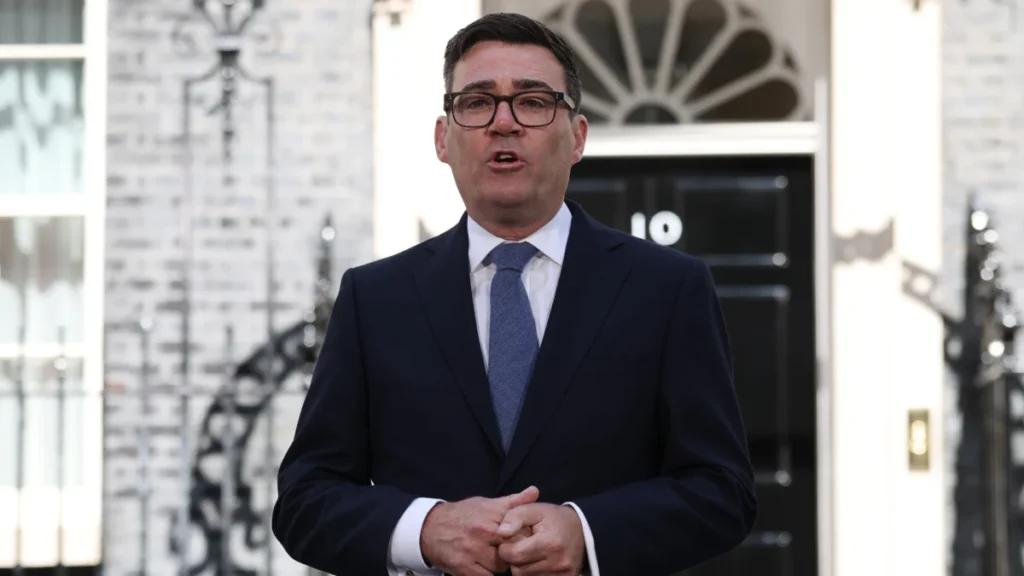

Andy Burnham, a seasoned political figure long dubbed the "King of the North," has officially ascended to the pinnacle of British politics, becoming the United Kingdom’s seventh Prime Minister in a span of just ten years. At 56 years old, Burnham’s appointment ushers in a new era for the Labour Party and the nation, with his term officially commencing on Monday following his formal election as Labour Party leader and an audience with the King, who extended the invitation to form a government. This transition marks a significant moment, highlighting a period of unprecedented political flux and public dissatisfaction that has plagued the nation’s leadership for a decade.
A Decade of Political Volatility and the Dawn of a New Era
Burnham’s premiership follows a tumultuous period in British politics, characterized by rapid changes in leadership and shifting national priorities. The last ten years have seen a revolving door at 10 Downing Street, with David Cameron, Theresa May, Boris Johnson, Liz Truss, Rishi Sunak, and most recently, Keir Starmer, all holding the nation’s highest office. This instability, driven by a confluence of factors including Brexit, economic challenges, and internal party strife, has left the public yearning for consistency and strong leadership. Burnham’s appointment as the seventh Prime Minister since 2014 underscores the deep-seated challenges facing the UK political system and the electorate’s ongoing search for a stable, unifying figure. His immediate task will be to project an image of calm and competence in a landscape scarred by recent upheavals.
The ascension of Andy Burnham was largely anticipated in the weeks leading up to the official announcement. His predecessor, Keir Starmer, faced mounting pressure and was ultimately compelled to resign by his own party. Starmer’s brief and controversial tenure as Prime Minister, which began in late 2027 following a snap general election, was marked by consistent speculation about his diminishing popularity among Labour ministers and a growing disconnect with the party’s traditional voter base. Critics within his own ranks and across the political spectrum frequently argued that Starmer’s leadership lacked a clear ideological compass, leading to perceived attempts to appease both Conservative and Reform voters on sensitive issues. These included the complex geopolitics surrounding the conflict in Gaza, the ongoing national debate on transgender rights, the contentious issue of immigration policy, and the persistent challenge of soaring economic inequality. The internal consensus that ultimately forced Starmer’s hand was that he simply wasn’t deemed a sufficiently robust or inspiring leader to steer Britain through its current myriad of domestic and international challenges.
From Failed Leadership Bids to Prime Ministerial Power
Andy Burnham’s journey to Downing Street is a testament to perseverance and a carefully cultivated political brand. Born in the Liverpool suburb of Aintree in 1970, Burnham joined the Labour Party at the formative age of 15, demonstrating an early commitment to public service and political engagement. His academic path led him to Cambridge University, where he studied English, before embarking on a steady ascent through the UK’s political ranks. Early career highlights included working in government for former Prime Ministers Tony Blair and Gordon Brown, gaining invaluable experience at the heart of the executive. He subsequently held significant shadow secretary roles during the leaderships of Ed Miliband and Jeremy Corbyn, serving as Shadow Health Secretary and Shadow Home Secretary, respectively. These positions allowed him to hone his policy expertise and public speaking skills, despite the Labour Party being in opposition for much of this period.
Crucially, Burnham’s path was not without its detours and setbacks. He launched multiple, ultimately unsuccessful, campaigns to become the leader of the Labour Party, most notably in 2010 and 2015. These attempts, while failing to secure him the party’s top job at the time, solidified his profile and allowed him to articulate his vision for the party and the country, building a loyal base of support among members. His tenacity and refusal to abandon his ambition for leadership ultimately paid off in this recent, unexpected vacancy.
The "King of the North" and the Hillsborough Legacy
A pivotal chapter in Burnham’s political career, and arguably the one that most significantly shaped his public image, was his tenure as Mayor of Greater Manchester from 2017 until his recent resignation in 2026. This role provided him with a direct mandate and a platform to implement his vision for regional empowerment, earning him a reputation as a true “man of the people.” During his time as mayor, Burnham successfully cultivated an incredibly broad appeal across the north of England, distinguishing himself from the often London-centric political establishment.
A cornerstone of his popularity and a testament to his commitment to justice was his instrumental role in introducing and successfully campaigning for the Hillsborough Law. This landmark piece of legislation is designed to prevent state cover-ups following public disasters and scandals, ensuring greater transparency and accountability from public bodies. The law is named in memory of the Hillsborough disaster of 1989, a tragic event that saw 97 Liverpool football fans unlawfully killed in a crowd crush at a soccer game. For decades, the victims’ families fought tirelessly and courageously to uncover the truth and hold authorities accountable, facing significant institutional resistance. Burnham, a vocal advocate for the families, championed their cause, transforming a deeply personal tragedy into a national legislative reform that resonates deeply with communities across the UK, particularly in the North West. His unwavering support for the Hillsborough families cemented his image as a politician who prioritizes ordinary people and stands up against injustice, further solidifying his "King of the North" moniker.
Politically, Burnham occupies a position closer to the left-leaning ideology of former Labour leader Jeremy Corbyn than to the more centrist approaches of Keir Starmer or Tony Blair. This ideological alignment, coupled with his distinctly anti-Westminster approach and focus on regional empowerment, has further endeared him to a segment of the electorate feeling alienated by the traditional political establishment. A central theme of Burnham’s nascent government is expected to be a concerted effort to decentralize power, pushing decision-making authority and resources out of London and into regional political hubs across the country. This includes ambitious plans to bolster public transport infrastructure connecting northern cities, a crucial step towards fostering economic growth and social cohesion outside the capital. Furthermore, tackling deeply entrenched issues such as homelessness and the critical shortage of social housing are high on his agenda, reflecting a commitment to addressing fundamental social inequalities.
Navigating a Treacherous Political Landscape
Burnham inherits a political landscape fraught with challenges and divisions. His government will have to traverse some exceptionally bumpy political terrain in Britain, where far-right politicians, most notably Nigel Farage’s Reform UK, are actively committed to weaponizing immigration policies and stoking the flames of division. Reform UK, having capitalized on public discontent and anxieties, is openly eyeing a significant electoral victory in the next general election, constitutionally mandated to take place no later than August 2029. This presents a formidable challenge for Burnham, who will need to craft a compelling narrative that addresses public concerns without succumbing to divisive rhetoric.
Adding to the complexity, Kemi Badenoch’s Conservative Party is increasingly adopting a more right-wing stance on certain policies, particularly on immigration and cultural issues, in a strategic effort to reclaim voters lost to Reform UK. This shift creates a crowded and ideologically charged political space, making it difficult for Labour to carve out a distinct and broadly appealing position. Burnham’s ability to navigate this multi-front ideological battle will be a critical test of his leadership.
Beyond the immediate political rivalries, Burnham faces a daunting list of practical governance challenges. Despite his long-held ambition to lead the Labour Party, the reality of the Prime Minister’s office comes with immense responsibilities. High on his agenda will be the crucial task of appointing a competent Chancellor of the Exchequer to manage the nation’s finances. He must also address pressing fiscal commitments, including finding an estimated £9 billion ($12 billion USD) to adequately fund Britain’s defense, ensuring the nation meets its international obligations and maintains its security.
The National Health Service (NHS), a cornerstone of British society, remains under immense strain, grappling with record waiting lists, staff shortages, and funding pressures. Protecting and revitalizing the NHS will be a central plank of his government’s domestic policy. Furthermore, Labour’s manifesto commitment to building 1.5 million new homes faces significant logistical and financial hurdles in a country grappling with a protracted housing crisis. A 2023 report by the National Housing Federation indicated a deficit of over 4 million homes in England alone, highlighting the scale of the challenge. Finally, amid a brutal and uncertain job market, Burnham has pledged to implement strategies aimed at getting over a million young people into meaningful work, a critical step towards fostering economic opportunity and social mobility. The youth unemployment rate, while fluctuating, has seen spikes in recent years, particularly in the wake of economic downturns, making this a pressing concern.
Cabinet Formation and Official Responses
A significant immediate challenge for Prime Minister Burnham will be the formation of his cabinet. The article notes the uncertainty surrounding the future of culture secretary Lisa Nandy, currently responsible for shaping industry policy around British film and TV and securing funding for the British Film Institute (BFI). While a reshuffle is imminent, the two are long-time friends and allies in British politics, suggesting a potential retention or a move to another senior cabinet role. The composition of Burnham’s cabinet will send a strong signal about his policy priorities and his leadership style. Key appointments, particularly for departments like the Treasury, Home Office, and Health, will be scrutinized for their expertise and alignment with his declared vision for a decentralized, socially conscious Britain.
While direct official responses from opposition parties were not provided, it is logical to infer immediate reactions. Nigel Farage’s Reform UK would likely immediately criticize Burnham’s perceived left-leaning economic policies and his stance on immigration, framing him as out of touch with the concerns of ordinary working people. They might argue that his focus on northern regeneration is a distraction from what they deem to be more pressing national issues. The Conservative Party, led by Kemi Badenoch, would probably focus on questioning Burnham’s economic competence and his ability to deliver on ambitious spending pledges without increasing the national debt or raising taxes. They would also likely challenge his approach to national security and defense spending, especially given the current geopolitical climate. From within Labour, there would be a mixture of relief and cautious optimism, with his supporters rallying around his vision, while others might quietly watch for signs of deviation from traditional party principles.
A New Chapter for Britain?
Andy Burnham is acutely aware of the tightrope he must walk on contentious issues such as immigration, policing, and the ongoing international debate surrounding Gaza. The pressures from both domestic and international fronts are immense. Yet, despite the formidable challenges ahead, Burnham maintains a resolute posture. "I am ready," the new Prime Minister declared on Friday when he was formally elected Labour Party leader, addressing his Members of Parliament. "What a moment… What backing you’ve given me." He concluded with a statement of intent, "I have a plan. I believe in all of you, and I am confident we can do it."
His confident declaration signals a leader determined to face the headwinds head-on. Burnham’s premiership represents a significant shift in the UK’s political landscape, potentially marking a return to a more regionally focused, socially democratic agenda after years of perceived drift. His ability to translate his "man of the people" image and his northern mandate into effective national governance, while unifying a fractured nation and navigating a deeply polarized political environment, will define his legacy and determine whether Britain can finally find stability after a decade of unprecedented political upheaval. The eyes of the nation, and indeed the world, will be watching closely as Andy Burnham embarks on this challenging yet potentially transformative chapter in British history.