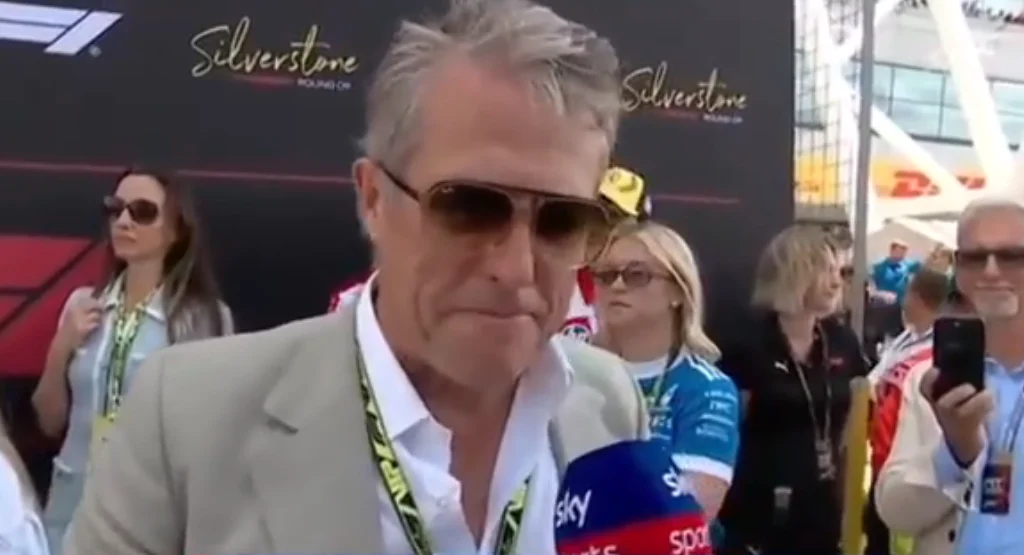

The recent Formula One Grand Prix gridwalk saw British actor Hugh Grant, often characterized by the media as "notoriously grumpy," engage in a brief yet widely discussed interaction with Sky Sports commentator Martin Brundle. The encounter, which took place on Sunday as Grant attended the event with his two sons as a guest of Ferrari, quickly garnered attention online and reignited conversations surrounding celebrity media interactions, journalistic preparation, and the actor’s well-documented aversion to press interviews.
The incident unfolded on the bustling pre-race grid, a notoriously chaotic environment where Brundle, a former F1 driver himself, conducts impromptu interviews with various personalities, from drivers and team principals to celebrities and VIPs. Brundle, known for his unique and often charmingly awkward style, approached Grant, who was positioned amidst the high-octane atmosphere. The central point of contention arose when Brundle inquired, "Are you doing another round of The Gentleman, soon, because I really loved that?" The question, seemingly innocuous, immediately introduced a factual error that set the tone for the remainder of the short exchange.
Chronology of the F1 Gridwalk Encounter
The interaction, though fleeting, progressed through several distinct phases, each contributing to its viral nature.
-
The Approach and Initial Question: Martin Brundle, navigating the crowded grid with his camera crew, spotted Hugh Grant. With characteristic enthusiasm, he posed the question regarding "The Gentleman" series. Brundle’s intention was clearly to connect with Grant about a recent, popular project associated with his work.
-
Grant’s Reaction and Correction: Grant, initially appearing somewhat taken aback, paused for a moment before delivering his clarification. "Well, I did the film of The Gentlemen. I haven’t seen the TV series," he stated, his tone measured but firm. This immediate correction highlighted Brundle’s factual inaccuracy regarding Grant’s involvement in the Netflix adaptation.

-
Brundle’s Sheepish Acknowledgment: Realizing his error, Brundle’s demeanor shifted noticeably. Looking somewhat embarrassed, he hastily replied, "Oh right, it’s really good, you really must." This rapid pivot indicated an attempt to recover from the misstep and maintain a semblance of professional composure in the live broadcast.
-
The Abrupt Conclussion: The conversation did not linger. Brundle, perhaps sensing the interaction was not progressing as hoped or conscious of the strict time limits of a live gridwalk, quickly moved to conclude the interview. "I’ve got ten seconds left… good to see you on the… grid," he uttered, looking awkwardly to his right as Grant began to shuffle away, effectively ending the exchange. The hurried nature of the farewell underscored the uncomfortable brevity of the encounter.
The "Gentlemen" Franchise: A Source of Confusion
The core of Brundle’s error lay in the distinction between Guy Ritchie’s 2019 crime comedy film, The Gentlemen, in which Hugh Grant played the memorable role of Fletcher, a cynical private investigator, and the subsequent 2024 Netflix television series of the same name. While the series is set in the same universe as the film and was also created by Ritchie, it features an entirely new cast and storyline, with no direct involvement from the original film’s actors, including Grant. The television adaptation stars Theo James in the lead role and has been a critical and commercial success for Netflix, leading to a common misconception among viewers that actors from the original film might have reprised their roles or been involved in its production. Brundle’s oversight, while understandable given the franchise’s shared title and creator, underscored the importance of thorough preparation when interviewing high-profile personalities, especially in a live broadcast environment.
Hugh Grant’s Enduring Persona: The "Grumpy" Gentleman
This F1 interaction is far from an isolated incident in Hugh Grant’s extensive public record. For decades, the actor, renowned for his charm and wit in romantic comedies like Notting Hill and Four Weddings and a Funeral, has cultivated a secondary public persona characterized by a distinct reluctance and occasional cantankerousness when engaging with the press. This "grumpy" disposition has become almost as famous as his acting career itself, leading to numerous viral moments and public discussions.
One of the most notable recent examples occurred at the 2023 Oscars, where Grant’s interview with model and red carpet correspondent Ashley Graham became a flashpoint. When Graham, attempting lighthearted banter, asked about his experience filming Glass Onion: A Knives Out Mystery, Grant famously retorted, "Well, I’m barely in it, I was in it for about three seconds." His subsequent monosyllabic responses to questions about his outfit ("My suit") and enjoyment of the event ("No, not really") led to widespread criticism from some quarters, while others defended his right to be authentic, even if unenthusiastic. Graham, for her part, handled the awkwardness with professional grace, but the moment highlighted the stark contrast between the expected effervescence of red carpet interviews and Grant’s candid, often minimalist, approach.

Further evidence of this persona emerged during the promotional tour for Wonka (2023), where Grant portrayed an Oompa Loompa. During an interview, he described the motion-capture process, which involved multiple cameras directed at his face, as like wearing "a crown of thorns" and admitted, "I made a big fuss about it. I couldn’t have hated the whole thing more." While delivered with a characteristic wry humor, these comments further solidified his image as an actor who doesn’t shy away from expressing his genuine, sometimes negative, feelings about the less glamorous aspects of his profession.
His own self-assessment aligns with this public perception. In a 2009 interview with Elle magazine, Grant candidly stated, "I’m grumpy. My mother had a theory about Englishmen: They are permanently all two gin and tonics under par. They need two gin and tonics to become human." This self-deprecating yet revealing comment offers a glimpse into his personal philosophy and provides context for his often-reserved public demeanor. This sentiment is further underscored by his decision in 2005 to take a hiatus from acting, citing that he had developed such a "bad attitude" that he was no longer enjoying his work and was struggling to secure roles. This break, which lasted for several years, speaks volumes about his internal struggles with the demands of fame and public scrutiny.
The Unique Challenges of the F1 Gridwalk
Martin Brundle’s F1 gridwalk interviews are a distinct phenomenon in sports broadcasting. Unlike pre-arranged, controlled studio interviews, the gridwalk is a live, unscripted, and inherently chaotic segment that takes place just minutes before a Grand Prix race begins. The environment is characterized by:
- Intense Noise: The roar of F1 engines, crowd cheers, and team radio communications create a cacophony that makes clear communication challenging.
- Constant Movement: Brundle, his camera crew, and interviewees are constantly navigating a dense crowd of personnel, security, and other media, making sustained, intimate conversation difficult.
- Time Constraints: The segment is strictly timed, requiring Brundle to identify, approach, interview, and disengage from subjects rapidly.
- Unpredictability: Brundle often approaches individuals without prior arrangement, leading to genuinely spontaneous and sometimes unpredictable interactions.
These factors contribute to the raw, unpolished charm of the gridwalk, but also create ripe conditions for awkward moments, miscommunications, and hurried exchanges. Brundle himself is a seasoned professional, adept at handling these challenges, and his segments are often praised for their authenticity and unique access. However, even for a veteran like Brundle, the pressure of live television in such an environment can lead to errors, as seen in the Hugh Grant incident. Past gridwalk moments that have gone viral include Brundle’s attempts to interview various celebrities who were either unaware of his role, uninterested in speaking, or simply overwhelmed by the F1 environment, such as his memorable exchange with Megan Thee Stallion, where her security intervened.
Analysis of Celebrity-Media Dynamics
The Hugh Grant-Martin Brundle interaction serves as a microcosm for the broader, often fraught relationship between celebrities and the media. On one hand, the public and media outlets expect a certain level of engagement from celebrities, particularly when they are attending high-profile events. This engagement is seen as part of the unspoken contract of fame, where access and personality contribute to public interest and, by extension, career longevity. On the other hand, celebrities, like any individuals, have varying comfort levels with public scrutiny and a right to their personal space and privacy.

Grant’s consistent behavior suggests a deep-seated discomfort with the performative aspect of celebrity interviews, particularly those that feel superficial or ill-informed. His direct, sometimes blunt, corrections can be interpreted as an attempt to assert control over the narrative and push back against what he perceives as lazy journalism or intrusive questioning. While some might view this as rude or ungracious, others see it as a refreshing honesty in an industry often characterized by manufactured pleasantries.
The immediate virality of such incidents, amplified by social media platforms, highlights the public’s fascination with these unscripted moments. They offer a glimpse behind the curated facade of celebrity, revealing moments of genuine human interaction, awkwardness, and personality clashes. This social media amplification also means that minor missteps can be blown out of proportion, leading to widespread debate and often polarizing opinions on who was "at fault."
Implications and Broader Impact
The Hugh Grant F1 interview, while minor in the grand scheme of news, carries several broader implications:
- Reinforcement of Persona: It further cements Hugh Grant’s image as the "grumpy but charming" intellectual, a persona that, ironically, may now contribute to his appeal in an era of hyper-curated celebrity. His authenticity, even if perceived as negative, resonates with a segment of the audience.
- Media Scrutiny: It serves as a reminder for media professionals about the importance of thorough research, especially in live, unscripted environments. A simple factual error can overshadow the intent of an interview and become the main talking point.
- The Future of Celebrity Interviews: The incident contributes to the ongoing discussion about the nature of celebrity interviews – should they be purely promotional, or is there room for more candid, even difficult, interactions? It also raises questions about the ethics of "ambush" interviews in high-pressure environments.
- Viral Content Culture: The rapid spread of clips and memes from the interaction underscores how quickly and thoroughly such moments are consumed and dissected by online audiences, often shaping public perception more powerfully than planned promotional campaigns.
In conclusion, Hugh Grant’s brief encounter with Martin Brundle at the Formula One grid was more than just a momentary gaffe. It was a potent distillation of several ongoing narratives: Grant’s unique and enduring public persona, the inherent challenges of live sports broadcasting, and the complex, often tense, relationship between celebrities and the media. While the incident itself was fleeting, its resonance speaks volumes about our collective fascination with authenticity, awkwardness, and the ever-present drama of human interaction in the public eye.