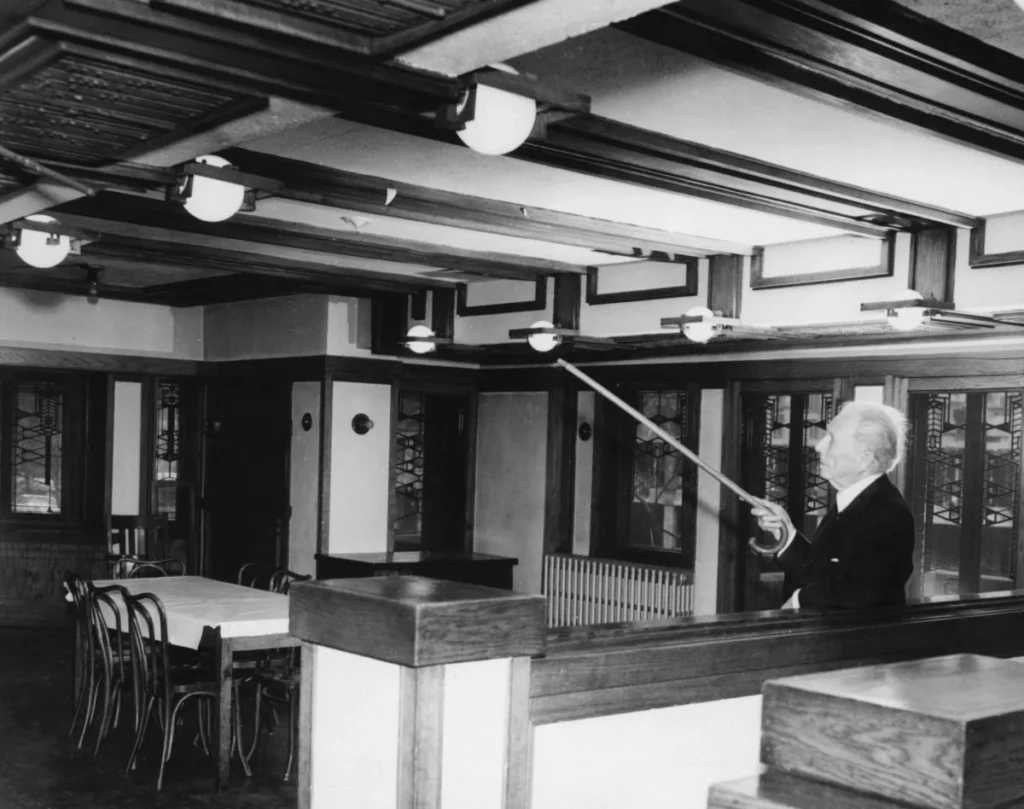

Chicago served as the essential forge that tempered Frank Lloyd Wright’s innate and formidable talent, according to Celeste Adams, CEO of the Frank Lloyd Wright Trust. The architect’s Chicago buildings were more than just a reflection of the city’s burgeoning industrial and cultural identity; they actively shaped it, establishing a new era in American architecture that continues to define global built environments today. Currently, the Chicago metropolitan area boasts the highest concentration of existing Wright-designed structures in the world, serving as a living museum of the architect’s evolution from a young apprentice to a master of modern design.
The decision for Wright to establish his roots in Chicago was born of necessity and opportunity. Though a native of rural Wisconsin, Wright recognized that his architectural ambitions required the scale and dynamism of a major urban center. Professor Brian Kelly of the University of Maryland School of Architecture, Planning, and Preservation notes that Wright’s arrival in Chicago in 1887 was no coincidence. Following the Great Fire of 1871, Chicago had become a laboratory of seemingly endless innovation. The city was a blank slate for architects, attracting the brightest minds in the world who sought to redefine the skyscraper and the American home.
The Evolution of the Prairie School in the Chicago Landscape
Wright’s tenure in Chicago began under the tutelage of Louis Sullivan at the firm of Adler & Sullivan. Sullivan’s mantra, "form follows function," became a foundational principle for Wright, though he would eventually expand this into his own philosophy of "organic architecture." This philosophy suggested that a building should grow naturally from its environment, harmonizing the needs of the inhabitants with the characteristics of the landscape.
.jpg)
Between 1889 and 1910, Wright developed what is now known as the Prairie School of architecture. This style was characterized by horizontal lines, flat or hipped roofs with broad overhanging eaves, windows grouped in horizontal bands, and an integration with the landscape. These features were intended to evoke the wide, flat expanse of the Midwestern prairie. The movement represented a radical departure from the vertical, European-inspired Victorian styles that dominated the era, offering a uniquely American architectural language.
Chronology of Frank Lloyd Wright’s Chicago Career
The timeline of Wright’s work in Chicago tracks the development of modernism itself. His career in the city can be divided into several critical phases that highlight his growing confidence and stylistic experimentation.
- 1887–1893: The Formative Years. Wright arrived in Chicago and began working for Adler & Sullivan. During this period, he designed "bootleg" houses on the side—private commissions that eventually led to his dismissal from the firm but established his independent reputation.
- 1889: The Oak Park Laboratory. Wright built his own home and studio in Oak Park, which served as his primary workspace for 20 years. This site was a testing ground for his evolving theories on space, light, and material.
- 1893–1901: The Independent Practice. Following his departure from Sullivan, Wright opened his own office. He began refining the Prairie style with projects like the Winslow House in River Forest.
- 1901–1910: The Golden Age of Prairie Style. This decade saw the completion of Wright’s most iconic Chicago-area works, including the Ward W. Willits House, Unity Temple, and the Frederick C. Robie House.
- 1915 and Beyond: Transition and Legacy. Projects like the Emil Bach House (1915) showed a shift toward more compact, geometric forms, signaling the transition toward his later works in California and Arizona.
Essential Landmarks of the Chicago Area
To understand Wright’s impact, one must examine the specific buildings that anchored his career. Each structure represents a specific breakthrough in engineering or aesthetic theory.
The Frank Lloyd Wright Home and Studio (Oak Park)
This site is where Wright’s architectural identity was truly forged. Over two decades, he used the home to experiment with interior volume and decorative arts. The studio was the birthplace of the Prairie School, where Wright and his associates—including Marion Mahony Griffin and Walter Burley Griffin—produced designs that would change the course of history.
.jpg)
The Frederick C. Robie House (Hyde Park)
Completed in 1910, the Robie House is widely considered the quintessential Prairie School structure. With its dramatic 20-foot cantilevers and continuous bands of art glass windows, it pushed the boundaries of structural engineering. In 2019, it was designated a UNESCO World Heritage site, underscoring its global significance as a masterpiece of 20th-century architecture.
Unity Temple (Oak Park)
Designed for a Unitarian Universalist congregation and completed in 1908, Unity Temple is often cited as the first modern building in the world. Wright chose reinforced concrete as his primary material—a choice that was both economical and revolutionary. The building’s interior is a masterclass in the "compression and release" technique, where narrow, dark entryways open into soaring, light-filled worship spaces.
The Rookery Building (The Loop)
While Wright did not design the Rookery (it was the work of Burnham and Root), he was commissioned in 1905 to redesign the interior light court. He transformed the dark, industrial space into a luminous, white-and-gold masterpiece, replacing the ornate cast iron with white Carrara marble and gilded geometric patterns.
The Emil Bach House (Rogers Park)
A late-Prairie-style residence built in 1915, the Bach House is notable for its compact, vertical emphasis and its use of geometric forms. It represents a more private, defensive style of architecture compared to the sprawling horizontal lines of his earlier work, reflecting Wright’s changing personal and professional outlook during a turbulent period of his life.

Navigating the Legacy: Comprehensive Tour Options
For enthusiasts and scholars, the high concentration of Wright’s works in Chicago necessitates organized tours to navigate the logistics and historical context of each site. Several organizations provide specialized itineraries that cater to different levels of interest.
Wright Around Chicago: The Full-Day Experience
The Frank Lloyd Wright Trust operates the "Wright Around Chicago" bus tour, which is designed for the dedicated enthusiast. This day-long itinerary is the most comprehensive option available, covering the Rookery Building in downtown Chicago before heading to the Oak Park neighborhood. Participants visit both the Home and Studio and the Robie House. By grouping these sites into a single day, the tour allows visitors to witness the full arc of Wright’s career, from his early interior renovations to his late-period residential masterpieces.
Frank Lloyd Wright by Bus: The Half-Day Alternative
For those seeking a more condensed experience, the Chicago Architecture Center (CAC) offers a four-hour "Frank Lloyd Wright by Bus" tour. This program focuses heavily on the Oak Park area, including a guided interior tour of the Home and Studio and a walking tour of the surrounding Frank Lloyd Wright Historic District. The tour also includes a stop at Unity Temple. CAC guides are specifically trained and certified, providing a high level of historical accuracy and architectural insight.
Wright Around Oak Park: Pedestrian and Cycling Tours
Most of Wright’s designs in the region remain private residences. To view these within their original neighborhood context, the Frank Lloyd Wright Trust offers walking tours departing from the Home and Studio. These tours navigate the Frank Lloyd Wright/Prairie School of Architecture Historic District, which contains the world’s largest collection of Wright-designed buildings. For a more active experience, the "Pedal Oak Park" cycling tour provides a seasonal alternative, while self-guided audio tours are available for those who prefer to explore at their own pace.

The Wright Plus Architectural Housewalk
Perhaps the most exclusive opportunity for fans is the annual Wright Plus Architectural Housewalk. Held on the third Saturday in May, this one-day event opens the doors of private residences that are typically closed to the public. The event features homes designed by Wright as well as those by his contemporaries, offering a rare glimpse into the lived experience of Prairie School architecture.
Supporting Data and Economic Impact
The preservation and promotion of Wright’s work are not merely matters of historical interest; they are significant drivers of the Chicago economy. According to data from the Frank Lloyd Wright Trust, thousands of international visitors travel to Chicago specifically to view these architectural landmarks each year.
The 2019 UNESCO World Heritage designation of eight Wright sites—two of which are in the Chicago area (Unity Temple and Robie House)—has further solidified Chicago’s status as a global architectural capital. This designation is shared with only a handful of other modern architectural sites, placing Wright’s work on the same level of cultural importance as the Pyramids of Giza or the Great Wall of China.
Broader Impact and Implications for Modern Design
The implications of Wright’s Chicago years extend far beyond the aesthetic beauty of his buildings. He fundamentally changed how Americans live. By championing the "open floor plan," Wright broke down the walls that traditionally separated the kitchen, dining, and living areas, creating the communal living spaces that are standard in modern residential design.

Furthermore, Wright’s focus on sustainable, local materials and the integration of indoor and outdoor spaces prefigured the contemporary green building movement. His work in Chicago demonstrated that architecture could be both functional and spiritual, a tool for improving the quality of human life through thoughtful design.
As Chicago continues to evolve, the preservation of Wright’s buildings remains a priority for the city’s planning commissions. These structures serve as a reminder of a period when Chicago was the epicenter of global architectural innovation. For the modern visitor, walking through a Wright-designed home in Oak Park or standing in the light court of the Rookery is not just a history lesson; it is an encounter with the origins of the modern world.