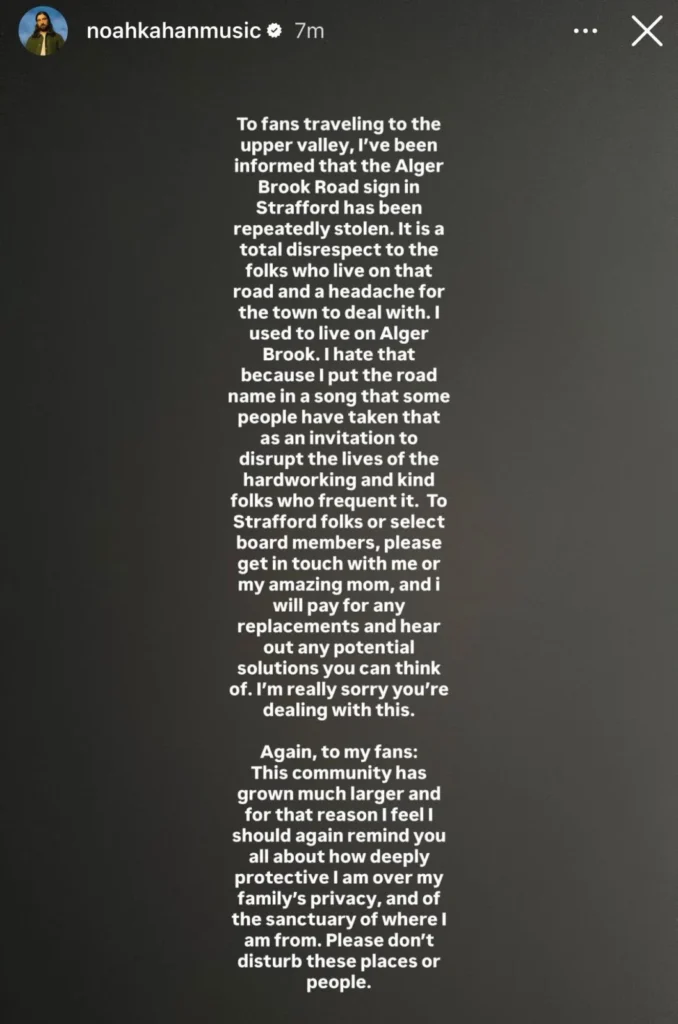

Noah Kahan, the acclaimed singer-songwriter whose music is deeply rooted in the landscapes and narratives of his home state, has issued a public appeal to his fanbase, urging them to cease the repeated theft of a road sign prominently featured in one of his most beloved songs. The artist took to social media on Friday, specifically his Instagram story, to address what he described as a persistent problem impacting the small Vermont community that inspired his work. The sign in question marks Alger Brook Road, located in the upper valley town of Strafford, Vermont, a place Kahan immortalized in the lyrics of "The View Between Villages," the poignant final track from his critically acclaimed 2022 album, Stick Season.
The Genesis of a Local Legend and Its Unintended Consequences
Noah Kahan has rapidly ascended to global prominence, captivating audiences with his unique blend of folk-pop, often dubbed "Vermont-core." His music is characterized by its raw honesty, introspective lyrics, and evocative storytelling, frequently drawing on themes of rural life, mental health, and the complex relationship with one’s hometown. Stick Season, in particular, resonated profoundly with listeners worldwide, transforming Kahan from a regional talent into an international sensation. The album’s success is deeply intertwined with its authentic portrayal of Vermont, with specific towns, roads, and experiences woven into its narrative fabric.
"The View Between Villages" stands as a powerful testament to Kahan’s connection to his roots. The song explores the bittersweet feelings of returning home, a place simultaneously familiar and distant. Within its verses, the line "Past Alger Brook Road, I’m over the bridge/ A minute from home, but I feel so far from it" serves as a specific geographical anchor, grounding the emotional journey in a tangible, recognizable location. For Kahan, Alger Brook Road is more than just a name; it’s a personal landmark, a place he once called home, contributing to the song’s profound authenticity. This deep personal connection, shared through his art, has unfortunately led to an unforeseen consequence: the repeated theft of the Alger Brook Road sign by overly enthusiastic, albeit misguided, fans.
Kahan’s social media post conveyed a clear message of dismay and frustration. He explicitly labeled the thievery as "a total disrespect to the folks who live on that road and a headache for the town to deal with." He elaborated on his personal connection, stating that he used to live on the road, which inspired its inclusion in the song. "I hate that because I put the road name in a song that some people have taken that as an invitation to disrupt the lives of the hardworking and kind folks who frequent it," Kahan wrote, underscoring the negative impact on the local community.
The Cost of Admiration: Financial and Social Implications
The repeated theft of public property, particularly road signs, carries significant financial and logistical burdens for municipalities, especially smaller towns like Strafford. While the exact frequency of the thefts of the Alger Brook Road sign was not specified, Kahan’s plea suggests it has been a recurring issue.
According to data from various state transportation departments across the United States, the average cost for replacing a standard road sign, including materials, manufacturing, and installation, can range from $150 to $500. More complex or custom signs can incur even higher costs. For a small, rural town such as Strafford, with a population typically hovering around 1,000 residents, these recurring expenses are not negligible. They represent a direct drain on limited public funds that could otherwise be allocated to critical services such as road maintenance, school programs, public safety initiatives, or emergency services. Each stolen sign necessitates administrative time for reporting, procurement, and scheduling, diverting municipal workers from other essential duties.
Beyond the financial implications, the absence of road signs poses tangible safety hazards. Rural roads, like many in Vermont’s upper valley, often lack streetlights and can be winding or unfamiliar to non-locals. Clear, visible signage is crucial for safe navigation, particularly at night, during adverse weather conditions, or for emergency responders unfamiliar with the area. A missing Alger Brook Road sign could lead to confusion, incorrect turns, or even accidents, potentially delaying critical services or endangering drivers and pedestrians.
Furthermore, the repeated incidents foster a sense of unease and invasion among local residents. What began as a celebration of local identity through music has morphed into an intrusion on daily life. Residents of Alger Brook Road, who value the peace and quiet of their rural community, are understandably frustrated by the constant disruption and the feeling that their privacy is being compromised by visitors driven by an urge to claim a piece of the artist’s narrative. This erosion of community trust and the disruption of local tranquility are intangible but deeply felt costs.
Broader Context: The Phenomenon of Fandom and Place
The phenomenon of fans interacting with locations mentioned in popular culture is not new. From tourists flocking to London’s Abbey Road to visitors leaving tributes at Graceland or exploring literary landmarks, the desire to connect physically with the sources of artistic inspiration is a powerful aspect of fandom. However, these interactions often exist on a spectrum, from respectful pilgrimages to disruptive acts.
Noah Kahan’s situation highlights a particular nuance in this phenomenon. His music is intensely personal and regional, celebrating the specificities of Vermont. This deep connection resonates with fans who feel a similar attachment to place or are drawn to the authenticity of his storytelling. The desire to "touch" the world he sings about is a testament to the evocative power of his art. Yet, the distinction between appreciative engagement and damaging interference becomes critical. While fans may view taking a sign as a harmless souvenir or a unique homage, it constitutes vandalism and disrespect for the community that inspired the artist.
Kahan’s plea also reflects a growing challenge for artists who draw heavily from their personal lives and local environments. As their fame expands, so does the public’s access to and interest in these intimate sources of inspiration. For an artist like Kahan, who champions authenticity and a grounded connection to his home, navigating this boundary between shared art and private life is especially delicate.

An Artist’s Plea for Privacy and Respect
In his Instagram story, Kahan went beyond merely condemning the theft; he offered a proactive solution and made a broader appeal for privacy. He stated his willingness to "connect with town officials about ways to stop the theft and pay for the replacement" of the signs. In a quintessential Vermont gesture, he also mentioned that officials could reach him through his "amazing mom," reinforcing his deep ties to the community and his accessible, down-to-earth persona.
Crucially, Kahan used this opportunity to reinforce his boundaries regarding privacy, particularly concerning his family and hometown. "My community has grown much larger and for that reason I feel I should again remind you all about how deeply protective I am over my family’s privacy, and of the sanctuary of where I am from," he wrote. He concluded with a direct and unambiguous request: "Please don’t disturb these places or people."
This statement underscores the inherent tension that artists, especially those whose work is autobiographical or deeply rooted in a specific locale, face as their popularity surges. What starts as a shared vulnerability in their art can quickly lead to an unwanted spotlight on their private lives and the lives of those around them. Kahan’s appeal is a call for respectful engagement, asking fans to appreciate the art without encroaching upon the reality of the people and places that inspire it. It serves as a reminder that while artists share their creativity, they also have a right to privacy and to protect their personal sanctuaries.
Official and Community Reactions: An Inferred Perspective
While no official statements from Strafford town authorities were immediately released following Kahan’s public appeal, it is reasonable to infer a sense of relief mixed with ongoing concern. Town officials, often grappling with limited budgets and staff, would likely welcome Kahan’s offer to cover replacement costs and collaborate on preventative measures. The repeated need to replace signs is not merely a financial drain but also a logistical headache, diverting public works personnel from other critical tasks. They would undoubtedly be focused on public safety and the efficient management of town resources. Kahan’s intervention could be seen as a significant step towards mitigating a persistent local problem.
For the residents of Alger Brook Road and the broader Strafford community, Kahan’s message likely resonated deeply. Their lives have been directly impacted by these incidents, experiencing increased traffic, potential disturbances, and the underlying feeling of their quiet lives being subjected to unwanted attention. Kahan, as one of their own, speaking out against these actions lends significant weight to their concerns and affirms their right to peace and privacy. It is plausible that many residents would appreciate his advocacy and his understanding of the local impact.
Within Kahan’s vast fanbase, the reaction to his message is expected to be largely supportive. The majority of fans are respectful and would likely view the sign theft as an unfortunate byproduct of intense admiration, not a sanctioned act. Kahan’s direct communication about the issue aims to educate and guide fan behavior, fostering a community that values respect and responsibility alongside enthusiasm. His authenticity and grounded nature are part of his appeal, and his stance on this issue further solidifies his connection with listeners who appreciate his genuine concern for his home.
The Path Forward: Balancing Fandom with Responsibility
Noah Kahan’s public plea represents a crucial moment in the ongoing dialogue between artists and their audiences. It highlights the collective responsibility required to maintain a respectful and sustainable relationship between art, inspiration, and real-world locations. Kahan’s proactive offer to assist town officials and fund replacements sets a precedent for artists to actively engage in mitigating the unintended negative consequences of their fame.
Possible solutions moving forward could include exploring anti-theft designs for future road signs, increasing local surveillance in the affected area, or implementing public awareness campaigns specifically targeting visitors to the region. Kahan’s involvement could amplify these efforts, leveraging his platform to educate fans about the real-world impact of their actions.
Kahan’s Ongoing Journey and Future Endeavors
Despite these local challenges, Noah Kahan’s professional trajectory continues to soar. He is currently in the midst of an extensive North American tour, with dates scheduled through August, captivating sold-out arenas and stadiums across the continent. His tour schedule includes major stops at iconic venues such as Rogers Stadium in Toronto, Fenway Park in Boston, Wrigley Field in Chicago, and Citi Field in Flushing, NY, culminating in shows at T-Mobile Park in Seattle. These performances underscore his monumental success and the vast reach of his music.
Furthermore, Kahan recently announced his ambitious 2027 Out of the Blue Festival, a multi-day event featuring a curated lineup of artists including Hayley Williams, Mt. Joy, and The Head and the Heart. This festival further solidifies his position as a significant force in the music industry, capable of not just performing but also curating major musical experiences.
Even as his career reaches new heights, Kahan’s deep connection to Vermont and his commitment to protecting its sanctity remain central to his identity. His plea regarding the Alger Brook Road sign serves as a powerful reminder that while his art may transcend geographical boundaries, its roots are firmly planted in the specific soil of his home, a place he passionately seeks to protect from the unintended pressures of his fame. The incident underscores the delicate balance between celebrating artistic inspiration and ensuring that admiration does not inadvertently harm the very communities that nurture it.