
In a scene that could easily have been lifted from an episode of his iconic comedy series, Larry David, the celebrated co-creator of Seinfeld and star of Curb Your Enthusiasm, found himself at the center of a humorous debate regarding concert etiquette, or rather, his distinct lack thereof. The incident unfolded during one of Paul McCartney’s exclusive, intimate club performances at The Fonda Theatre in Los Angeles, an event typically characterized by fervent fan participation and shared musical euphoria. David’s refusal to engage in the traditional sing-along for the legendary Beatles anthem “Hey Jude” became a point of public discussion, brought to light by late-night host Jimmy Kimmel on a recent episode of Jimmy Kimmel Live. This revelation offered a quintessential “Larry David moment,” reinforcing his established public persona as a connoisseur of social awkwardness and a relentless critic of conventional pleasantries, even in the presence of rock royalty.
A Night of Legends: The Fonda Theatre Engagements
Paul McCartney’s decision to perform a pair of intimate club shows at The Fonda Theatre in Los Angeles a few months prior to this revelation was a significant event in the city’s music calendar. The Fonda Theatre, an iconic venue located on Hollywood Boulevard, boasts a rich history dating back to 1926. Originally known as Carter DeHaven’s Music Box, it has undergone several transformations, eventually reopening as The Fonda in 2012, quickly re-establishing itself as a premier destination for live music. With a standing capacity of approximately 1,200, it offers a markedly different experience from the arena and stadium tours McCartney typically undertakes, providing fans with a rare opportunity for a close-up encounter with the musical legend.
These "secret" shows, often announced with little lead time, create an immediate buzz and become highly coveted tickets. For McCartney, performing in such a setting allows for a raw, unfiltered connection with the audience, reminiscent of his early days in Liverpool clubs. The setlists for these intimate gigs often blend universally beloved classics with deeper cuts, offering a comprehensive journey through his six-decade career, encompassing his work with The Beatles, Wings, and his extensive solo catalog. The atmosphere at such events is invariably electric, characterized by a palpable sense of shared history and collective admiration for one of music’s most enduring figures.
The guest list for these particular McCartney performances was, as expected, a veritable who’s who of Hollywood and the music industry. Attendees across the two nights reportedly included a constellation of stars such as pop sensation Taylor Swift, rising talents Sabrina Carpenter and Olivia Rodrigo, acclaimed actor Harrison Ford, talk show host Jimmy Kimmel, and notably, McCartney’s former bandmate and fellow Beatle, Ringo Starr. The presence of such an illustrious audience underscored the magnitude of the event, transforming the shows into significant cultural happenings that transcended mere musical performances. By all accounts from the majority of attendees, the atmosphere was one of unbridled joy, with the crowd enthusiastically singing, dancing, and celebrating McCartney’s unparalleled musical legacy. Yet, it was within this very tableau of collective elation that Larry David, in his own inimitable fashion, chose to chart a different course.
The Chronology of a Curmudgeon: From Concert Floor to Late-Night Couch
The seeds of this now-viral anecdote were sown during one of these aforementioned McCartney concerts at The Fonda. While the exact date of Larry David’s attendance remains undisclosed, it occurred "a few months back," placing it within the timeframe of McCartney’s limited engagement at the venue. During the performance, as McCartney launched into the iconic final verses of "Hey Jude," a moment traditionally characterized by its soaring "na, na, na" outro, the entire audience, swept up in the emotion and communal spirit of the song, joined in the legendary sing-along. This is a standard and almost ritualistic part of any McCartney concert, a moment of universal participation that transcends age, background, and even musical preference.
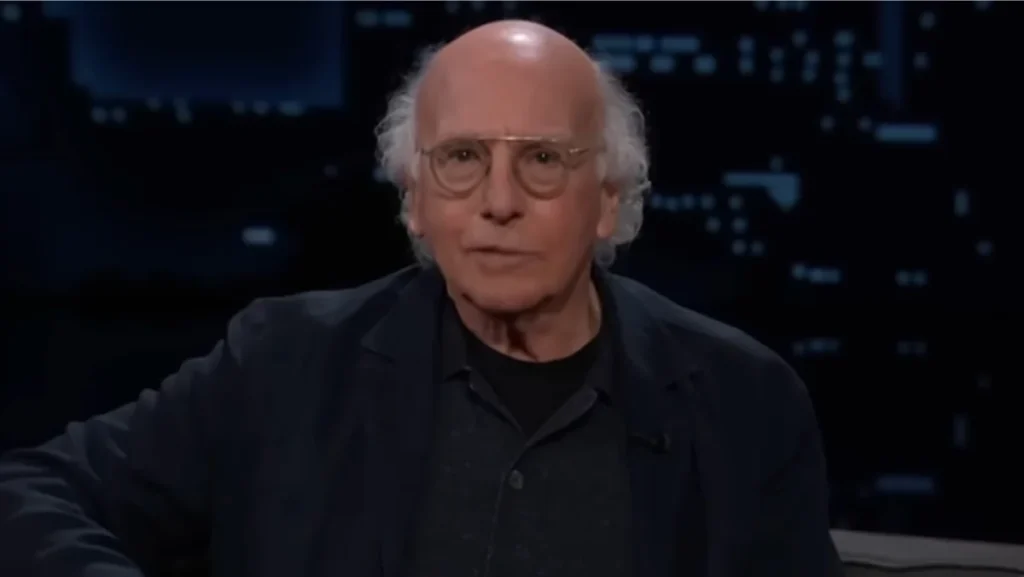
It was during this crescendo of collective enthusiasm that Jimmy Kimmel, also present at the concert, observed David. While others swayed, clapped, and belted out the famous refrain, David reportedly stood silent, seemingly immune to the infectious energy that permeated the venue. This observation remained a private anecdote for Kimmel until Thursday night’s episode of Jimmy Kimmel Live. The segment was particularly timely, as Larry David was a guest on the show, ostensibly to promote his upcoming HBO project, Life, Larry and the Pursuit of Unhappiness, which is set to premiere on June 26th. The interview provided the perfect platform for Kimmel to unveil his concert-going observation and directly confront David about his uncharacteristic (or perhaps, entirely characteristic) lack of participation.
Kimmel initiated the conversation with a theatrical build-up, asking David, "I witnessed something at a Paul McCartney concert. Two months ago, the whole audience was singing ‘Hey Jude’ along with Paul McCartney—with the notable exception of one person. And who do you guess that person was?" The reveal, predictably, was Larry David himself. What ensued was a classic exchange that perfectly encapsulated David’s comedic style and his unique worldview. David, far from being apologetic or embarrassed, defended his inaction with a logic that was both absurd and, to his fans, perfectly understandable. He articulated his disdain for what he perceived as the "lame" and conformist act of joining a mass sing-along, particularly the repetitive "na, na, na" section.
The Iconic "Hey Jude" and the Culture of Concert Sing-Alongs
To fully appreciate the comedic dissonance of David’s stance, one must consider the monumental cultural significance of "Hey Jude" and the pervasive culture of audience participation at live music events. "Hey Jude," released by The Beatles in 1968, stands as one of the band’s most enduring and universally recognized anthems. Written by Paul McCartney to comfort Julian Lennon during his parents’ divorce, the song evolved into a powerful message of hope and resilience. Its structure, particularly the extended four-minute outro featuring the repeated "na, na, na" refrain, was deliberately designed to invite and encourage collective singing. This segment, swelling with orchestral accompaniment and layered harmonies, transforms from a simple chant into a communal expression of joy and unity.
Historically, audience participation has been a cornerstone of live music, serving as a powerful bond between performer and listener. From call-and-response spirituals to stadium-rock anthems, the act of singing along, clapping, or swaying in unison fosters a shared experience that transcends individual enjoyment. For an artist of Paul McCartney’s stature, whose career spans over six decades and whose music has soundtracked generations, these sing-along moments are not merely tolerated; they are often actively solicited and cherished. They represent a reciprocal exchange of energy and affection, a testament to the enduring impact of his artistry. When McCartney leads thousands, or even hundreds in an intimate setting, through the final chorus of "Hey Jude," it is a moment of collective catharsis, a celebratory affirmation of musical legacy. To abstain from such a moment, particularly for a song so intrinsically linked to communal singing, is to make a distinct statement, whether intentional or not, against the very fabric of the live concert experience.
Larry David’s Enduring Persona: A Masterclass in Misanthropy
Larry David’s reaction, or rather, his lack of reaction, at the McCartney concert is not an isolated incident but a perfect manifestation of his carefully cultivated and beloved public persona. Since the late 1990s, David has become synonymous with the "curmudgeon" archetype, a character he refined and elevated to an art form through Curb Your Enthusiasm. In Curb, David plays a fictionalized version of himself, a semi-retired television writer living in Los Angeles, whose life is a constant, often hilarious, struggle against societal norms, unspoken rules, and the perceived idiocy of others. His comedy thrives on social transgression, awkward encounters, and an unwavering commitment to his own idiosyncratic principles, no matter how petty or inconvenient they may be for those around him.
Key elements of the "Larry David" persona include:
- Aversion to Faux Politeness: David consistently challenges social conventions he deems illogical or insincere, such as forced smiles, obligatory small talk, or unnecessary apologies.
- Obsessive Attention to Detail and Pet Peeves: He fixates on minor infractions and perceived injustices, often escalating them into major conflicts.
- Skepticism of Collective Emotion: David often views overt displays of collective joy or sentimentality with suspicion, finding them "lame" or inauthentic.
- The Pursuit of Comfort and Avoidance of Effort: His character frequently seeks the path of least resistance or greatest personal comfort, even if it means inconveniencing others or appearing rude.
- A Self-Deprecating Yet Defiant Honesty: Despite his often-unlikable actions, there’s an underlying honesty and consistency to his character that resonates with audiences who secretly harbor similar frustrations.
His refusal to "na, na, na" at a Paul McCartney concert is therefore not merely a personal preference but a direct extension of this comedic brand. It’s an act of defiance against the expectation of collective joy, a statement that he will not be swayed by mass sentiment, even when it involves one of the most revered musicians in history. This incident serves as a real-life improv scene from Curb Your Enthusiasm, where the protagonist’s stubborn adherence to his own code creates comedic friction with the established social order. For his fans, it’s not surprising; it’s precisely what they expect and love about Larry David.
The Dialogue Unpacked: Kimmel vs. David on Concert Etiquette
The exchange between Jimmy Kimmel and Larry David on Jimmy Kimmel Live provided a fascinating micro-study of contrasting philosophies on public conduct. Kimmel, representing the conventional concertgoer, expressed a viewpoint rooted in appreciation, reciprocity, and a sense of shared community. His argument was simple: "I just feel like if Paul McCartney is going to stand there and ‘na, na, na’… It seemed like he wanted us to ‘na, na, na.’… He wants this from us. We’ve given him nothing. He’s given us so much. Why wouldn’t you do a little ‘na, na, na’?" This perspective highlights the unwritten social contract of a live performance, where the audience contributes to the atmosphere as a form of gratitude and engagement.
David, however, dismantled this argument with characteristic bluntness and a logic that, while absurd, was consistent with his persona. He dismissed the act as "so lame," questioning the authenticity and coolness of such participation. His counter-arguments were sharp: "He wrote the song. He’s allowed, that’s in the song: ‘na, na, na.’" This implied that McCartney’s role as creator grants him unique permission, a permission not extended to the audience. When Kimmel suggested McCartney wanted the audience to participate, David retorted, "He did, but you don’t have to listen to him." This statement perfectly encapsulates David’s contrarian spirit, challenging the very notion of an unspoken obligation.
The dialogue further escalated into a humorous tangent about the cost of tickets. When Kimmel pressed David about what he had given McCartney, David vaguely claimed, "I’ve given him a little something." Kimmel, ever the instigator, immediately called out, "What did you give him? You didn’t even pay for those tickets, did you? You got those for free." David’s quick, deadpan response, "You think I would pay for that?" delivered with a dismissive air, not only confirmed his free attendance but further cemented his image as someone perpetually seeking to avoid unnecessary expenditures or efforts, even for a legendary artist. This entire exchange was a masterclass in comedic timing and character consistency, proving that David’s on-screen persona is remarkably close to his off-screen reality.
Reactions and Interpretations: A Spectrum of Amusement
The public reaction to the revelation of Larry David’s concert "curmudgeonliness" has largely been one of amusement and recognition. For fans of Curb Your Enthusiasm, the incident was met with knowing nods and laughter, instantly identifiable as a quintessential "Larry David" moment. It’s the kind of social faux pas and defiance of expectation that forms the very bedrock of his comedy. Many found it perfectly fitting that the man who built a career on satirizing social conventions would remain steadfastly aloof even at a McCartney concert.
From Paul McCartney’s perspective, while he has not issued a direct statement, it is highly improbable that David’s non-participation would have registered as anything more than a fleeting anomaly in a sea of adoring fans. McCartney is renowned for his genial stage presence and his genuine delight in audience engagement. His encouragement of sing-alongs is a testament to his desire for a shared, joyful experience. It is reasonable to infer that his implicit stance would be one of benign amusement, perhaps even a quiet appreciation for David’s unique brand of comedic integrity, even if it meant abstaining from a collective "na, na, na."
Jimmy Kimmel’s reaction, as evident in the interview, was a blend of genuine bewilderment and comedic opportunity. As a long-time admirer of McCartney and a seasoned talk show host, Kimmel understood the cultural significance of the moment and the inherent humor in David’s contrarianism. His role was to highlight the absurdity and challenge David’s logic, thereby amplifying the comedic effect for the audience.
For the general concert-going public, the incident sparked discussions about concert etiquette, the nature of fandom, and the unspoken rules of collective experiences. While some might view David’s actions as rude or disrespectful, most understand it within the context of his established comedic identity. It serves as a reminder that not everyone adheres to the same social scripts, and sometimes, that deviation can be profoundly entertaining.
Broader Implications: Branding, Comedy, and the Unwritten Rules of Fandom
The "Larry David at the Paul McCartney concert" incident, while seemingly trivial, carries several broader implications for celebrity branding, the nature of comedy, and the evolving dynamics between artists and their audiences.
Firstly, for Larry David, this event served as an unintentional yet highly effective piece of viral marketing for his upcoming HBO show, Life, Larry and the Pursuit of Unhappiness. The timing of the revelation, coinciding with his promotional tour, created an organic buzz that perfectly aligned with his brand. It demonstrated that the "Larry David" character is not merely a performance but an intrinsic part of his public persona, blurring the lines between fiction and reality in a way that only enhances his comedic appeal. It reinforces the idea that what you see on Curb Your Enthusiasm is often what you get in real life, making his comedy feel more authentic and relatable to those who share his frustrations with modern society.
Secondly, the incident speaks to the power of humor derived from social transgression. David’s comedy often dissects the unspoken rules that govern our daily interactions. By refusing to participate in a universally accepted and expected act of collective joy, he highlights the arbitrary nature of some social norms and the discomfort that arises when they are challenged. His actions, while seemingly anti-social, ultimately serve a comedic purpose, inviting audiences to reflect on their own compliance with social rituals and to find humor in the person who dares to opt out. It’s a subtle form of social commentary, wrapped in a blanket of awkwardness.
Finally, the discussion around concert etiquette and the reciprocal relationship between performer and audience is brought to the forefront. While most concertgoers embrace the opportunity to participate, David’s stance prompts a consideration of individual autonomy within a collective experience. Is participation truly obligatory, or is quiet appreciation equally valid? While McCartney’s performances thrive on audience engagement, David’s incident serves as a humorous outlier, a reminder that even in moments of universal celebration, individual quirks and preferences persist. It subtly challenges the notion of a monolithic audience, emphasizing the individual’s right to experience art in their own way, even if that way involves a healthy dose of curmudgeonly detachment.
Conclusion: A Perfectly Larry David Moment
In an era saturated with curated celebrity appearances and carefully managed public images, Larry David’s unadorned refusal to conform at a Paul McCartney concert stands out as a refreshing, albeit amusing, act of defiance. It was a moment that perfectly encapsulated his comedic genius and unwavering commitment to his persona. Far from being a mere spectator, David inadvertently became a central character in a real-life comedic sketch, providing further proof that the boundaries between his fictional world and reality are delightfully porous. As he continues to promote his latest project, this perfectly "Larry David" moment will undoubtedly become another cherished anecdote in the annals of his uniquely awkward and endlessly entertaining career.