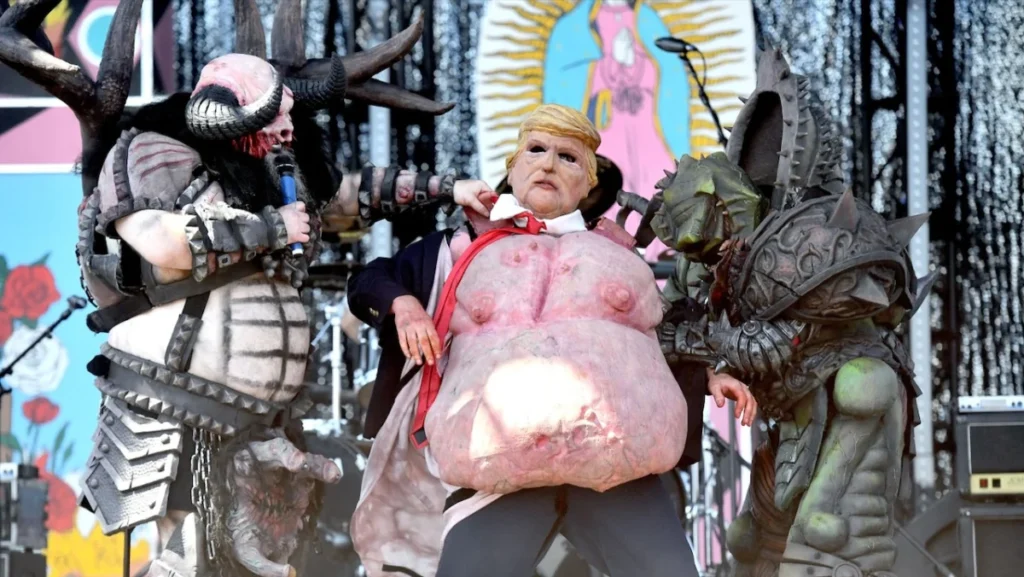

The veteran shock rock band GWAR, renowned for its four-decade history of theatrical stage performances featuring the mock execution of public figures, has asserted that their first encounter with the United States Secret Service occurred only after their satirical portrayal of former President Donald Trump. This claim, made by GWAR frontman Mike "Blöthar The Berserker" Bishop in a recent interview with Rocking With Jam Man, highlights a perceived shift in the tolerance for political satire and artistic expression in recent years, particularly concerning figures on one side of the political spectrum.
GWAR’s Enduring Legacy of Anarchy and Artistry
For over forty years, GWAR has cultivated a unique and indelible niche in the heavy metal landscape, distinguishing themselves through their elaborate sci-fi/horror costumes, grotesque stage props, and a performance style that is as much performance art as it is a rock concert. Hailing from Richmond, Virginia, the band, whose members adopt the personas of monstrous, intergalactic warriors known as the "Scumdogs of the Universe," has consistently used their platform to satirize politics, consumerism, religion, and pop culture. Their live shows are infamous for their gratuitous use of fake blood and bodily fluids, often culminating in the highly theatrical dismemberment or execution of effigies representing various political leaders, celebrities, and cultural icons.
This tradition of political parody is a cornerstone of the GWAR identity. From their early days in the mid-1980s, figures like Ronald Reagan, George H.W. Bush, Bill Clinton, and George W. Bush have all been subjected to GWAR’s macabre stagecraft. Later, President Barack Obama also fell victim to their fictitious blades, with Bishop explicitly stating, "We [fictitiously] killed President Obama. We didn’t hear from the Secret Service." This consistent, bipartisan approach to lampooning power figures has historically been understood by their audience and, seemingly, by authorities, as a form of protected artistic expression, albeit one that is undeniably provocative and extreme. The band’s narrative centers on their alien overlords seeking revenge on humanity, and political figures often serve as symbolic representations of societal ills or specific policies they wish to critique. Their art, while visually shocking, has largely been interpreted within the context of hyper-stylized satire, not as genuine calls for violence. Their albums, such as "Scumdogs of the Universe" (1990) and "America Must Be Destroyed" (1992), have consistently embedded this satirical agenda within a heavy metal framework, establishing a long-standing precedent for their confrontational yet ultimately fictional artistic approach.
The Secret Service Mandate and the Line of Threat Assessment
To understand the significance of GWAR’s recent Secret Service encounter, it is crucial to examine the role and responsibilities of the United States Secret Service. Established in 1865 to combat currency counterfeiting, the agency’s protective mission expanded significantly after the assassination of President William McKinley in 1901 to include the protection of the President, Vice President, their families, former Presidents, and major presidential candidates, among others. A critical component of this protective mandate is the investigation of threats against these protected individuals.
Federal law, specifically 118 U.S. Code § 871, makes it a felony to knowingly and willfully mail or otherwise make "any threat to take the life of, to kidnap, or to inflict bodily harm upon the President of the United States." The Secret Service maintains a vigilant watch over public discourse, social media, and any communication that could be construed as a threat. When assessing a potential threat, agents consider various factors, including the context of the statement, the intent of the speaker, the likelihood of the threat being carried out, and the speaker’s history. Importantly, the Secret Service operates on the principle of erring on the side of caution; any communication that could be interpreted as a threat is typically investigated, regardless of whether it originates from an artist, a comedian, or a political activist. While the agency rarely comments on specific investigations, their standard procedure involves interviewing individuals to assess intent and to ensure they understand the legal ramifications of making direct or indirect threats against protected persons. The line between protected speech under the First Amendment and an actionable threat is often a delicate one, determined by legal precedent and contextual interpretation. Historically, satire and artistic expression, even when depicting violent acts against public figures, have generally been safeguarded under free speech, provided there is no genuine intent or capacity to carry out such acts. GWAR’s long history without Secret Service intervention would suggest their performances have consistently been evaluated within this framework, indicating that their theatrical "executions" were not perceived as credible threats until recently.
A Shifting Political Landscape and Amplified Backlash
Bishop’s assertion that "until Donald Trump got in office, that’s when people started getting extremely upset about politics and music and politics in art" points to a broader cultural phenomenon. The Trump presidency, characterized by intense political polarization, the proliferation of "fake news" accusations, and a highly combative media environment, arguably created a climate where artistic expression, particularly satire directed at the President, was met with unprecedented scrutiny and outrage. This period saw a significant increase in online vigilantism and calls for boycotts against artists and brands perceived as disrespectful or politically aligned against the administration.
GWAR’s past provocations, though sometimes met with minor public outcry, never escalated to the level of drawing federal law enforcement attention. Bishop recalled specific instances: "I mean, granted, when we killed Princess Diana, people got a little upset. When we pulled a fish out of Laci Peterson’s pussy, people got a little upset." These examples, while disturbing to some segments of the public, were widely understood as grotesque performance art, not incitement. The shift, according to Bishop, was not in GWAR’s content but in the audience’s reception and the broader political mood. "People acted as if GWAR had changed, but GWAR didn’t change. The world fricking changed. The way people felt about politics changed. The way people felt about comedy and humor changed," he elaborated.
This sentiment resonates with observations made by many artists and commentators across various media during the Trump administration. Satire, once a more broadly accepted tool for political critique, increasingly became a flashpoint for intense partisan division. What one group viewed as humorous commentary, another saw as deeply offensive or even treasonous. Social media platforms played a significant role in this amplification, allowing for rapid dissemination of controversial content and the swift mobilization of backlash campaigns, often targeting artists, venues, and sponsors. The highly charged political atmosphere meant that nuanced artistic intent was often lost in the immediate, often emotional, reaction fueled by partisan loyalty.
The Warped Tour Incident and the "Trump Fan" Backlash
The specific incident that may have triggered the Secret Service’s interest, or at least exemplifies the new wave of controversy, occurred recently at the Washington, D.C., stop of Warped Tour. GWAR, true to form, "disemboweled an effigy of President Trump." A tweet from user @CassandraRules, dated June 19, 2026, shows footage of the performance and notes the "meltdown" in the comments from those who "don’t understand what Gwar does (they are monster alien warriors, scumdogs of the universe)." The tweet correctly points out that GWAR’s practice extends to "every president (foreign and domestic, also the queen) and celebrity." This incident is consistent with GWAR’s four-decade-long history of targeting whoever holds power, making the subsequent Secret Service attention a notable deviation from past patterns. The timing of the visit from the Secret Service relative to such performances suggests a heightened sensitivity to depictions of harm against the President during this particular political climate.
Bishop specifically singled out "Trump fans" as the primary source of the intensified negative reaction, distinguishing them from other groups often associated with "cancel culture" or "wokeness." He noted, "It’s not like feminists or the politically correct squad, they didn’t really come after GWAR. Who came after GWAR was fucking Trump fans. That’s who came after GWAR." This observation challenges a common narrative that attributes artistic censorship primarily to progressive "identity politics" on college campuses or social justice advocates. GWAR’s experience suggests that conservative segments of the population, particularly those aligned with the "Make America Great Again" movement, can be equally, if not more, vociferous in their condemnation of art they deem disrespectful to their chosen political figures. This highlights the bipartisan nature of outrage and the selective application of "free speech" principles depending on whose ox is being gored, indicating a broader cultural shift where political loyalty often trumps traditional comedic or artistic conventions.
Allegations of Financial Pressure and "Soft Censorship"
Beyond direct interaction with the Secret Service, Bishop also raised concerns about financial pressure and its implications for artistic freedom. He stated, "What they have to do is make it hard for you to make money. And that’s what they try to do. And especially a company like Live Nation, which is a big concert company that does shows and stuff like that, they are susceptible to pressure from the government." Bishop explicitly labeled this as "fucking censorship, no matter what you call it," and claimed, "GWAR faces it all the time. It’s a real fucking thing."
This allegation of "soft censorship" through economic leverage is a significant one. Live Nation Entertainment is a global leader in live entertainment, controlling a vast network of venues, ticketing operations (Ticketmaster), and artist management. Its dominant position in the industry means that pressure applied to Live Nation, whether from government entities, powerful political groups, or large-scale public boycotts, can have a profound impact on an artist’s ability to tour, secure venues, and ultimately earn a living. While Live Nation, as a publicly traded corporation, must navigate various stakeholder interests and public relations challenges, the suggestion of government "leaning" on such a company due to an artist’s political satire raises serious questions about the indirect suppression of speech. This form of pressure, unlike direct government prohibition, operates through economic mechanisms, potentially leading companies to self-censor or distance themselves from controversial acts to protect their business interests. It is a subtle but potent threat to artistic independence, where the marketplace of ideas can be influenced not by consumer preference alone, but by external political forces. While Live Nation has not publicly commented on specific instances of alleged government pressure concerning GWAR, major corporations are inherently sensitive to maintaining good relationships with government bodies and avoiding controversies that could impact their licenses, permits, or regulatory standing, thereby creating an environment where self-censorship becomes a pragmatic business decision.
Broader Implications for Artistic Freedom and Political Discourse
GWAR’s experience serves as a stark illustration of the evolving challenges faced by artists who engage in political satire in an increasingly polarized society. The band’s consistent methodology of theatrical exaggeration, which for decades was largely understood as distinct from genuine threat, now appears to be crossing a threshold of tolerance for some, particularly when directed at specific political figures. This raises crucial questions about the boundaries of artistic freedom, the interpretation of intent in provocative art, and the role of law enforcement in a democratic society that champions free speech.
The incident underscores the growing difficulty in discerning between symbolic protest and genuine incitement, particularly in an age where online rhetoric often blurs these lines. For artists, the threat of Secret Service investigation, coupled with potential financial repercussions from powerful industry players, creates a chilling effect that could lead to self-censorship. If artists fear professional or legal consequences for engaging in satire, the public discourse loses a vital avenue for critique, dissent, and humor – elements essential for a healthy democracy. The potential for such actions to be perceived as punitive measures against political expression, regardless of actual intent, could erode public trust in institutions meant to protect both public safety and civil liberties.
Furthermore, Bishop’s observation about the source of the backlash – "Trump fans" rather than traditional "politically correct" groups – highlights a broader trend: the weaponization of outrage across the political spectrum. Both conservative and progressive factions can, and do, mobilize to condemn and attempt to silence speech they deem unacceptable, often invoking principles like "respect" or "safety" selectively. This complicates the traditional narrative of artistic censorship and suggests a more complex, multi-faceted threat to free expression, where any group with sufficient online presence or political influence can become a force of censorship.
Despite these challenges, GWAR shows no signs of relenting. Their continued disembowelment of a Trump effigy at the recent Warped Tour stop in Washington, D.C., reaffirms their commitment to their artistic mission, regardless of the heat it generates. This defiance is not merely an act of stubbornness but a powerful statement on the band’s belief in the unyielding right to satirical expression, even when it targets the most powerful figures and elicits scrutiny from federal agencies. In an era where political divides run deep, GWAR remains a bizarre, bloody, and undeniably relevant barometer of cultural tolerance for provocative art, continuing to push boundaries and provoke thought through their unique brand of performance.