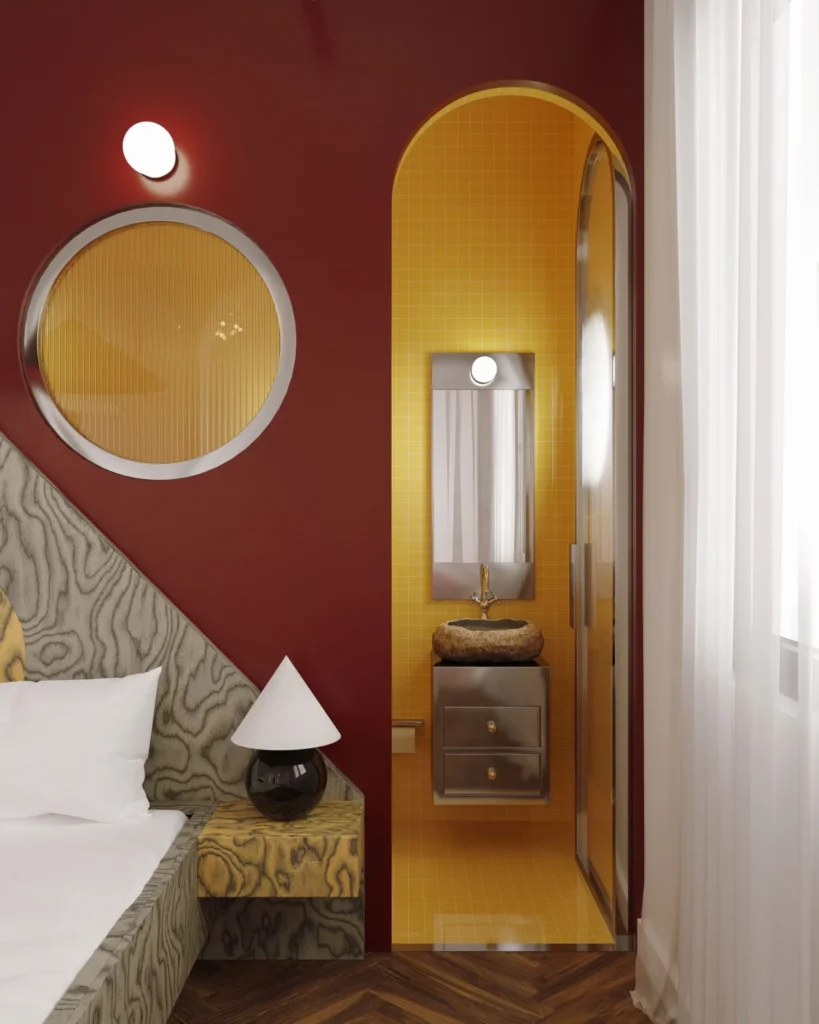

In the dense urban fabric of the City of Light, the repurposing of former industrial and production spaces has become a hallmark of sophisticated urban living. The recent conversion of a 462-square-foot studio in Paris, led by Istanbul-based interior architect Ömer Öztürk, serves as a premier example of how utilitarian history can be seamlessly integrated with postmodern aesthetics. Originally functioning as a ceramics studio, the space was characterized by a raw, functionalist atmosphere that lacked the traditional divisions of a residential home. Rather than opting for a total erasure of this industrial heritage, Öztürk’s design philosophy centered on a reinterpretation of the artisanal past, creating a contemporary living environment that prioritizes fluid transitions and bold, expressive materiality.
The renovation of this compact footprint represents a broader trend in European metropolitan centers, where the scarcity of square footage drives innovation in interior architecture. In Paris, where real estate prices frequently exceed €10,000 per square meter in central arrondissements, the efficient use of space is not merely an aesthetic choice but a financial and social necessity. By stripping the former studio back to its essential volumes, the project sought to "push the boundaries of small-scale living," moving away from the claustrophobic constraints of traditional Parisian apartments toward a more breathable, open-concept model.

The Architectural Vision: Fluidity and Light
The primary challenge of the renovation was the management of a limited footprint that was originally "defined by its raw, utilitarian character." To address this, Öztürk moved away from the use of rigid, permanent partitions that would have truncated the natural light and airflow. Instead, the architect implemented a versatile curtain system. This soft architecture allows the bedroom to remain an integrated part of the larger living area during the day, while providing privacy and acoustic dampening when needed.
This strategy of "fluid visual transitions" is essential in micro-apartments, where the eye needs long sightlines to perceive a sense of spaciousness. By replacing walls with gauzy, translucent barriers, the studio benefits from the light provided by the original industrial-sized windows, ensuring that even the deepest corners of the apartment are illuminated. The bedroom itself is framed by bold, white archways, which act as a structural motif that softens the transitions between the various functional zones of the home.
A Masterclass in Postmodern Color Theory
One of the most striking elements of the project is its departure from the minimalist, neutral palettes that often dominate contemporary renovations. Öztürk expressed a specific interest in pairing colors that initially seem dissonant, relying on instinct to create a vibrant, high-energy environment. The living room serves as the centerpiece of this chromatic exploration, featuring a red velvet sofa that sits in deliberate contrast to a bright blue USM Haller modular storage unit.

These primary colors are grounded by the warmth of walnut hardwood floors, creating a balanced but undeniably bold aesthetic. The kitchen continues this theme of "unexpected combinations," where stainless-steel fixtures provide a sleek, industrial nod to the space’s history, tempered by pops of blue and orange. In the bathroom, the architect chose glossy yellow tiles, a choice that is echoed through a circular window connecting the bathroom to the bedroom. This "spatial gesture" ensures that the design language remains consistent throughout the apartment, with colors and shapes resonating from one room to the next.
Bespoke Solutions for Irregular Geometry
Small-scale living often requires custom furniture to navigate the idiosyncrasies of older buildings. In this Paris studio, the bedroom area was situated at an awkward angle that precluded the use of standard, off-the-shelf furniture. To resolve this, Öztürk’s studio designed a custom bed made with Alpi wood veneer and supported by industrial metal legs. This bespoke piece was not merely a functional necessity but a sculptural endeavor in its own right.
The bed’s design features a deep burgundy wall as its backdrop, accented by touches of green leather on a matching desk and a Cassina stool. By treating furniture as an extension of the architecture, the design team was able to maximize every square inch of the 462-square-foot layout. This approach is increasingly common in high-end Parisian renovations, where the "custom-built" model allows residents to bypass the limitations of historic floor plans.

Chronology of the Transformation
The lifecycle of an industrial-to-residential conversion in Paris typically follows a rigorous timeline, often dictated by both architectural ambition and local heritage regulations.
- Acquisition and Assessment: The initial phase involved identifying the former ceramics studio as a viable residential site. In Paris, industrial spaces (ateliers) are highly coveted but require a change-of-use permit from the local prefecture.
- Structural Stripping: The space was cleared of its former ceramic production equipment and raw industrial remnants, exposing the original "raw character" that Öztürk sought to preserve.
- Design and Prototyping: Given the awkward angles of the floor plan, the design phase included detailed 3D modeling to ensure the custom furniture, such as the Alpi wood bed, would fit the proportions exactly.
- Material Sourcing: The selection of materials was a global effort, incorporating Swiss-made USM modules, Italian Cassina furniture, Flos lighting, and Otto tiles for the flooring.
- Installation and Finishing: The final phase focused on the "gauzy transitions," installing the curtain systems and the circular window that connects the bathroom and bedroom, completing the visual continuity of the space.
Supporting Data: The Rise of the Parisian Atelier
The renovation of the ceramics studio reflects significant data points in the Parisian housing market. According to recent reports from the Chamber of Notaries of Paris, the demand for "exceptional properties"—which includes former workshops and industrial lofts—has remained resilient despite fluctuations in the broader market.
- Average Size: The 462-square-foot (approx. 43 square meters) size of the studio is slightly above the average for a one-bedroom apartment in central Paris, which typically ranges between 30 and 40 square meters.
- Market Value: Renovated ateliers can command a premium of 15% to 20% over standard residential apartments due to their high ceilings and unique architectural features.
- Micro-Living Trends: Research from the Institut d’Aménagement et d’Urbanisme (IAU) suggests that as the number of single-person households in Paris continues to rise (now exceeding 50% in some districts), the "studio loft" has become the gold standard for urban professionals.
Reactions and Design Community Impact
While the client’s identity remains private, the design community has lauded the project for its "expressive and immersive" nature. Critics from AD France, where the project was originally featured, noted that the apartment challenges traditional conventions of small-space living. By prioritizing "sculptural forms and postmodern aesthetics over classical lines," Öztürk has provided a template for how small apartments can possess a strong, individualistic identity.

Architectural analysts have pointed out that the use of a circular window and bold color blocking evokes the spirit of the Memphis Group, a design movement known for its rebellion against the "good taste" of mid-century modernism. By bringing this energy to a 19th-century Parisian structure, the project creates a dialogue between different eras of design.
Analysis of Implications: The Future of Urban Living
The success of this 462-square-foot studio has broader implications for urban planning and interior design in high-density cities. It demonstrates that "quality of space" is not strictly a function of "quantity of space." Through the use of geometry, color contrast, and high-quality materials, the perception of a home can be transformed.
Furthermore, the project highlights the importance of the "artisanal past." As cities move away from manufacturing and toward service and tech-based economies, the physical remnants of the industrial age—like ceramics studios—risk being demolished. Adaptive reuse projects like this one preserve the "identity" of the neighborhood while providing modern housing solutions.

In conclusion, the transformation of this Paris studio by Ömer Öztürk is a testament to the power of thoughtful, instinct-driven design. It proves that even the most utilitarian and awkwardly shaped spaces can be converted into sophisticated, contemporary homes. By embracing dissonance in color and fluidity in structure, the project provides an immersive living experience that belies its modest square footage. For the modern urbanite, this studio is a reminder that in the heart of a historic city, one can still find room for a bold, postmodern future.