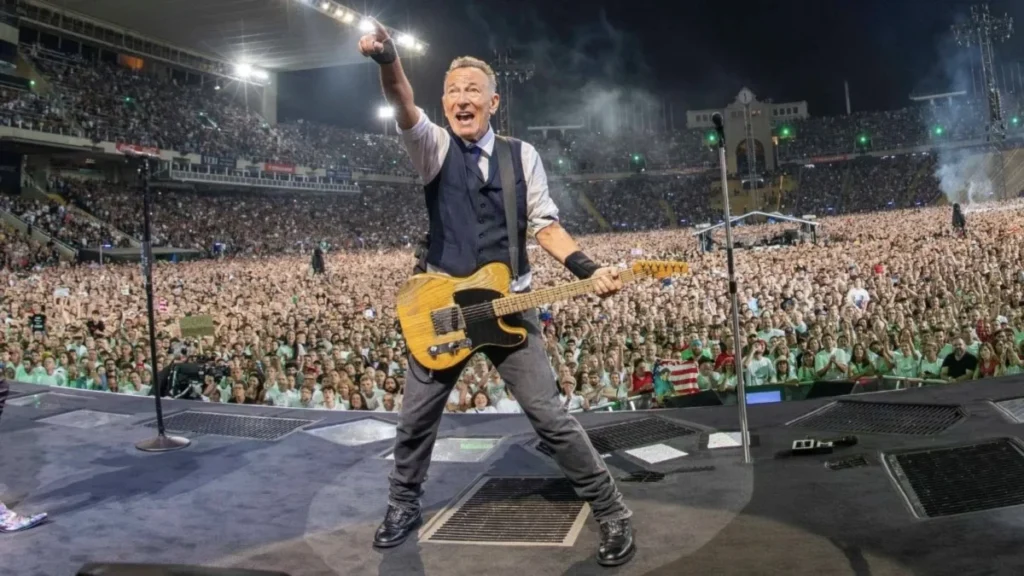

New York, NY – Legendary rock icon Bruce Springsteen has publicly expressed a profound desire to bridge the divide with fans who have distanced themselves due to his candid progressive political views. Speaking at the prestigious Tribeca Film Festival, where he was honored with the 2026 Harry Belafonte Voices for Social Justice Award, Springsteen addressed the challenging reality of fan alienation stemming from his outspokenness, emphasizing themes of hope, faith, and the possibility of national unity.
The Tribeca Dialogue: Seeking Common Ground
The poignant discussion unfolded during a moderated conversation with U2 frontman Bono, a fellow artist renowned for his own extensive activism. Bono directly posed the question that many artists grapple with: "Do you feel torn at all by thinking that there’s people in this town that they used to come and see my shows that don’t now, or have you made peace with that?" This query struck at the heart of a growing tension in contemporary culture, where political polarization increasingly infiltrates all facets of public life, including entertainment.
Springsteen’s response, delivered with his characteristic blend of introspection and conviction, underscored his unwavering commitment to his beliefs while simultaneously extending an olive branch. "You have to do two things," he articulated. "You make your stand, and you follow your beliefs." This foundational principle, he elaborated, is rooted in the conviction that these beliefs are not only explicable but also understandable by fellow citizens. He further posited a fundamental American ideal: "America is an argument, and it’s a compromise constantly, and then finding some sort of common ground is a possibility."
This statement is particularly resonant given the current socio-political climate, where divisions often seem intractable. Springsteen’s aspiration for common ground is not merely a personal wish but reflects a broader cultural longing for dialogue and reconciliation. His perspective, drawing from the lyrical narratives that have defined his half-century career, suggests that shared values can still emerge from fervent disagreement, an enduring tenet of American democracy.
A History of Engagement: The Boss’s Political Evolution
Bruce Springsteen’s journey as a socially conscious artist is well-documented and spans decades, evolving from the gritty realism of his early work to more explicit political commentary in recent years. While often seen through the lens of working-class anthems, his music has consistently explored themes of economic struggle, social injustice, and the elusive American Dream. Songs like "Born in the U.S.A.," though frequently misinterpreted as a jingoistic anthem, is in fact a searing critique of the Vietnam War’s impact on veterans and the working class. Similarly, albums like "The Ghost of Tom Joad" (1995) and "American Skin (41 Shots)" (2000) directly tackled issues of poverty, immigration, and police brutality, cementing his reputation as an artist deeply attuned to the pulse of the nation.
In the early 2000s, Springsteen became more overtly involved in partisan politics, lending his support to Democratic presidential candidates. His appearances and endorsements for figures like John Kerry in 2004 and Barack Obama in 2008 and 2012 marked a shift from implicit commentary to explicit political advocacy. This engagement intensified during the administration of President Donald Trump.
Recent Stances and Public Reactions: A Timeline
The period leading up to Springsteen’s Tribeca comments saw several instances where his political views became prominent, generating both fervent support and significant backlash.
- April 2026 – Minneapolis Concert and Trump Criticism: Just days before a scheduled concert in Minneapolis, Springsteen actively participated in a "No Kings" protest. This demonstration followed the highly publicized killings of Alex Pretti and René Good by federal immigration agents in Minnesota. At the subsequent concert, Springsteen delivered a powerful and unvarnished condemnation of the then-current administration. He told the Minneapolis crowd that the U.S. was "in the hands of a corrupt, incompetent, racist, reckless, and treasonous administration." He then issued a rallying cry, urging attendees to "join with us in choosing hope over fear democracy over authoritarianism, the rule of law over lawlessness, ethics over unbridled corruption, resistance over complacency, unity over division, and peace over war."
- April 2026 – Presidential Response: The explicit nature of Springsteen’s criticism did not go unnoticed by the former President. In a characteristic public reaction, President Trump "threw a fit," lambasting Springsteen for his exercise of free expression and suggesting a "MAGA boycott" of his music and concerts. This incident highlighted the deep chasm that had opened between a segment of Springsteen’s traditional fanbase and his evolving political persona. The swift and public exchange underscored the high stakes involved for public figures who choose to engage in political discourse in an era of heightened polarization.
- May 2026 – "Land of Hope & Dreams Tour" Conclusion: The "Land of Hope & Dreams Tour," which had provided a platform for both musical celebration and underlying social commentary, concluded in May 2026. The tour’s title itself, echoing themes of aspiration and resilience, perhaps implicitly reflected the artist’s continued hope for the nation, despite the challenging political landscape he often addressed on stage.
These events created a clear backdrop for Springsteen’s reflections at Tribeca, illustrating the very real consequences of his political engagement and the alienation he acknowledges.
The "Concerned Citizen" vs. "Activist" Dichotomy
Despite a career steeped in social commentary and recent explicit political stands, Springsteen, during the Tribeca session, made a point to disclaim the label of "activist." He told Bono, "I don’t even really consider myself an activist," adding that he felt "a bit embarrassed" to be receiving a social justice award. His self-assessment leaned towards a more modest role: "I feel like I’m, at best, a concerned citizen… I sing my songs, I say a few things and wish for the best, you know, help folks out a little bit here and a little bit there."
This humble self-description stands in stark contrast to the public perception of his influence and the tangible impact of his actions. He even playfully deferred to Bono, stating, "You’re more of an activist," and acknowledging, "There’re so many people that do so much more than I do." This distinction, while seemingly semantic, reveals an important aspect of Springsteen’s approach. By framing himself as a "concerned citizen" rather than a dedicated "activist," he may be attempting to maintain a connection with a broader audience, emphasizing shared humanity and civic responsibility over partisan ideology. It could also be a reflection of his artistic identity, where his primary role is a storyteller and musician, with political engagement being a natural outgrowth of his artistic themes rather than an end in itself. This nuanced positioning allows him to speak truth to power while perhaps leaving a door open for those who might disagree with his politics but still connect with his music’s universal messages of struggle and resilience.
Broader Implications: Music, Fandom, and Polarization
Springsteen’s candid admission about alienated fans highlights a pervasive challenge for artists in an increasingly polarized society. The expectation for public figures to take stances on social and political issues has grown, yet doing so often comes at the cost of alienating segments of their audience. This phenomenon is not unique to Springsteen; numerous artists across genres have faced similar dilemmas, with fan bases often fragmenting along ideological lines.
- The "Uncomfortable Truth": Springsteen’s willingness to make listeners "uncomfortable" with his opinions through his music and concerts speaks to a deeper artistic philosophy. For many artists, art serves not just as entertainment but as a mirror reflecting societal truths, however unpalatable. This commitment to artistic integrity, even when it costs him fans, underscores his belief in the power of music to provoke thought and stimulate dialogue.
- Economic vs. Artistic Freedom: The choice to speak out carries potential economic consequences. In an era where streaming revenue already provides modest returns, and touring remains crucial, alienating a portion of the fanbase can impact ticket sales and merchandise. Springsteen, as an established icon, possesses a degree of financial security that might allow him more freedom than emerging artists, but the principle remains. His stance reaffirms the prioritization of artistic and moral conviction over commercial considerations.
- The Future of Fandom: The incident raises questions about the nature of fandom itself. Is it possible to separate the art from the artist’s politics? For many, especially in an age of heightened identity politics, this separation becomes increasingly difficult. Springsteen’s call for "common ground" suggests a hope that shared appreciation for art can transcend political differences, even if those differences are acknowledged and addressed. It implies a belief that the human connection forged through music can still serve as a unifying force, even when political beliefs diverge sharply.
- The Role of Artists in Social Discourse: Springsteen’s enduring engagement solidifies his place not just as a musician but as a significant voice in American social discourse. His receiving the Harry Belafonte Voices for Social Justice Award—an honor named after a pioneering artist and activist—underscores this recognition. Whether he embraces the term "activist" or not, his actions and words consistently contribute to public conversations about justice, equality, and the direction of the nation.
Looking Ahead: Continued Engagement
Following the reflective conversation at Tribeca and the conclusion of his tour, Springsteen is set to continue his public engagements. He is scheduled to perform at Tom Morello’s "Power to the People Festival" on Saturday, October 3rd, at Merriweather Post Pavilion in Columbia, Maryland. This event is described as a "non-partisan celebration of peace, justice, solidarity, music, and community action."
The descriptor "non-partisan" is notable in the context of Springsteen’s recent highly partisan criticisms. It suggests a potential shift towards broader, unifying themes, even while maintaining a focus on social justice. This could be interpreted as a practical application of his stated desire to find "common ground," participating in events that promote shared values like peace and community action, which theoretically resonate across the political spectrum. His continued presence at such events signals that while he acknowledges the cost of his outspokenness, his commitment to using his platform for what he believes is right remains undimmed, echoing the enduring spirit of hope and resilience that has always characterized the Boss’s monumental career.