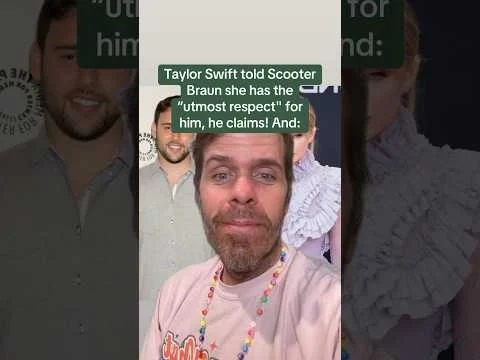

Music manager Scooter Braun has reportedly made a new claim regarding his past interactions with global superstar Taylor Swift, asserting that Swift once expressed "utmost respect" for him. This revelation, reportedly stemming from a recent interview, has been brought to public attention by entertainment news outlets, reigniting discussions around one of the music industry’s most high-profile and contentious disputes. The alleged statement from Swift stands in stark contrast to the widely publicized narrative of a prolonged and acrimonious battle over the ownership of her master recordings, which has defined a significant chapter in both their careers.
The claim, emerging years after the initial conflict erupted, adds another layer of complexity to an already intricate narrative. Given the deeply personal and public nature of Swift’s previous statements regarding Braun’s acquisition of her catalog, this new assertion by Braun is likely to provoke intense scrutiny and analysis from fans, industry observers, and media alike. It forces a re-evaluation of public perception and the underlying dynamics of a feud that has had far-reaching implications for artist rights and intellectual property in the digital age.
The Genesis of a Public Feud: The Big Machine Acquisition
To fully understand the weight of Braun’s recent claim, it is essential to revisit the origins of the highly publicized dispute between him and Taylor Swift. The conflict began in June 2019, when Ithaca Holdings, a company owned by Scooter Braun, acquired Big Machine Label Group (BMLG) for an estimated $300 million. This acquisition included the master recordings of Taylor Swift’s first six studio albums: Taylor Swift (2006), Fearless (2008), Speak Now (2010), Red (2012), 1989 (2014), and Reputation (2017). These masters represented the original sound recordings of Swift’s music, granting their owner significant control over their commercial use, licensing, and distribution.
Swift, who had departed BMLG in 2018 to sign with Republic Records and Universal Music Group, publicly reacted to the news with profound distress. In a lengthy Tumblr post published shortly after the acquisition was announced, Swift described feeling "sad and grossed out" by the sale. She accused Braun of "manipulative bullying" for years, citing past incidents involving his then-client Kanye West and Kim Kardashian, which she claimed were orchestrated to "dismantle her musical legacy." Swift asserted that she had repeatedly attempted to purchase her masters from BMLG CEO Scott Borchetta, but alleged that the terms offered were prohibitive, effectively tying her future work to BMLG for years to come. Her post painted a picture of a calculated move by Braun and Borchetta to seize control of her life’s work without her consent, leaving her feeling betrayed and disempowered.
Scott Borchetta and Scooter Braun swiftly countered Swift’s narrative. Borchetta issued a statement claiming that Swift’s father, Scott Swift, was a shareholder in BMLG and had been made aware of the impending deal. He also asserted that Swift had been offered an "extremely generous" deal to acquire her masters, which she purportedly declined, choosing instead to leave the label. Braun, for his part, initially remained more reserved in his public comments, but his camp largely supported Borchetta’s version of events, framing the acquisition as a legitimate business transaction. The public exchange of accusations and counter-accusations immediately polarized the music industry and Swift’s massive fanbase.
The Re-Recording Strategy: "Taylor’s Version"
In response to what she perceived as an injustice and a violation of her artistic ownership, Taylor Swift announced an unprecedented strategy: she would re-record her first six albums. This decision, revealed in August 2019, was made possible by clauses in her original recording contracts which typically stipulate a period (often five to ten years, or a certain number of albums) after which an artist can re-record their work. By creating "Taylor’s Version" of each album, Swift aimed to create new master recordings that she would fully own, thereby devaluing the original masters held by Braun and later Shamrock Holdings.
The "Taylor’s Version" project was not merely a commercial endeavor; it was a powerful statement on artist autonomy and intellectual property rights. Swift leveraged her immense global platform to educate fans and the wider public about the distinction between songwriting credits (which she always owned) and master recordings. Her initiative sparked a broader industry conversation about how artists, particularly emerging ones, can protect their creative output.
The re-recordings proved to be a monumental success, both critically and commercially.
- Fearless (Taylor’s Version) was released in April 2021, featuring six previously unreleased "From The Vault" tracks. It debuted at number one on the Billboard 200, becoming the first re-recorded album to do so.
- Red (Taylor’s Version) followed in November 2021, an expanded 30-track version including the highly anticipated 10-minute version of "All Too Well." This album also shattered records, debuting at number one and achieving the biggest opening week for any album in 2021 at the time.
- Speak Now (Taylor’s Version) was released in July 2023, similarly reaching the top of the charts and continuing the trend of fan engagement and commercial triumph.
- 1989 (Taylor’s Version) arrived in October 2023, breaking multiple streaming and sales records, solidifying the re-recording project’s unprecedented success and further demonstrating the unwavering loyalty of Swift’s fanbase.
Each "Taylor’s Version" release was accompanied by extensive fan campaigns, encouraging listeners to stream and purchase the new versions to support Swift in her quest to reclaim her music. This collective action not only drove impressive sales figures but also sent a clear message to the industry about the power of artist-fan solidarity.
Timeline of Key Events in the Dispute:
- June 2019: Ithaca Holdings, led by Scooter Braun, acquires Big Machine Label Group, including the master recordings of Taylor Swift’s first six albums. Swift publicly condemns the acquisition in a lengthy Tumblr post, accusing Braun of "manipulative bullying."
- August 2019: Swift announces her intention to re-record her first six albums to regain ownership of her masters.
- November 2019: Swift alleges that Braun and Borchetta are preventing her from performing her old songs at the American Music Awards and using them in a Netflix documentary. BMLG denies the claims, and a resolution is eventually reached allowing her performance.
- April 2020: Swift reveals she will begin re-recording her catalog in November 2020, the earliest date permitted by her original contract.
- November 2020: Scooter Braun’s Ithaca Holdings sells Taylor Swift’s master recordings to Shamrock Holdings, a private equity firm, for an estimated $300 million. Swift again publicly criticizes the sale, stating she was not given an opportunity to buy her masters directly and that Braun required her to sign an "ironclad NDA" to even see the financial terms, which she refused.
- February 2021: Swift announces the first re-recorded album, Fearless (Taylor’s Version).
- April 2021: Fearless (Taylor’s Version) is released, debuting at number one on the Billboard 200.
- June 2021: Swift announces Red (Taylor’s Version).
- November 2021: Red (Taylor’s Version) is released, also debuting at number one and breaking records.
- May 2022: Braun addresses the controversy more extensively in an interview, expressing regret over how the situation unfolded but maintaining it was a legitimate business transaction. He states he wishes he could have handled the communication differently.
- July 2023: Speak Now (Taylor’s Version) is released, continuing the commercial and critical success of the re-recordings.
- October 2023: 1989 (Taylor’s Version) is released, breaking multiple streaming and sales records worldwide.
- May 2026: Scooter Braun reportedly makes the claim that Taylor Swift once expressed "utmost respect" for him, as reported by entertainment news outlets.
Analyzing Braun’s New Claim and Its Implications
Scooter Braun’s latest assertion—that Taylor Swift once told him she had "utmost respect" for him—arrives years into a dispute characterized by public animosity and a clear divergence of narratives. This claim is particularly striking given Swift’s consistent portrayal of Braun as an adversary who sought to undermine her career and control her artistic legacy.
Why Now? Potential Motivations:
Braun’s timing for this alleged revelation, occurring nearly seven years after the initial acquisition and well into Swift’s successful re-recording campaign, invites speculation about his motivations.
- Reputation Management: Braun has faced significant public backlash and criticism since 2019. This claim could be an attempt to soften his image, suggesting a more complex and perhaps less antagonistic relationship with Swift than the public perceives. It could aim to introduce nuance into a narrative that has largely cast him as the villain.
- Historical Revisionism: By suggesting a past moment of mutual respect, Braun might be trying to rewrite or reframe the historical context of the dispute. It could be an effort to imply that the animosity was not always present, or that Swift’s public outrage was disproportionate to their private interactions.
- Ongoing Media Scrutiny: As the re-recording project continues to garner massive attention and critical acclaim for Swift, the topic of the masters dispute periodically resurfaces. Braun might be seeking to inject his perspective back into the conversation.
- Business Strategy: While less direct, maintaining a certain public image is crucial for a music manager and entrepreneur. A claim like this could be part of a broader strategy to navigate the competitive and often perception-driven music industry.
Contradictions with Swift’s Established Narrative:
Swift’s public statements have consistently painted a picture of deep mistrust and animosity towards Braun. Her Tumblr post from June 2019, her subsequent interviews, and her continued efforts through the "Taylor’s Version" project all underscore a narrative of an artist fighting for control against a perceived oppressor. A private expression of "utmost respect" from Swift, if true, would dramatically contradict this carefully constructed and widely accepted public narrative. It would imply a level of hypocrisy or duplicity that is inconsistent with Swift’s public persona as an authentic and outspoken advocate for artists’ rights.
Potential Reactions and Responses:
As of the time of publication, representatives for Ms. Swift have not yet issued a public statement addressing Mr. Braun’s latest remarks. Given the history, any response from Swift or her team would likely be carefully considered. They could choose to ignore the claim, dismissing it as a baseless attempt to distract from the core issues. Alternatively, they might issue a firm denial, reinforcing Swift’s long-held position and challenging Braun’s credibility. The "Swifties," Taylor Swift’s dedicated fanbase, are highly attuned to these narratives and have historically been fierce defenders of their idol. They are likely to view Braun’s claim with skepticism, interpreting it as an attempt to undermine Swift’s integrity.
Broader Impact and Implications:
This new claim, regardless of its veracity, reignites interest in a dispute that has already had significant implications for the music industry.
- Artist Rights Advocacy: The Taylor Swift vs. Scooter Braun saga has become a touchstone for discussions about artist ownership, master recordings, and the power dynamics between artists and labels/managers. Braun’s new claim, by introducing a potentially conflicting detail, could complicate these ongoing conversations or fuel further debate.
- Media Scrutiny: The entertainment media will undoubtedly scrutinize this claim, comparing it against past statements and actions from both parties. Investigative journalism might seek to uncover the context of the alleged "utmost respect" statement, if it indeed occurred.
- Public Perception: For Braun, the success of Swift’s re-recordings has cemented a particular public image. This claim could be an attempt to shift that perception, even marginally. For Swift, whose narrative has largely been one of resilience and triumph, the claim could test the solidity of her established story, though her immense public support base makes it unlikely to significantly damage her standing.
Unanswered Questions and Future Developments:
The biggest question remains: when and in what context did Taylor Swift allegedly express "utmost respect" for Scooter Braun? Was it before the Big Machine acquisition, during a period of professional interaction? Or was it during the tumultuous period of the dispute itself, perhaps in a private exchange that Braun is now selectively revealing? Without further details from Braun or a direct response from Swift, the claim remains unsubstantiated and open to broad interpretation.
The music industry will be watching to see if this claim elicits a direct response from Taylor Swift, who has never shied away from defending her position and her art. Her silence, or a carefully worded denial, would carry significant weight. This latest development underscores the enduring nature of the dispute and how deeply ingrained it has become in the public consciousness, continuing to shape the legacies of both Taylor Swift and Scooter Braun years after its initial eruption. The saga serves as a powerful reminder of the high stakes involved in the ownership and control of creative works, and the profound impact of public narrative in the entertainment world.