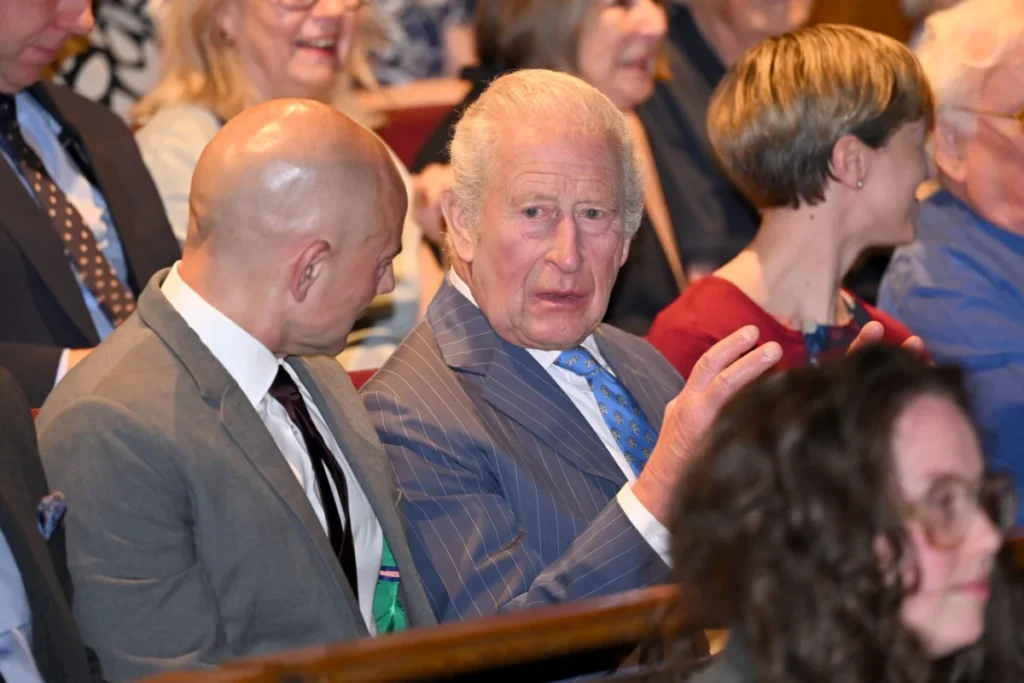

In a notable affirmation of the monarchy’s enduring commitment to the arts, King Charles III made a surprise visit to the Royal Shakespeare Theatre in Stratford-upon-Avon, Warwickshire, delighting theatregoers with his presence at a sold-out performance of William Shakespeare’s late masterpiece, The Tempest. The King, who has been a patron of the Royal Shakespeare Company (RSC) since 2024, continued a long-standing royal tradition of supporting one of Britain’s most cherished cultural institutions, following in the footsteps of his late mother, Queen Elizabeth II. His unannounced attendance underscored a personal enthusiasm for theatre and a public dedication to the nation’s rich dramatic heritage.
A Royal Arrival and Enthusiastic Reception
The atmosphere in Stratford-upon-Avon buzzed with an unexpected excitement as King Charles arrived at the iconic Royal Shakespeare Theatre. Crowds gathered, greeting him with cheers and palpable enthusiasm, clearly taken by surprise by the royal presence. The King’s visit was not publicly announced beforehand, adding an element of spontaneous joy to the evening. Upon his arrival, His Majesty was formally welcomed by a distinguished retinue, including the Lord Lieutenant of Warwickshire, Tim Cox, and the RSC’s co-artistic directors, Daniel Evans and Tamara Harvey. This initial reception set the tone for an evening where royal formality blended seamlessly with the communal joy of live theatre.
As King Charles entered the auditorium, the buzz escalated into a flurry of activity. Audience members in the dress circle craned their necks to catch a glimpse, while those in the stalls eagerly reached for their phones to capture the moment. The King took his seat discreetly near the back of the auditorium, positioning himself between Mr. Evans and Ms. Harvey. This choice of seating, among general patrons rather than in a private box, further highlighted his desire for an immersive and communal theatrical experience, echoing the accessibility he often strives for in public engagements. Also seated nearby was Sir Richard Eyre, the acclaimed director of the evening’s performance, marking a gathering of significant figures in British theatre and royalty.
A Royal Patron’s Appreciation for the Bard
Throughout the performance of The Tempest, the King’s engagement was evident and enthusiastic. Tamara Harvey, one of the RSC’s co-artistic directors, remarked that His Majesty was "laughing away" next to her, adding, "I think he genuinely enjoyed it." This anecdotal observation paints a picture of a monarch not merely fulfilling a duty but genuinely captivated by the dramatic unfolding on stage. Further testament to his deep appreciation for theatre came from Daniel Evans, who shared a specific instance of the King’s impressive knowledge. When actor Guy Henry appeared on stage in the role of Stephano, the King leaned over to Evans, asking, "Is that Guy Henry?" Evans expressed his astonishment at the King’s detailed familiarity with actors, concluding that "You get the impression he’s a true enthusiast of the theatre." These personal insights offer a rare glimpse into the King’s genuine passion for the performing arts, suggesting a connoisseur’s eye and a memory for talent.

The King’s attentiveness culminated at the performance’s end when he joined the rest of the audience in a heartfelt standing ovation. This gesture, a universal sign of profound appreciation in the theatre, underscored his respect for the actors, the production team, and the timeless artistry of Shakespeare. It was a moment of shared admiration, bridging the gap between monarch and public through the power of dramatic expression.
Behind the Scenes: A Glimpse into Theatrical Craft
The interval provided an opportunity for the King to delve deeper into the intricate world of theatrical production. After being handed a refreshing drink, His Majesty was introduced to the RSC’s in-house costume department. This segment of his visit highlighted the often-unseen craftsmanship vital to bringing Shakespeare’s worlds to life. The King expressed his admiration for a crown that had been used in the company’s production of Edward II the previous year, acknowledging the meticulous work involved in creating such detailed props.
His engagement extended to some of the RSC’s most treasured historical pieces. He was observed touching the fabric of a dress famously worn by Dame Judi Dench in All’s Well That Ends Well in 2003, connecting with the legacy of one of Britain’s greatest actresses. Further demonstrating his appreciation for theatrical history, he marvelled at David Tennant’s distinctive robe and gown from his critically acclaimed role as Richard II in 2013, and a costume worn by the late Sir Antony Sher in his iconic 1984 production of Richard III. These encounters allowed the King to appreciate the tangible artistry and historical weight encapsulated within these garments, which have adorned some of the finest actors to grace the British stage. His simple yet profound description of the costumes as "brilliant" conveyed his genuine admiration for the skill and artistry involved.
The Enduring Legacy of Royal Patronage
King Charles’s visit to the Royal Shakespeare Theatre continues a long and distinguished history of royal patronage, particularly within the performing arts. His assumption of the RSC patronage in 2024 follows directly from the unparalleled legacy of his mother, Queen Elizabeth II, who held the patronage since the company’s very inception in 1961. This continuity underscores the monarchy’s consistent commitment to national cultural institutions and their role in preserving and promoting British heritage.
The RSC, established to celebrate and perform the works of William Shakespeare, stands as a cornerstone of British culture. Located in Shakespeare’s birthplace, Stratford-upon-Avon, it serves as both a national treasure and an international ambassador for English literature and theatre. Royal patronage provides significant prestige, drawing attention to the company’s work and often aiding in fundraising and public engagement. For over six decades, Queen Elizabeth II’s patronage offered stability and a symbol of national importance to the RSC, fostering its growth into a world-renowned theatrical powerhouse. King Charles’s active engagement, as evidenced by his surprise visit, signals a continuation of this deep connection, reinforcing the monarchy’s role not just as ceremonial heads, but as active supporters of the cultural landscape. His personal interest, as noted by the RSC directors, adds an authentic layer to this formal patronage, suggesting a deep-seated belief in the power and importance of theatre.

The Production: A Stellar Cast and Crew
The performance King Charles attended was a landmark production of The Tempest, notable for several reasons. Headlining the cast was the venerable Sir Kenneth Branagh, taking on the iconic role of the exiled Duke of Milan, Prospero, for the very first time in his illustrious career. Branagh, often hailed as one of the pre-eminent Shakespearean actors and directors of his generation, has an extensive history with the Bard, having starred in or directed 35 Shakespeare productions throughout his career. His return to Stratford-upon-Avon for this role marked his first appearance at the Royal Shakespeare Theatre in over 30 years, an event eagerly anticipated by theatre enthusiasts.
Directing this significant production was Sir Richard Eyre, a titan of British theatre and film, making his debut with the Royal Shakespeare Company. Eyre’s long and distinguished career, encompassing acclaimed productions for the National Theatre, opera, and cinema, brought a formidable vision to The Tempest. His collaboration with Branagh on such a pivotal play at the RSC created a theatrical event of considerable artistic weight.
The Tempest itself holds a special place in Shakespeare’s canon, widely considered one of his final solo plays. Written around 1610-1611, it is a play rich in themes of magic, illusion, revenge, forgiveness, and reconciliation. Its exploration of power dynamics, colonialism, and the human condition, set on a remote island, continues to resonate with contemporary audiences. The play’s lyrical language and fantastical elements make it a challenging yet rewarding work to stage, requiring immense creativity and skilled performers. The production, which runs at the Royal Shakespeare Theatre until June 20, offers a profound theatrical experience for all who attend.
In a joint statement, RSC co-artistic directors Daniel Evans and Tamara Harvey articulated the significance of the royal visit: "It was a tremendous honour to welcome His Majesty the King back to the Royal Shakespeare Theatre for this landmark production of The Tempest, which marks both Sir Kenneth Branagh’s historic return to Stratford-upon-Avon for the first time in over 30 years and Sir Richard Eyre’s debut with the company after a long and distinguished career directing for the British stage." Their words encapsulate the multi-layered importance of the evening, celebrating both royal endorsement and artistic achievement.
Stratford-upon-Avon: The Heart of Shakespearean Heritage
Stratford-upon-Avon, the birthplace of William Shakespeare, holds an unparalleled position in the cultural landscape of Britain and the world. It is not merely a historical town but a living testament to the legacy of the greatest playwright in the English language. The Royal Shakespeare Company, headquartered here, is integral to the town’s identity and global appeal. Its theatres – the Royal Shakespeare Theatre, the Swan Theatre, and The Other Place – attract hundreds of thousands of visitors annually, from scholars and students to casual tourists and avid theatregoers.

The RSC’s mission extends beyond merely staging plays; it encompasses educational initiatives, archival preservation, and the continuous reinterpretation of Shakespeare’s works for new generations. The town itself thrives on this Shakespearean connection, with numerous historical sites linked to the Bard’s life, including his birth house, Anne Hathaway’s Cottage, and Mary Arden’s Farm. A royal visit to this nexus of Shakespearean heritage serves to further elevate its profile, reinforcing its status as a vital cultural destination. It highlights the symbiotic relationship between the monarchy, national heritage, and the arts, all converging in this historically significant location.
Broader Implications: Monarchy, Culture, and Public Engagement
King Charles’s surprise visit carries significant implications beyond the immediate delight of theatregoers. In an era where cultural funding and public engagement with the arts can be challenging, a visible show of support from the Head of State provides an invaluable boost. Such an event draws national and international media attention to the RSC, The Tempest, and the broader theatre industry, potentially encouraging more people to attend live performances. This is particularly pertinent for an institution like the RSC, which relies on public support and patronage to continue its world-class productions and educational outreach programs.
Furthermore, the King’s personal, enthusiastic engagement, as described by the RSC directors, reinforces the perception of the monarchy as a guardian of national identity and cultural excellence. His interest in the intricate details of costume design and his knowledge of actors demonstrates a genuine connection, making the royal patronage feel less ceremonial and more substantive. This active role helps to bridge the gap between the formal institution of the monarchy and the everyday cultural experiences of the public, fostering a sense of shared national pride in artistic achievements. The visit serves as a powerful symbol of the enduring relevance of Shakespeare and the performing arts in contemporary British society, championed from the highest echelons of the state. It underscores the belief that cultural institutions are not mere luxuries but essential components of national well-being and identity.
The King’s attendance at this particular production, featuring such eminent figures as Sir Kenneth Branagh and Sir Richard Eyre, also acts as an endorsement of artistic excellence, signaling that the highest standards of theatrical production are valued and celebrated. In a world increasingly dominated by digital entertainment, the monarch’s presence at a live theatre performance champions the unique, irreplaceable experience that only the stage can offer. It was an evening that beautifully intertwined royal duty with personal passion, leaving a lasting impression on all involved and reaffirming the vital place of the arts in national life.