
The landscape of the Hudson Valley and the Catskill Mountains is undergoing a profound transformation as a new generation of hospitality developers reimagines the traditional American summer camp. This movement, characterized by high-end freestanding cabins, communal gathering spaces, and an emphasis on "unplugged" luxury, is bridging the gap between the rugged outdoors and five-star service. While the region has long been a retreat for urban dwellers, the current shift represents a sophisticated evolution of the "bungalow colony" model that defined the area nearly a century ago.
This resurgence is not merely a nostalgic exercise but a multi-million-dollar industry response to changing consumer preferences. Modern travelers, particularly those from the New York metropolitan area, are increasingly seeking "semi-unregulated" environments that offer a sense of community and nature-immersion without the austerity of traditional camping or the isolation of private vacation rentals.

The Historical Blueprint: From the Borscht Belt to Modernity
To understand the current boom in luxury cabin resorts, one must look back to the early 20th century. Beginning in the 1920s, Sullivan and Ulster counties became the epicenter of a cultural phenomenon known as the Borscht Belt. Thousands of Jewish families, seeking refuge from the heat and congestion of New York City, flocked to close-knit colonies of bungalows and grand hotels like Grossinger’s and the Nevele.
These original colonies understood a fundamental tenet of leisure: it is inherently social. The architecture reflected this, with individual sleeping quarters clustered around shared amenities—communal pools, dining halls, and playgrounds. This "social-spatial" model thrived for five decades before falling into a state of decline in the 1970s, a period of dilapidation documented by photographers and historians such as Marisa Scheinfeld.
The current revival, however, swaps the modest bungalows of the past for architecturally significant structures. While the core philosophy remains—private quarters paired with shared social hubs—the execution has been elevated to meet the standards of the ultra-luxury market.

The Rise of the Luxury Cabin Resort
A cornerstone of this new era is Wildflower Farms, an Auberge Collection resort located in Gardiner, New York. Spanning 140 acres, the property features 65 freestanding wood cabins that emphasize a connection to the environment. The design avoids the traditional hotel corridor in favor of dirt footpaths, leading guests through nine acres of working farmlands and orchards.
According to Kristin Soong Rappoport, co-owner of Wildflower Farms, the business model was born from a personal desire for nature among city dwellers. The property offers a high-touch experience that includes a world-class spa, a fitness studio offering daily yoga and Pilates, and a partnership with Mercedes-Benz. This "ultra-luxury" approach is reflected in the resort’s amenities, which range from farm-to-table dining at the on-site restaurant, Clay, to high-end experiences like "caviar bumps" and $500 martinis.
Despite the high price point, the resort maintains a "summer camp" ethos. Guests are encouraged to participate in morning walking tours to interact with farm animals and explore the local flora and fauna. This blend of high-end hospitality and rustic activity characterizes the new market standard for the region.

Innovative Spatial Models: AutoCamp and Prospect Berkshires
The trend extends beyond traditional cabins. AutoCamp, which has expanded its footprint from Zion to the Catskills, utilizes luxury Airstreams and modern suites to create a unique spatial model. Bryan Terzi, Chief Commercial Officer at AutoCamp, notes that the goal is to provide a format that is private and elevated yet fully immersed in nature.
"The balance of privacy, thoughtful design, and immediate connection to place and people is what neither traditional hotels nor vacation rentals deliver," Terzi stated. This model addresses a specific gap in the market: the desire to be "outside" without being "removed" from the comforts of modern design or the presence of other travelers.
Similarly, Prospect Berkshires offers lakeside cabins in Massachusetts, further proving that the appetite for curated, nature-centric lodging is a regional trend across the Northeastern United States.

The Architecture of Social Leisure: Camptown and Eastwind
In Leeds, New York, the resort Camptown serves as a direct homage to the original bungalow colonies. With 51 cabins spread across 22 acres, the property focuses on the interplay between individual privacy and communal leisure. Ray Pirkle, who co-owns the property with Kim Bucci, emphasizes that the design is intended to solve the social-privacy paradox through architecture.
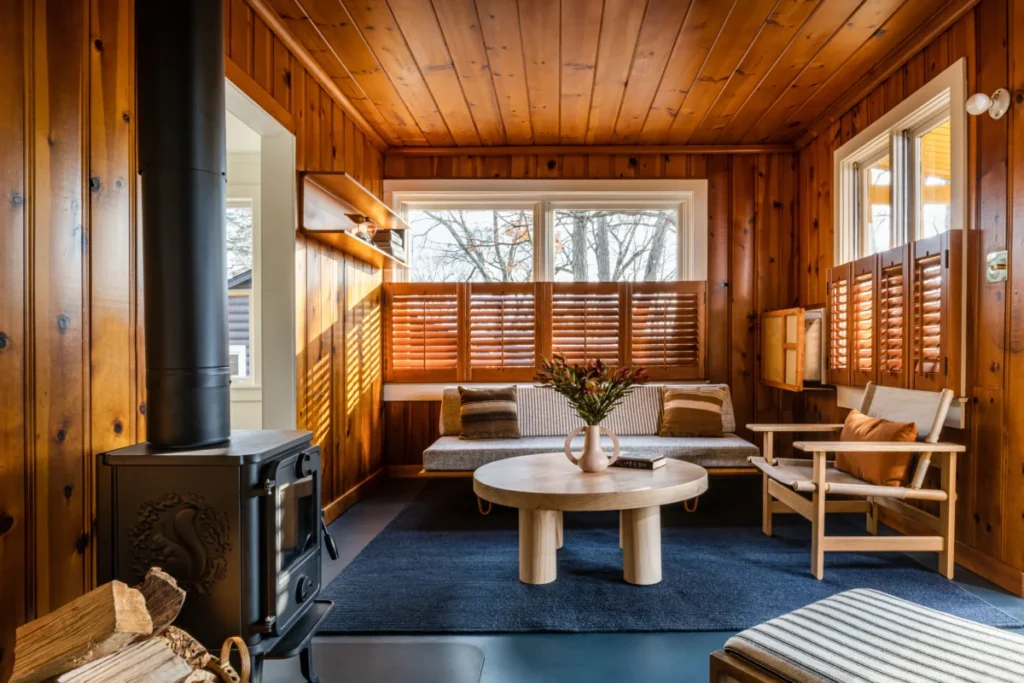
Camptown features Casa Susanna, a modern Mexican restaurant named after a historic Catskills refuge for transgender people, and a 24/7 pantry stocked with local goods. Each unit is equipped with a wood-burning stove, which Pirkle describes as a "functional sculpture" and a focal point for guest activity. The owners have been vocal about avoiding a "performative" relationship with rural life, opting instead for authentic materials and local sourcing over "staged" rustic decor.
Further north in Big Indian, Eastwind Oliverea Valley utilizes a minimalist Scandinavian aesthetic to achieve a similar goal. Creative Director Julija Stoliarova explains that the property is designed around "moments of quiet, private retreat" anchored by communal spaces like the Dandelion restaurant and outdoor saunas. The "Lushna" cabins—small, triangular structures—are scattered throughout the woods, forcing guests to walk through the landscape to reach the pool or dining areas, thereby making the environment an active participant in the stay.

Economic Impact and Regional Growth Data
The proliferation of these resorts is supported by robust economic data. According to reports from Empire State Development, tourism in the Hudson Valley and Catskills regions has seen a steady increase in spending over the last five years, with the hospitality sector being a primary driver. In 2022 alone, tourism in the Hudson Valley region generated an estimated $4.4 billion in economic impact, supporting over 50,000 jobs.
The shift toward luxury cabin colonies is also a reaction to the oversaturation of the short-term rental market. As platforms like Airbnb faced increased regulation and rising prices in the Hudson Valley, developers saw an opportunity to offer a "managed" alternative. These resorts provide the consistency and amenities of a luxury hotel with the aesthetic appeal and privacy of a standalone cabin, a combination that has proven highly resilient in the post-pandemic travel market.
Market Analysis and Future Implications
The success of these properties suggests a long-term shift in how high-net-worth individuals consume nature. The "summer camp for adults" concept works because it mitigates the stresses of traditional travel. There is no need to navigate local grocery stores or manage a rental property’s maintenance; instead, the experience is curated, safe, and social.

Industry analysts suggest several implications for the future of the Hudson Valley:
- Increased Investment: Major hospitality brands are likely to continue acquiring land in the Catskills and Hudson Valley to develop similar "colony" style resorts.
- Cultural Preservation vs. Gentrification: While these resorts bring economic activity and preserve the "bungalow colony" aesthetic, they also contribute to rising land values, creating a complex dynamic with long-term local residents.
- Sustainable Development: Many of these new properties, such as Wildflower Farms and Eastwind, emphasize sustainability and land conservation, which may set a new environmental standard for rural hospitality.
- The "Unplugged" Premium: As digital saturation increases, the ability to offer a high-end "analog" experience—characterized by fire-building, hiking, and communal dining—will become an even more valuable commodity.
Conclusion
The luxury cabin colonies of the Hudson Valley represent a sophisticated synthesis of American history and modern hospitality. By reclaiming the social architecture of the Borscht Belt and infusing it with contemporary design and five-star amenities, developers have created a new category of travel that resonates with the modern urbanite.
Whether it is through a $500 martini at an Auberge resort or a quiet night by a wood-burning stove in a Leeds cabin, the message is clear: the magic of the summer camp has been modernized. The "belonging that comes from being outside," as seen through the lens of ultra-luxury, is no longer about sharing a bunk bed—it is about sharing an experience, curated to perfection in the heart of the New York wilderness.