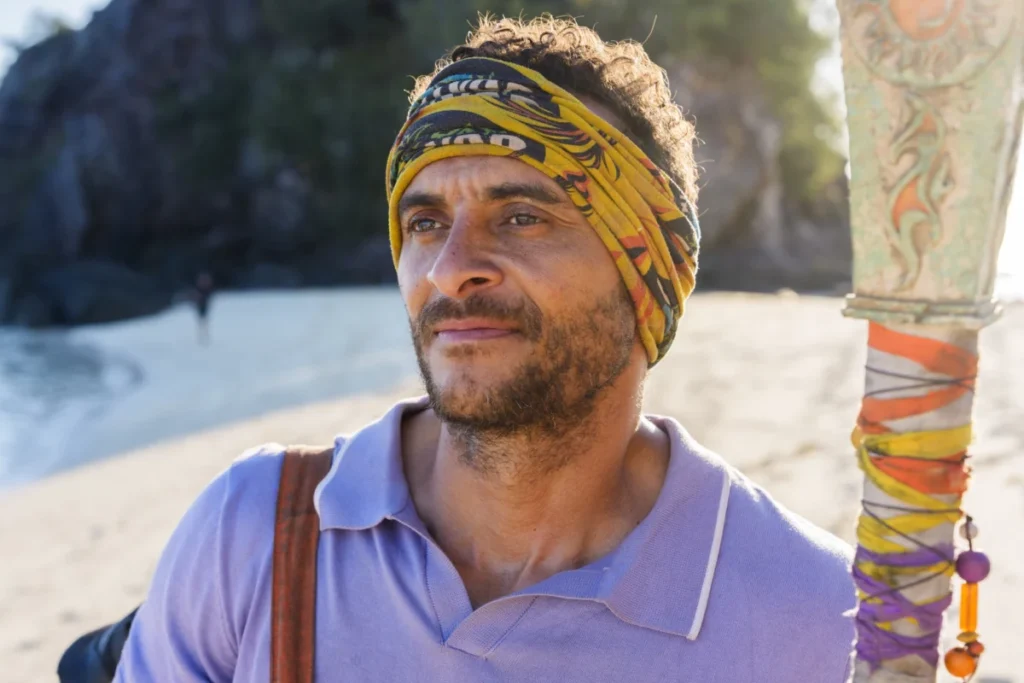

Joe Hunter’s journey on Survivor 50 concluded with a second consecutive appearance in the final three, a remarkable feat achieved through a strategy of perceived honesty that, while earning him a spot at the end, ultimately failed to secure the win. Reflecting on his experience in an exclusive interview with TV Insider, Hunter detailed the challenges of navigating a returning player season where his authentic approach was met with skepticism and, at times, outright disdain from his fellow contestants. Despite the outcome, Hunter expressed a profound sense of gratitude and pride, emphasizing his commitment to playing the game as himself, even when it seemed unpopular.
The seasoned Survivor player, who previously reached the final three in Survivor 48, found himself in a similar position once again in Survivor 50. In both instances, his path to the final three was facilitated by the last immunity winner, a strategic alliance that speaks to his ability to build trust and forge connections, albeit in a game often characterized by deception. Hunter candidly admitted that the moment he sat down for the final Tribal Council, he felt his chances of winning were slim. "It was immediately clear at the beginning of the final tribal council that I wasn’t getting any votes," he stated. "In fact, I felt like some players hated me." This stark realization, he explained, stemmed from a perceived lack of appreciation for his gameplay style among the veteran cast.
Despite the zero votes received at the Final Tribal Council, Hunter maintains a unique distinction in Survivor history: he has never been voted out. This fact underscores a strategic approach that, while not always resulting in a victory, has consistently kept him in contention. In his interview, Hunter delved into the reasons behind his perceived disconnect with the Survivor 50 cast and defended his playing style, arguing that it is a valid and often underestimated approach to the game.
The Live Finale and Jeff Probst’s Impeccable Recovery
The Survivor 50 live finale was a night of high stakes and unexpected moments, including a notable gaffe by host Jeff Probst during the Rizo confusion. Hunter, however, focused on Probst’s masterful handling of the situation. "You know what sucks about that is I go, man, Jeff Probst is the head of the show, and he’s hit every single time," Hunter remarked, highlighting Probst’s consistent ability to navigate live television without error. "Every Applebee’s thing you see does all that live. Never misses a beat, never cue cards, no rebut, no pause button."

When the Rizo confusion unfolded, Probst’s ability to recover and even inject humor into the situation impressed Hunter. "I thought it just showed how awesome he is," Hunter said. "That’s to me, just showed on live television how others would’ve failed. Other people in that spot, it’s over. He crushed it. So I thought it was awesome that he recovered." This moment served as a testament to Probst’s decades of experience and his unparalleled skill in managing the unpredictable nature of live television and the game of Survivor.
Redefining "Honesty" in the Game of Survivor
A recurring theme in discussions surrounding Joe Hunter’s gameplay is his perceived commitment to honesty and integrity. However, Hunter clarified that he never explicitly used these terms himself. "I never said the words ‘honor and integrity.’ I never forced it. I never said it," he explained. "It’s just like, here you go. And I’m like, OK. Well, I mean, out of the gate, I’ve never mentioned it before, during, or after this season. And I was just being me."
Hunter’s realization that his authentic approach was not resonating with the Survivor 50 cast came early in the game. He attributed this to pre-existing relationships and a cast that perhaps favored more aggressive or deceptive gameplay. "What I realized was in this cast, based on previous relationships, didn’t like more personality," he stated. "And I just thought, man, I don’t know how to navigate." He likened the situation to walking into a party where everyone is already paired up, leaving him struggling to find a connection and integrate into the social fabric of the game.
"You can’t have a plan when the game is already rolling. You have to adapt," Hunter asserted. His strategy, therefore, shifted to utilizing existing relationships as a means of adaptation, rather than adhering to a rigid, pre-conceived game plan. "So what I really tried to do was just be me and use relationships to adapt in the game."
The Evolution of Strategy: Lying and Adaptation
The question of whether Hunter ever resorted to lying in Survivor 50 was met with a direct and disarming response: "Of course." He elaborated on instances where he withheld information or offered misdirection, acknowledging these as "dishonest moments." These included lying to Ozzy about his safety, Tiffany, Cirie, and Stephenie regarding idols or the Shot in the Dark, and even to Jenna in the early stages of the game about her potential elimination.

Hunter explained the strategic nuance of his actions. "These players all know that Joe is going to tell you the truth," he said. "If they tell me the plan, and then I go over there and tell them, ‘You’re going home,’ they’re going to know that I told you. What’s hard now is they used that against me." This highlights a core challenge of playing an honest game in a deceptive environment: when you are known for your truthfulness, any deviation, even a strategic one, can be perceived as a betrayal or a sign of desperation.
His participation in the fire-making challenge between Rizo and Jonathan also sparked discussion. Hunter’s decision to provide Rizo with a "sword" for the challenge, essentially offering him a tool to make fire, was interpreted by some as aiding an opponent. Hunter defended his actions, framing them as an attempt to ensure a fair and balanced competition. "I’m just trying to make it more balanced," he stated. "That’s all." He reasoned that not helping Rizo would have been detrimental to Rizo but potentially beneficial to Jonathan, and his intervention aimed to create a more equitable outcome.
Parallels and Reflections: A Tale of Two Final Threes
The parallels between Hunter’s Survivor 48 and Survivor 50 journeys are striking. In both seasons, he was selected for the final three by the immunity winner. He also observed a parallel in the fire-making challenge faced by Rizo and Jonathan, as both had experienced it in their initial seasons. Hunter views being chosen for the final three as a strategic advantage in itself. "If you’re chosen, that’s a skillset," he explained. "Now, granted, others would argue they’re taking you into it for a reason strategically without a doubt, but that same move is all part of the strategy of your game, too."
He also expressed a concern that the modern era of Survivor may not value the fire-making challenge as highly as it once did. "I feel the new generation does not value that fire-making challenge enough," he noted. "In old-school, I feel that if you stepped up to say, ‘I’m going to sacrifice [immunity] for fire,’ now it doesn’t hold enough value to me as it did." Hunter prefers a direct confrontation with the jury over a fire-making showdown, believing that "the jury is where you win the game."
The Inevitable Verdict: Final Tribal Council Realities
Hunter’s feelings heading into the Final Tribal Council were notably somber. "Oh, right when I sat down on that stool in Fiji, right away – this is me being totally transparent – I go, ‘Well, okay, should I go home? What are we doing here?’" he confessed. He felt a palpable sense of disconnect with the jury, sensing a strong undercurrent of dislike. "Hate me, hate me as a person. Hate me, hate me, hate me, hate me. Maybe."

He acknowledged that a select few players, including Emily, Christian, Rick Devens, and Dee, might have been open to considering his game, but he believed the majority had already made up their minds. "It was locked," he stated definitively. Hunter expressed a sense of luck in simply reaching the final three, but the overwhelming sentiment was that his game, characterized by its perceived honesty, had already been judged by the jury.
When asked about feeling "embarrassed" at the Final Tribal Council, Hunter refuted the notion, stating, "I was not embarrassed. I’ll go back every time, every single. I stand ten toes down. I’m so proud of how I played." His pride stems from his consistent performance, never having his torch snuffed in two seasons, and consistently outplaying numerous opponents. He attributed his lack of votes not to embarrassment, but to a personal regret for decisions made within the game. "Whatever I did or didn’t do in the game is why I didn’t get votes, so I have more regret than embarrassment."
The Future of Joe Hunter on Survivor
Despite the outcome of Survivor 50, Joe Hunter remains unequivocally open to returning to the game. "One-hundred percent," he affirmed when asked if he would come back if asked. His passion for Survivor and his belief in his own unique approach to the game are clearly undiminished. Hunter’s journey exemplifies the enduring appeal of a player who prioritizes authenticity, even in the face of a game that often rewards deception. His story serves as a compelling narrative within the rich tapestry of Survivor lore, highlighting the complex dynamics of strategy, personality, and the ever-evolving nature of the game.
Survivor 50 is available for streaming on Paramount+. The next season, Survivor 51, is slated for its premiere in Fall 2026 on CBS. For further insights into Survivor 50 and its contestants, a special collector’s issue of TV Guide Magazine‘s Survivor at 50 is available now.