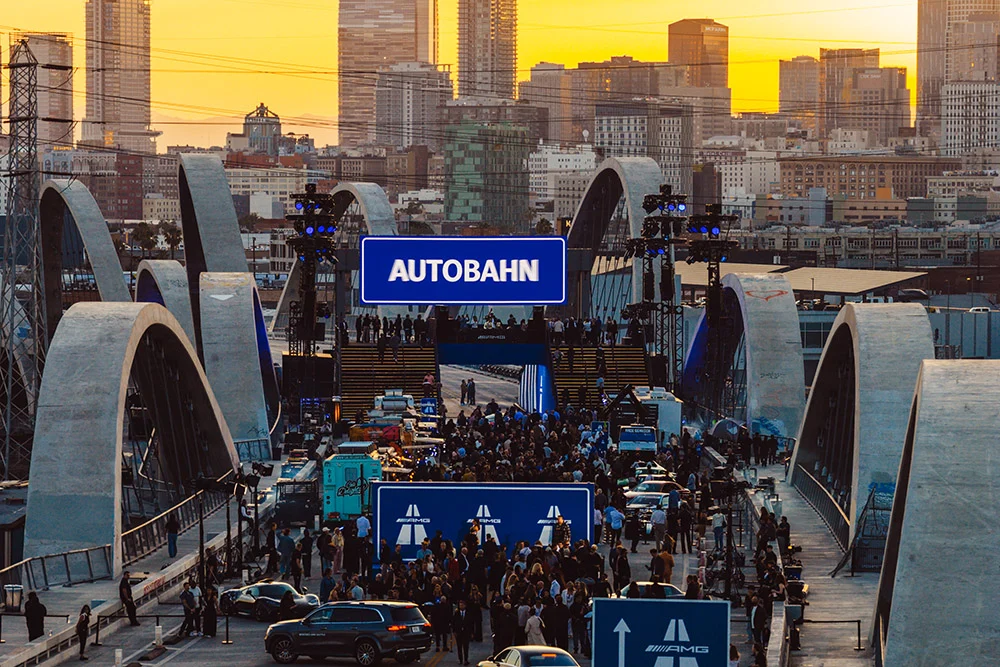

On a Tuesday night that redefined the intersection of automotive prowess, Hollywood glamour, and urban spectacle, a brilliant tennis-ball yellow car, powered by an all-electric drivetrain, executed a dramatic, tire-smoking surge across Los Angeles’s famed Sixth Street Viaduct. This unprecedented display, a stark departure from the traditional roaring gasoline engines typically associated with the bridge’s storied automotive history, marked the global unveiling of the latest high-performance machine from Mercedes-AMG. The event, meticulously orchestrated, saw the iconic L.A. River crossing transformed from a public thoroughfare into a closed set, complete with signage mimicking the German Autobahn, culminating in the emergence of none other than Academy Award-winning actor Brad Pitt from the vehicle.
The scene on the Sixth Street Viaduct was a carefully crafted tableau, designed to maximize impact and underscore the forward-looking nature of the launch. Unlike the impromptu gatherings of hot rods, drag racers, and lowriders that have long cemented the bridge’s status as a mecca for Angeleno automotive enthusiasts, or its appearances in cinematic classics like Grease and Terminator 2, this was a controlled, high-stakes affair. The star’s presence was not merely a celebrity endorsement but a strategic extension of his role as Sonny Hayes, the redemption-seeking racecar driver from the eagerly anticipated 2025 blockbuster F1. This cinematic connection was no coincidence; Mercedes-Benz, through its high-performance subsidiary Mercedes-AMG, is deeply intertwined with Pitt’s on-screen persona, having served as the in-movie sponsor of Hayes’s fictional APXGP racing team. The real-world event, therefore, served as a powerful cross-promotional platform, marrying the allure of Hollywood with cutting-edge automotive engineering.
The Sixth Street Viaduct: A Symbol of Los Angeles’s Evolving Identity
The choice of the Sixth Street Viaduct for such a monumental reveal was deeply symbolic, tapping into the very soul of Los Angeles’s automotive and cultural identity. The original Sixth Street Viaduct, a majestic concrete structure spanning the Los Angeles River and a vital artery connecting downtown L.A. with the Boyle Heights neighborhood, had stood for nearly a century as a beloved landmark. Opened in 1932, it became an indelible part of the city’s fabric, celebrated not only for its Art Deco and Streamline Moderne architectural elements but also for its frequent appearances in film, television, and music videos. Its long, sweeping curves and dramatic backdrop of the downtown skyline made it a favored spot for car enthusiasts to cruise, showcase their vehicles, and even engage in illicit street racing, further cementing its legend in L.A.’s car culture.
However, due to seismic vulnerability and "concrete cancer," the original bridge was demolished in 2016, a poignant moment for many Angelenos. Its replacement, the new Sixth Street Viaduct, officially named the "Sixth Street Viaduct at Sam Boyd Freeway" but colloquially known as the "Ribbon of Light," opened in July 2022 after years of construction and a budget exceeding $588 million. Designed by architect Michael Maltzan, the new bridge features a distinctive series of illuminated arches, quickly becoming a modern architectural marvel and a new iconic symbol for the city. Its contemporary design and renewed prominence have made it a fresh canvas for cultural expression, from community gatherings to high-profile events like this Mercedes-AMG launch. By choosing this location, Mercedes-AMG not only leveraged the bridge’s cinematic legacy but also its renewed status as a beacon of modernity and progress, perfectly aligning with the launch of an avant-garde electric performance vehicle. The juxtaposition of the bridge’s enduring appeal to car culture with the introduction of a silent, electric supercar underscored a profound shift in the automotive landscape.
Unveiling the Future: The Mercedes-AMG GT 63 4-Door Coupe
At the heart of the spectacle was the global reveal of the all-new Mercedes-AMG GT 63 4-Door Coupe, a vehicle that represents a significant leap forward in the luxury performance segment and a bold statement in the era of electrification. While specific model designations can vary, the vehicle showcased on the bridge, a "swoopy 1153 hp all-electric sports sedan," is understood to be a highly anticipated variant of the AMG GT family, engineered to redefine performance benchmarks. This model, boasting an astonishing 1153 horsepower, is capable of accelerating from 0 to 60 mph in a breathtaking 2 seconds. This blistering acceleration time positions it firmly at the pinnacle of automotive performance, not merely competing with but indeed "Ferrari-besting" many of the most elite internal combustion engine supercars.
The development of such a vehicle signifies Mercedes-AMG’s unwavering commitment to maintaining its heritage of extreme performance even as the automotive world pivots towards sustainable mobility. Historically, AMG has been synonymous with powerful V8 engines and a visceral driving experience. The new electric GT 4-Door Coupe demonstrates that the future of AMG performance will be equally, if not more, electrifying. This vehicle is more than just a fast car; it represents the culmination of advanced battery technology, sophisticated electric motor integration, and AMG’s renowned chassis tuning expertise. It aims to deliver not only raw speed but also the refined luxury, precise handling, and distinctive character expected from a Mercedes-AMG product. Its market positioning is clear: to capture the discerning customer who demands ultimate performance and luxury, now delivered with an electric powertrain that offers instant torque, silent operation, and zero emissions. This launch positions Mercedes-AMG directly against formidable electric competitors like the Porsche Taycan Turbo S, Lucid Air Sapphire, and Tesla Model S Plaid, all of which have pushed the boundaries of what electric vehicles can achieve in terms of speed and luxury. The 1153 hp figure suggests a multi-motor setup, likely providing advanced torque vectoring and all-wheel-drive capabilities for unparalleled traction and dynamic handling.
Brad Pitt’s Strategic Partnership and the ‘F1’ Movie Synergy
Brad Pitt’s involvement in the event was a masterstroke of synergistic marketing, meticulously planned to capitalize on his association with the upcoming F1 film. In the movie, Pitt portrays Sonny Hayes, a veteran Formula 1 driver who comes out of retirement to mentor a young talent, aiming for one last shot at glory. Mercedes-Benz, through its deep involvement in Formula 1 racing and its partnership with the movie’s production, has leveraged this narrative to create a seamless link between fiction and reality. The "APXGP racing team" in the movie, sponsored by Mercedes, mirrors the brand’s real-world dominance in F1 with its Mercedes-AMG Petronas Formula One Team.
Melody Lee, Mercedes-Benz’s Chief Marketing Officer, explicitly confirmed Pitt’s participation as a "paid partnership," acknowledging the actor’s significant value as a brand ambassador. Lee highlighted Pitt’s acquired driving skills, stating, "He is a really good driver after his training on ‘F1’." While Pitt was a passenger in the new electric GT 4-Door Coupe for its dramatic crossing of the Viaduct, with a professional driver at the wheel, his training for the movie undoubtedly deepened his understanding and appreciation for high-performance vehicles, lending authenticity to his endorsement. The rationale for his selection was pragmatic: "because of the ties between the team, the movie, and the car debuting here, he seemed like a logical choice." This multi-layered approach demonstrates the increasing sophistication of celebrity endorsements, moving beyond simple product placement to integrate stars into broader brand narratives, particularly when a film project provides a natural and credible context. The ‘F1’ movie itself has garnered significant attention, not only for Pitt’s involvement but also for its unprecedented access to the Formula 1 paddock and real-world racing events, promising a level of authenticity rarely seen in motorsports cinema. This long-term association positions Pitt not just as an actor, but as a credible figure within the high-stakes world of racing, making his presence at the AMG launch all the more impactful.
A Constellation of Stars: Celebrity Engagement and Brand Strategy
The star-studded guest list extended far beyond Brad Pitt, creating a veritable who’s who of Hollywood, sports, and music, further amplifying the event’s visibility and cultural resonance. Among the luminaries joining Pitt were actor Jacob Elordi, comedian Kevin Hart, reality television personality Kourtney Kardashian, NFL star Odell Beckham Jr., actor Gabriel Macht, musician Finneas, Olympic fencing medalist Miles Chamley-Watson, and even Mercedes’s own Formula One drivers, George Russell and Kimi Antonelli. The evening’s festivities were capped by a live performance from pop-punk pioneers Blink-182, transforming the product launch into a full-fledged cultural event.

Melody Lee offered insight into Mercedes-Benz’s nuanced approach to celebrity partnerships, explaining that the nature of engagement varies significantly. "A great example is Jacob Elordi, who found us," Lee remarked, illustrating instances where celebrities genuinely gravitate towards the brand due to personal affinity, sometimes participating "uncompensated because they just truly love the brand." Conversely, she acknowledged that "others, sure, they ask for compensation to show up, and sometimes we work it out with a car or a fee or both." This flexible strategy allows Mercedes-Benz to cultivate a diverse roster of ambassadors, from organic enthusiasts to strategically compensated partners, ensuring broad appeal across various demographics. The presence of F1 drivers George Russell and Kimi Antonelli also served to bridge the gap between Mercedes-AMG’s racing pedigree and its road-going performance vehicles, reinforcing the brand’s authentic connection to motorsport. The inclusion of Blink-182 added a dynamic, energetic element to the evening, appealing to a younger demographic and creating a memorable, festival-like atmosphere around the product reveal. This comprehensive celebrity and entertainment strategy underscores Mercedes-Benz’s commitment to creating experiences that transcend traditional automotive marketing, embedding its brand deeply within popular culture.
The Logistics of Grandeur: Shutting Down a Major Thoroughfare
The logistical undertaking of closing a major public roadway like the Sixth Street Viaduct in the heart of Los Angeles for a private event was immense, requiring extensive planning, negotiation, and significant financial investment. Melody Lee shed light on the complexity, stating, "It took many months of discussions, negotiations, petitions, permits." Such an endeavor involves navigating a labyrinth of city agencies, including the Department of Transportation, the Los Angeles Police Department, and various local community boards, each with their own requirements and concerns. Permitting for street closures, especially for critical infrastructure like a major bridge, demands rigorous safety protocols, traffic management plans for detours, and clear communication with affected residents and businesses.
The cost associated with such a closure is substantial, encompassing not only direct permit fees but also expenses for security, traffic control personnel, alternative transportation arrangements, and compensation for potential disruptions. "You obviously have to pay a price to shut down a major thoroughfare," Lee confirmed, hinting at the multi-million dollar investment required for such an ambitious launch. However, from the city’s perspective, the benefits often outweigh the inconveniences. Lee emphasized this reciprocity, noting, "for the city of L.A, it’s a really exciting moment. It’s a lot of publicity for the city." She elaborated on the deeper cultural significance: "But more than that, it’s an absolute tribute to the place that Los Angeles plays in our culture. The city, and the Sixth Street Bridge, are not just production locations, they’re iconic characters in movies and television."
For Los Angeles, hosting such a high-profile global event reinforces its status as a world-class city capable of staging large-scale productions. It generates international media attention, showcasing the city’s landmarks and vibrant cultural scene, which can translate into increased tourism and investment. The event also symbolizes a modern reinterpretation of L.A.’s car culture, moving from traditional hot rods to cutting-edge electric performance, mirroring the city’s own progressive environmental goals. The successful execution of such an event sets a precedent for future high-impact marketing initiatives, demonstrating the city’s willingness and capability to collaborate with major brands for mutually beneficial outcomes, even if it means temporarily re-routing daily commutes.
Broader Impact and Implications for the Automotive Landscape
The Mercedes-AMG GT 4-Door Coupe launch on the Sixth Street Viaduct transcended a mere product reveal; it served as a powerful declaration of intent for the luxury automotive industry and a cultural milestone for Los Angeles. The event underscored several critical shifts:
Firstly, it crystallized the accelerating transition of high-performance automotive brands towards electrification. Mercedes-AMG, a bastion of internal combustion engine power, has unequivocally embraced electric propulsion as the future of speed and luxury. The 1153 hp electric GT 4-Door Coupe is not just an alternative; it’s presented as the evolution, capable of delivering performance figures that challenge and often surpass traditional supercars. This signals a broader industry trend where electrification is no longer a compromise but an enhancement, offering instant torque, silent operation, and innovative driving dynamics.
Secondly, the event highlighted the deepening intertwining of Hollywood, sports, and luxury brands in modern marketing. By leveraging Brad Pitt’s role in a major F1 movie, integrating real-world F1 drivers, and featuring a diverse array of celebrities and a live music performance, Mercedes-AMG crafted an immersive brand experience that resonated across multiple cultural touchpoints. This multi-platform approach generates unparalleled buzz and demonstrates how luxury brands are now storytellers, weaving their products into compelling narratives that extend far beyond traditional advertising.
Thirdly, the selection of the Sixth Street Viaduct as the stage showcased Los Angeles’s unique position as a global cultural capital. The city’s iconic landmarks, rich cinematic history, and vibrant car culture provide an unparalleled backdrop for such ambitious events. The willingness of city officials to facilitate such a high-profile, albeit disruptive, undertaking speaks to L.A.’s understanding of its role as a global stage and its embrace of innovative partnerships that generate worldwide publicity. This event reaffirms the city’s capacity to host large-scale productions and its evolving identity as a hub for future-forward industries.
Finally, the silent, yet tire-smoking, passage of the electric supercar across a bridge famed for its roaring engines symbolizes a profound shift in "car culture" itself. It suggests that the thrill of driving, the pursuit of performance, and the allure of automotive beauty can thrive in an electric future, redefining what it means to be an automotive enthusiast in the 21st century. The Mercedes-AMG GT 4-Door Coupe is not just a car; it’s a testament to a future where sustainable luxury and uncompromising performance coexist, heralded by a celebrity spectacle on one of America’s most iconic bridges.