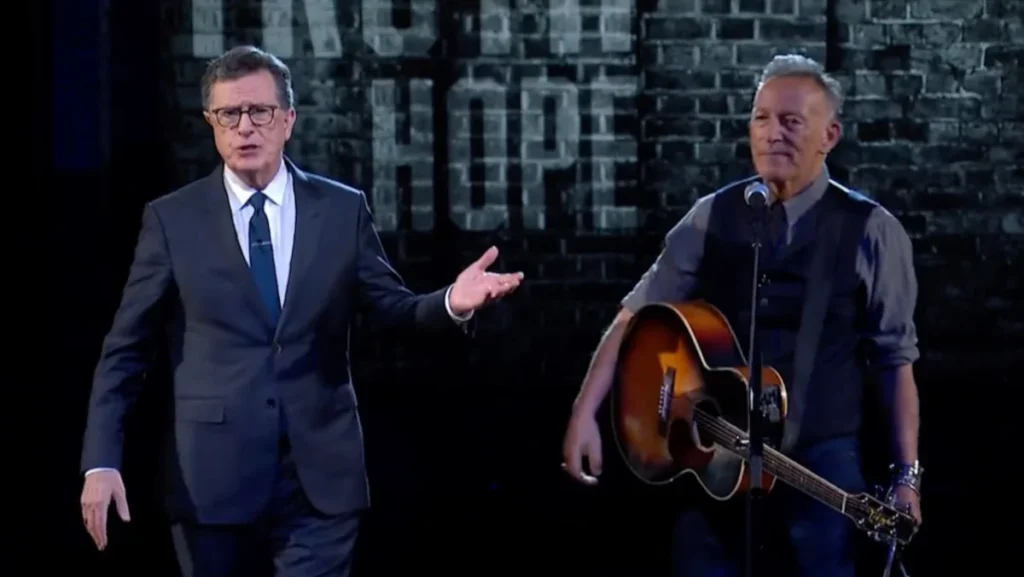

In a powerful and unvarnished moment that reverberated across the cultural and political landscape, legendary musician Bruce Springsteen delivered a scathing critique of corporate media independence and political sensitivity during his appearance on the penultimate episode of The Late Show with Stephen Colbert. As the iconic late-night program neared its conclusion, Springsteen stood firmly in support of host Stephen Colbert, asserting that the show’s cancellation was a direct consequence of a president intolerant of satire and media owners prioritizing political appeasement over journalistic integrity. This statement, made on Wednesday, May 21, 2026, ahead of his performance of the protest song "Streets of Minneapolis," immediately ignited widespread debate regarding free speech, corporate influence, and the future of political commentary in broadcast television.
The Curtain Falls on a Satirical Era
The Late Show with Stephen Colbert has long been a bastion of sharp political humor, incisive interviews, and cultural commentary since its inception. For over a decade, Colbert navigated the complex currents of American politics, particularly during periods of intense polarization, often using his platform to challenge power and articulate the anxieties of a significant portion of the populace. His unique blend of intellectual wit, earnest passion, and comedic timing earned him critical acclaim and a dedicated viewership. The announcement of the show’s impending end, a decision made by CBS parent company Paramount, sent ripples of concern through the industry, with many speculating about the underlying reasons for discontinuing such a prominent and culturally significant program. While official statements often cite evolving viewership habits, rising production costs, or a natural conclusion to a long run, Springsteen’s direct accusation introduced a far more contentious narrative.
Springsteen’s Unflinching Accusation
Prior to his emotionally charged performance, Bruce Springsteen addressed the audience and, more pointedly, the wider public, with a statement that left little room for misinterpretation. "I am here in support tonight for Stephen, because you are the first guy in America who lost his show because we got a president who can’t take a joke," Springsteen declared. This assertion immediately framed Colbert’s departure not as a routine network decision but as a capitulation to political pressure. Springsteen then expanded his criticism to include the corporate figures at the helm of CBS’s parent company, Paramount. "And because Larry and David Ellison [the owners of CBS parent company, Paramount] feel they need to kiss his ass to get what they want. Stephen, these are small-minded people. They got no idea what the freedoms of this beautiful country are supposed to be about."
The Ellisons, known for their vast tech empire through Oracle Corporation and their significant investments in media, including Paramount Global, represent a powerful nexus of corporate influence. Springsteen’s insinuation suggests that these media magnates, in pursuit of business interests or regulatory favors, allegedly sacrificed a prominent voice of satire to placate a politically sensitive administration. This accusation raises profound questions about the independence of major media outlets and the potential chilling effect on critical commentary when corporate interests intersect with political power.
"Streets of Minneapolis": A Song of Protest and Principle
Springsteen’s choice of song, "Streets of Minneapolis," underscored the politically charged nature of his appearance. Released in early 2026, the track quickly became an anthem for immigrant rights and social justice. The song was a direct response to the tragic deaths of Renée Good and Alex Pretti, two individuals who died under the custody of U.S. Immigration and Customs Enforcement (ICE) in Minneapolis detention facilities in late 2025. Their deaths, which sparked nationwide protests and renewed scrutiny of ICE practices, were attributed by advocates to inadequate medical care and inhumane conditions. Springsteen, renowned for his long history of protest music and social activism, channeled public outrage into a poignant and powerful musical statement. His performance on The Late Show, coming just months after the song’s release, served as a stark reminder of the social issues that continue to demand attention and the artist’s role in challenging the status quo. From his early work addressing the plight of the working class to his more recent critiques of governmental policies, Springsteen has consistently used his platform to advocate for justice, making his solidarity with Colbert a natural extension of his enduring principles.
The Corporate-Political Nexus: A Deeper Dive
The claim that Larry and David Ellison, through Paramount, bowed to presidential pressure carries significant weight. Corporate media conglomerates often operate in highly regulated environments, where government decisions on mergers, antitrust issues, spectrum allocation, and foreign ownership can have colossal financial implications. While no specific political pressure or demand has been officially confirmed by Paramount or the White House, the inference by Springsteen suggests a climate where media owners might preemptively self-censor or remove perceived thorns in the side of an administration to safeguard broader business interests. This dynamic is not unprecedented in media history, where the lines between news, entertainment, and corporate strategy can blur, particularly when facing powerful political figures.
Industry analysts, speaking on background, have often highlighted the delicate balance major networks must strike. "In an era where every major media merger faces intense regulatory scrutiny, and content distribution deals are subject to geopolitical shifts, media executives are under immense pressure to maintain amicable relationships with those in power," one anonymous media executive commented. "Whether that manifests as direct demands or subtle signals, the potential for political influence on programming decisions is a constant undercurrent."
Colbert’s Legacy: A Decade of Sharp Satire
Stephen Colbert’s journey to becoming a late-night icon is itself a testament to his unique comedic and intellectual prowess. He first rose to prominence with The Colbert Report on Comedy Central, a highly influential satirical news program that ran from 2005 to 2014. On The Colbert Report, he perfected a character that was a parody of conservative cable news pundits, using irony and mock patriotism to dissect political discourse. This character became a cultural phenomenon, earning him Peabody Awards and Emmy Awards for its innovative approach to political satire.
When he took over The Late Show from David Letterman in 2015, Colbert transitioned from character-driven comedy to a more direct, yet still deeply satirical, approach. He inherited a show with a long legacy but quickly made it his own, particularly during the politically turbulent years that followed. Colbert distinguished himself by consistently engaging with current events, often delivering passionate monologues that blended humor with genuine moral outrage. His willingness to directly confront political figures, dissect complex policy, and offer sharp social commentary made The Late Show a nightly staple for viewers seeking both entertainment and intellectual engagement. This very commitment to unvarnished critique, as Springsteen suggests, may have ultimately contributed to its early demise.
The Political Climate of 2026: An Era of Sensitivity
While Springsteen refrained from naming the specific president, his statement paints a picture of a political landscape in 2026 where criticism, particularly through humor, is not tolerated. This reflects a growing concern among civil liberties advocates and media watchdogs about the increasing fragility of free expression in democratic societies. In recent years, political figures across the spectrum have shown a tendency to respond aggressively to satire, often conflating comedic critique with disloyalty or personal attacks.
The role of satire in a democracy is foundational. It provides a crucial check on power, allowing citizens to laugh at, and thereby demystify, figures of authority. It can expose hypocrisy, challenge conventional wisdom, and foster critical thinking. When a political leader is depicted as "unable to take a joke," it suggests a broader authoritarian impulse that seeks to control narratives and suppress dissent, even in its most playful forms. Such an environment can lead to self-censorship, as media outlets and artists become wary of provoking official displeasure, thereby eroding the very freedoms Springsteen invoked.
A Week of Poignant Farewells and Symbolic Acts
Colbert’s final week on The Late Show was marked by a series of high-profile and emotionally resonant performances, each seemingly imbued with a deeper, symbolic meaning in light of the show’s impending end. The night before Springsteen’s appearance, on Tuesday, May 20, Colbert joined legendary Talking Heads frontman David Byrne for a cathartic performance of "Burning Down the House." The song, an iconic anthem of rebellion and societal upheaval, took on particular significance as Colbert and Byrne, backed by a vibrant musical ensemble, delivered a spirited rendition. Many viewers interpreted this choice as a subtle, yet powerful, commentary on the forces at play within the media landscape and the political establishment. The image of Colbert, a figure often associated with intellectual resistance, singing about "burning down the house" resonated deeply with audiences who perceived the show’s cancellation as an affront to independent media. The guest lineup for the ultimate final episode, airing on Thursday, May 22, remained shrouded in mystery, intensifying anticipation and speculation about what final statements, both overt and subtle, Colbert might deliver.
The Evolving Landscape of Late-Night Television
The cancellation of The Late Show with Stephen Colbert also prompts a broader examination of the state of late-night television. For decades, these programs have been a cornerstone of American broadcasting, offering a nightly dose of news, celebrity interviews, and comedic relief. However, the rise of streaming services, on-demand content, and fragmented media consumption has significantly altered viewing habits. Traditional broadcast numbers have steadily declined, forcing networks to re-evaluate their programming strategies.
While some argue that the shift away from linear television makes politically charged commentary less impactful on traditional networks, others contend that a strong, independent voice like Colbert’s is more critical than ever in an age of misinformation and echo chambers. The question of whether late-night satire can thrive, or even survive, under increasing corporate and political pressures remains a pressing concern for media professionals and audiences alike. Will future late-night hosts be forced to adopt a more cautious, less confrontational approach, or will new platforms emerge to champion independent, fearless comedic voices?
Springsteen’s "Land of Hope and Dreams Tour" Continues
Coinciding with his impactful appearance on The Late Show, Bruce Springsteen is in the final stretch of his critically acclaimed "Land of Hope and Dreams Tour." The tour, which has been lauded for its powerful performances and nostalgic resonance, serves as a backdrop to his continued engagement with contemporary social and political issues. His remaining tour dates include:
- May 22 – Cleveland, OH @ Rocket Arena
- May 24 – Boston, MA @ TD Garden
- May 27 – Washington, DC @ Nationals Park
- May 30 – Philadelphia, PA @ Xfinity Mobile Arena
These performances offer Springsteen continued opportunities to connect with his dedicated fanbase and reinforce his status not just as a music legend, but as an enduring voice of conscience in American culture.
Broader Implications and Reactions
Springsteen’s direct and potent accusation has sparked a vigorous debate across various sectors. Political commentators have highlighted the implications for freedom of speech and the potential for a chilling effect on journalistic independence. Media ethicists are discussing the responsibilities of corporate ownership in upholding editorial integrity, especially when faced with governmental pressure. Social media platforms have exploded with discussions, with many viewers expressing outrage and solidarity with Colbert, while others have dismissed Springsteen’s claims as unfounded partisan rhetoric.
The White House, through anonymous sources, has reportedly dismissed Springsteen’s comments as "unsubstantiated and politically motivated," asserting that the administration respects freedom of expression and does not interfere with private corporate decisions. Paramount Global has yet to issue a direct response to Springsteen’s specific allegations, reiterating earlier statements about the natural evolution of programming.
Ultimately, Bruce Springsteen’s dramatic intervention on The Late Show serves as a stark reminder of the ongoing tension between artistic freedom, corporate interests, and political power. As Stephen Colbert signs off, his departure, framed by Springsteen’s powerful words, leaves behind not just a legacy of laughter and insight, but a profound question about the integrity of media in an increasingly complex and politically charged world. The incident is likely to be remembered as a pivotal moment, forcing a critical re-evaluation of the forces that shape public discourse and the enduring importance of voices willing to challenge authority, even at great personal and professional cost.