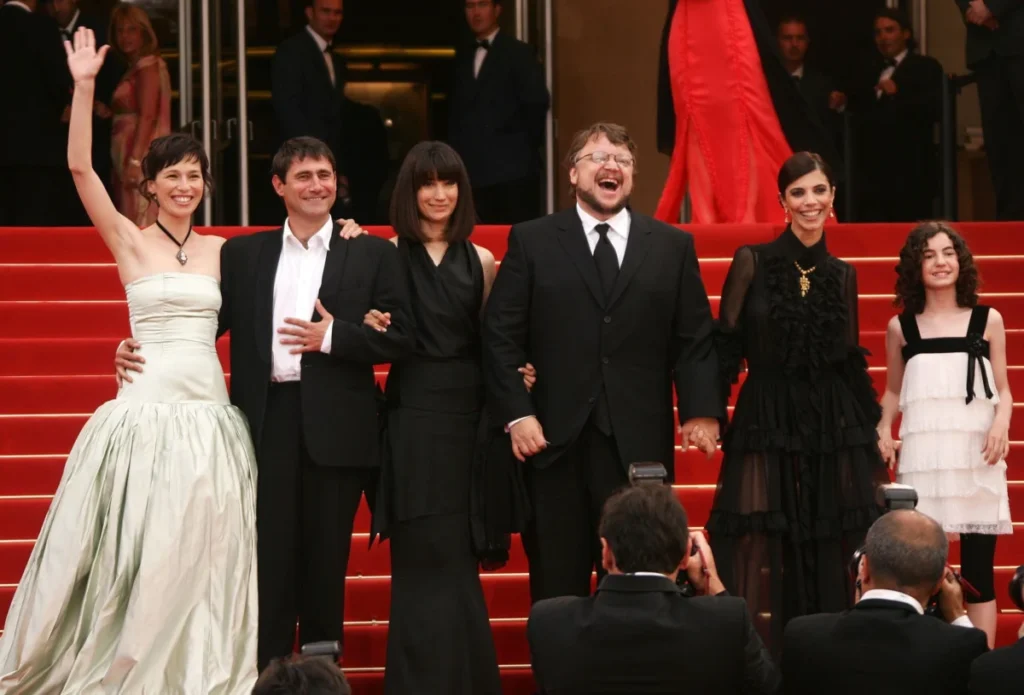

When visionary filmmaker Guillermo del Toro arrived at the Cannes Film Festival two decades ago with his dark, ravishing fantasy, Pan’s Labyrinth, he harbored no expectations of a triumph; rather, he anticipated being largely overlooked. Fast forward to today, the film stands as a monumental achievement in modern cinema, its 20th anniversary celebrated with a newly restored 4K version and an impending 3D release, prompting del Toro’s return to the Croisette for the opening of the Cannes Classics selection. His reflections reveal a journey fraught with challenges, culminating in an unprecedented outpouring of critical and public adoration that reshaped not only his career but also the very fabric of how prestigious film festivals approach genre cinema.
The Genesis of an Unforeseen Triumph
The year was 2006. Pan’s Labyrinth, a Spanish-language co-production set against the brutal backdrop of Francoist Spain in 1944, was the last film scheduled to screen in competition at that year’s Cannes Film Festival. The late slot, often perceived as a disadvantage, led del Toro to believe that much of the international press would have already departed. "A lot of the press was leaving," del Toro recounted to The Hollywood Reporter during his recent visit to Cannes. "I was thinking: ‘How many people are going to show up for this, on the final day?’ Then the screening was packed, packed!" This unexpected turnout was merely a prelude to what would become a legendary moment in festival history.
The film’s conclusion was met with an "explosion of applause that is the largest and most emotional I’ve ever had in my life," a standing ovation that remarkably lasted an astonishing 23 minutes. This duration remains a Cannes record, a testament to the profound impact the film had on its inaugural audience. "Twenty-three minutes is a commute," del Toro quipped to the audience at the Cannes Classics screening on May 12, held in the Debussy Theatre, underscoring the sheer length of the spontaneous tribute. Such effusive displays are rare at Cannes, a festival known for its often "circumspect" reactions. Del Toro noted, "Normally Cannes is very circumspect. You either get no sound or you get aggressive sound. But rarely do people react to the screen loudly, and then they start reacting. And then it gets more and more emotional." Overwhelmed by the moment, del Toro found himself struggling to internalize the adulation. His close friend and fellow Mexican director, Alfonso Cuarón, present at the screening, offered a poignant piece of advice: "Let it in. Let the love get in."
A Brutal Production Journey to Critical Acclaim

The path to that euphoric Cannes premiere was anything but smooth. Del Toro candidly described the making of Pan’s Labyrinth as "the second-worst filmmaking experience of my life," surpassed only by his ordeal with Mimic under the infamous Weinsteins. Financing proved to be an immense hurdle, with "nobody wanting to finance it" initially. The production itself was plagued with difficulties, extending into a challenging post-production phase. The film arrived at Cannes "basically just in time with the print," a testament to the frantic race against the clock to complete the ambitious project.
Despite these struggles, the film emerged as a singular artistic vision. Set five years after the Spanish Civil War, Pan’s Labyrinth follows Ofelia (played by Ivana Baquero), a young girl who moves with her pregnant mother to a remote military outpost commanded by her new stepfather, the sadistic Francoist Captain Vidal (Sergi López). In the ancient labyrinth near their new home, Ofelia encounters a mysterious faun who reveals her to be a princess from an enchanted realm, tasking her with three dangerous quests to prove her worth and return to her true home. Del Toro masterfully intertwines this dark fairy tale with the grim reality of the Republican resistance, subtly suggesting that imagination and fantasy serve as powerful forms of defiance against oppression and brutality – a recurring theme in much of his acclaimed work. The film’s nuanced narrative, breathtaking visuals, and haunting score resonated deeply with critics and audiences alike.
Cannes: A Shifting Paradigm for Genre Cinema
The 2006 Cannes competition was, in hindsight, a pivotal moment for the festival itself. Del Toro remarked that Pan’s Labyrinth and Park Chan-wook’s Oldboy, another genre-bending film that screened in competition that year, "marked a big shift." He observed, "This is early days at Cannes of changing the mentality of the programming from the 10 or 20 directors that normally came to Cannes." Prior to this, del Toro had attended Cannes with his debut feature Cronos in 1992, and his contemporary Alejandro González Iñárritu with Amores Perros, but their films were consistently relegated to sidebar sections, never the prestigious main competition. The inclusion and subsequent acclaim for Pan’s Labyrinth and Oldboy signaled a significant opening of Cannes to genre-inflected cinema originating from beyond the traditional European and American art-house circuits, broadening its scope and appeal. This shift reflected an evolving global cinematic landscape where diverse storytelling and innovative forms were gaining increasing recognition.
Following its groundbreaking Cannes premiere, Pan’s Labyrinth embarked on a highly successful festival circuit, further solidifying its reputation. It received another standing ovation at the New York Film Festival, an institution del Toro also characterized as "very circumspect," before moving on to the Toronto International Film Festival. This sustained positive reception confirmed to del Toro and the industry that "there was something there." The film’s momentum carried it through the awards season, culminating in six Academy Award nominations, including Best Foreign Language Film and Best Original Screenplay. It ultimately secured three Oscars: for Best Cinematography (Guillermo Navarro), Best Art Direction (Eugenio Caballero, Pilar Revuelta), and Best Makeup (David Martí, Montse Ribé). Produced on a modest budget of under $20 million, Pan’s Labyrinth went on to gross an impressive $83 million worldwide, a remarkable feat for a Spanish-language fantasy film. Its critical success was also echoed in numerous other awards, including three BAFTA Awards, seven Goya Awards (Spain’s national film awards), and the Critics’ Choice Movie Award for Best Foreign Language Film, cementing its status as a critical darling and commercial success.
The Enduring Craftsmanship: A Vision Untouched

Returning to the film for its 20th anniversary, del Toro expressed profound satisfaction with its enduring quality. "I was quite taken about how beautifully physical the movie is," he reflected. He detailed his unwavering commitment to practical filmmaking, a hallmark of his artistic philosophy. "Back then, just as we did with Frankenstein, I was determined that every set was going to be built. We were going to handmake this movie. We did not shoot on location except for the forest. We built every set, every prop, built every piece of furniture. I wanted it to be, as much as possible, something fabricated." This meticulous approach was driven by a specific design intent: "There was a sense of design to create a juxtaposition between the imaginary world and the round, warm colors and the cool, straight lines of the captain’s world." Revisiting the film, he was "very impacted, just feeling how the craftsmanship is beautiful."
This dedication extended to the film’s pioneering blend of animatronics, in-camera effects, and subtle digital visual effects, all of which del Toro has chosen to leave untouched in the restoration. Unlike some filmmakers who might revisit and "improve" older effects, del Toro stands by his original vision. He mused, "The only film where I feel I did an effect that failed was on Blade II. There’s a digital shot in there that’s bad, and it will always be bad, because it was not well conceived and it was too ambitious. But there’s nothing I would change in Pan’s Labyrinth." This unwavering confidence in the film’s original execution speaks volumes about its timeless artistry.
The Grand Re-Release: 4K Restoration and Immersive 3D
To mark its two-decade milestone, Pan’s Labyrinth is receiving a comprehensive re-release, spearheaded by a stunning 4K restoration. This meticulously revitalized version will launch theatrically in the United States through Cineverse and Fathom Entertainment, offering audiences a chance to experience its visual splendor anew. StudioCanal, a major European film production and distribution company, has acquired international rights, planning theatrical releases across key territories including Germany, the U.K., France, Benelux, and Australia this autumn, followed by premium Collector’s Editions. Mexican exhibitor Cinépolis will lead distribution in Mexico and across Latin America, acknowledging the film’s cultural significance in its region of origin. The theatrical run is scheduled to commence on October 9th, a date of personal significance for del Toro, as it is his birthday.
In a surprising and innovative move, the October release will also feature, for the very first time, a 3D version of the film. Del Toro has been actively involved in this conversion process for months, which he admits is still ongoing. His rationale is to entice audiences who experienced the film initially to return to theaters. "My idea is, what can have people that experienced it in theaters say, ‘I want to experience it in theaters again’?" he explained. He believes the film’s original photographic style, characterized by "heavily composed foregrounds," makes it uniquely suited for the 3D format. "I always, as when I was watching it and we were placing the fairies in the digital effects, I always felt, ‘Oh, this would be so great if it had depth.’" Beyond mere spectacle, del Toro envisions using 3D expressively: "I said, ‘Oh, I can use it as an element of depth’ – when she is in the real world, it’s a little more shallow, and when she is in the imaginary world, I can have a little more depth. And I thought it could be used expressively."
The 3D conversion is being handled by SDFX Studios (formerly Stereo D), the same company del Toro collaborated with on his epic science fiction film, Pacific Rim. He holds a high regard for their work, stating, "For me, the best version of Pacific Rim is the IMAX 3D version. I feel you haven’t seen the movie if you haven’t seen it in IMAX 3D." Calibrating Pan’s Labyrinth to achieve a comparable, yet appropriate, result has been a painstaking endeavor. "It is taking many months because it has to be very carefully calibrated. You don’t want to overdo it. You don’t want to underdo it. The separation of elements has to be really carefully done for it to pop." He anticipates "many more months to finish" the meticulous 3D conversion, underscoring his commitment to delivering a truly immersive and artistically justified experience.

A Legacy for New Generations and the Future of Theatrical Cinema
One of the most remarkable aspects of Pan’s Labyrinth‘s enduring appeal, as del Toro has come to understand, is its unique structural longevity. Unlike many of his other works, which tend to age alongside their initial fanbases, Pan’s Labyrinth consistently finds purchase with each new generation. "If I talk to somebody that likes Hellboy or Blade, they’re 20 years older than when I launched it," he observed. "But if you talk to someone that loves Pan’s Labyrinth, most of the time you get a bunch of them are young people. For some reason it connects with the strength of being young, when the world is telling you that you’re wrong and you know that you’re right. I wanted to put it out in the world in a big way so that I can keep connecting with the spirits that remain young." This generational resonance ensures the film’s continued cultural relevance, speaking to universal themes of innocence, rebellion, and the power of belief in the face of adversity.
Del Toro also holds broader convictions about the value of bringing restored films back to cinemas, a perspective that aligns with the current industry discourse on the future of theatrical exhibition. "I think the future of theatrical is a mixture of reissues and new movies," he posited. He champions "the European model of the art house that exists very much enmeshed in the distribution and exhibition system – it’s such an interesting model, and it doesn’t quite get embraced outside of Europe, but I think it’s very promising." He reminisced about his own formative filmgoing experiences: "I would see the Hammer horror films opening weekend, and then three years later they were back in a double program or something. And it was always great – you wanted to revisit them. You put Road Warrior (1981) out there on a big screen, and I’m there. You put The Devils (1971) by Ken Russell in theaters, I’m there." This vision suggests a vibrant cinematic future where classic and contemporary films coexist on the big screen, fostering a deeper appreciation for film history and artistry.
Art as Resistance: A Timeless Message
Twenty years after that record-breaking standing ovation in Cannes, Guillermo del Toro continues to articulate the same fundamental arguments that underpinned Pan’s Labyrinth: that imagination is not a luxury, but a vital necessity, and that humanity must resist the insidious creep of fascism, fear, and the dangerous notion that human creativity can be replaced. His concluding remarks at the Cannes Classics screening served as a powerful reminder of the film’s enduring relevance in an increasingly complex world.
"We live in times where they tell us that what we are facing is so formidable that it is useless to resist, and that art can be made by a f*king app," he passionately declared to the Cannes crowd. "I feel [that] like the girl Ofelia in Pan’s Labyrinth, we can hope to leave a mark. If we can put our faith against their faith, and our strength against their strength, there is hope. We have to give in to one of two forces. We can give in to love. We can give in to fear. Never, never, never give in to fear." This powerful message, delivered by a filmmaker who has consistently championed the marginalized and celebrated the fantastical, resonates with profound urgency today, ensuring that Pan’s Labyrinth* remains not just a cinematic masterpiece, but a timeless beacon of hope and resistance.