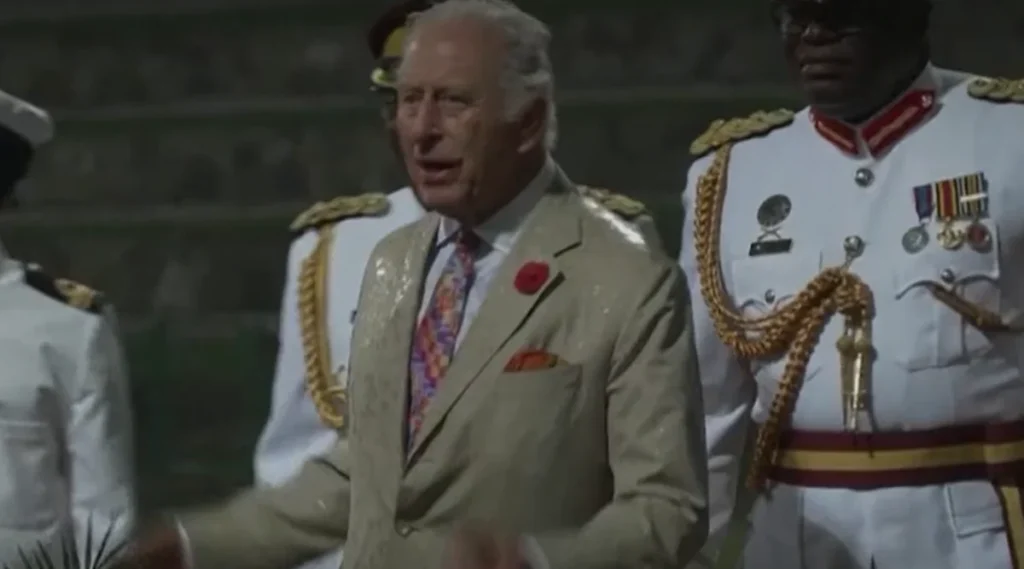

The unforgiving intersection of intense diplomatic pressure, public scrutiny, and unpredictable tropical weather was recently highlighted during an official royal tour of the Caribbean. King Charles and Queen Camilla found themselves at the center of international attention not merely due to high-stakes political discussions surrounding the Commonwealth and historical reparations, but because of a remarkably candid, rain-soaked moment during an Independence Day military parade in Antigua and Barbuda. As torrential downpours battered the ceremonial dais, a brief moment of vulnerability—famously captured on camera as the monarch asked, “Where’s the umbrella?”—sparked a global conversation about the realities of modern royal duty, the pressures of public representation, and the inherent lack of privacy faced by public figures.
The incident has since become a focal point for analyzing how royal figures manage high-pressure international engagements while navigating delicate diplomatic landscapes. Beyond the viral nature of the soaked beige suit and the hurried search for shelter, the episode underscores the complex realities of contemporary royal tours, where every gesture, micro-expression, and weather-induced mishap is magnified across digital platforms worldwide.
Chronology of the Event: From Celebration to Sudden Downpour
The sequence of events unfolded during the high-profile celebrations marking the Independence Day of Antigua and Barbuda, a momentous occasion for the Caribbean nation. King Charles and Queen Camilla were seated on an official dais to review a military parade, an event rich in tradition and civic pride. The atmosphere was initially celebratory, with the royal couple observing the proceedings under clear skies.
However, the regional climate shifted with characteristic swiftness. Within moments, clear skies gave way to a heavy, unyielding tropical downpour accompanied by strong winds. The sudden change in weather caught the assembly off guard. While the royal couple initially maintained their composure, the sheer intensity of the rain forced an immediate logistical scramble on the dais.
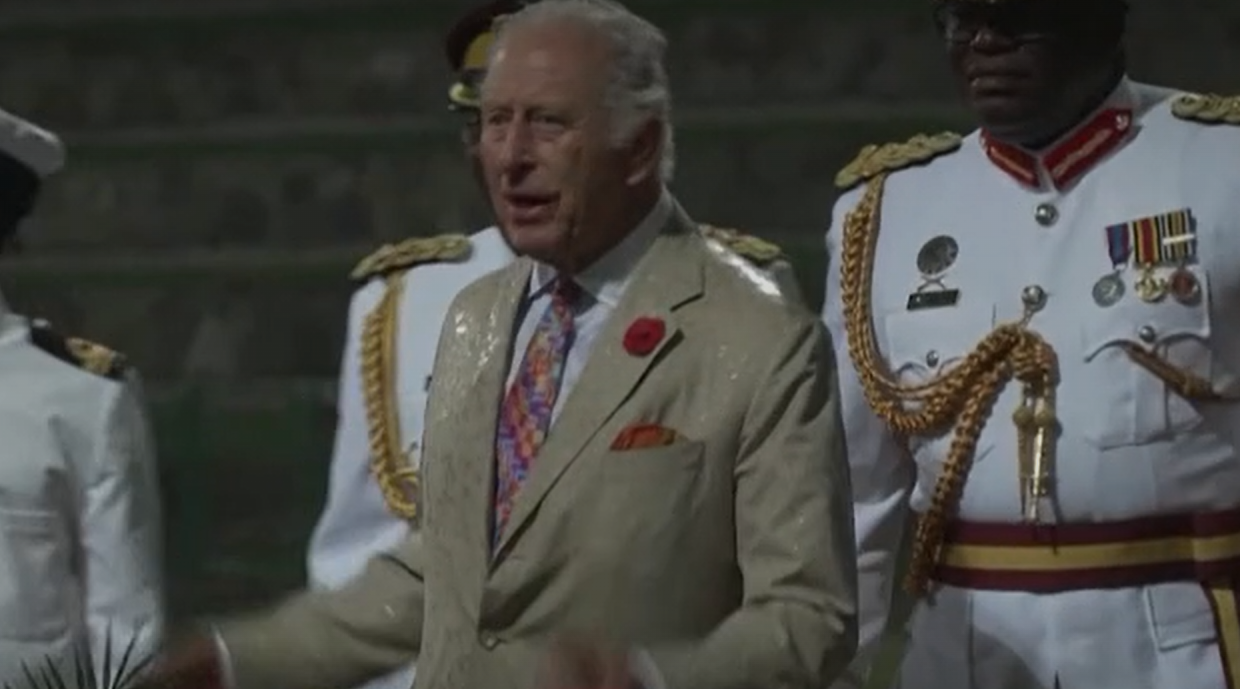
An umbrella was swiftly produced for Queen Camilla. Recognizing the vulnerability of her white attire—which poses distinct challenges during heavy rain due to transparency and fabric clinging—she made the tactical decision to step away from the exposed dais to maintain her professional appearance. King Charles, meanwhile, momentarily found himself isolated on the platform. Turning around to assess the situation, he posed the now-famous query caught by live broadcast cameras: “Where’s the umbrella?”
After a brief spatial retreat to gauge the severity of the weather, the King returned to his designated position on the dais. Standing entirely exposed to the elements, water streaming down his face and soaking his immaculate beige suit, he remained at his post to observe the remainder of the military parade. An umbrella was eventually delivered to him, but the damage to his attire was already complete. Later in the day, the monarch lightheartedly remarked that the trousers of his suit were so thoroughly soaked they were practically growing watercress, demonstrating a self-deprecating humor that defused the tension of the moment.
Background Context: A High-Stakes Diplomatic Mission
To fully understand the significance of the King’s steadfastness during the downpour, it is essential to examine the broader geopolitical context of the tour. King Charles and Queen Camilla’s visit to Antigua and Barbuda was not merely ceremonial; it served as a critical anchor for a broader series of engagements, chief among them the Commonwealth Heads of Government Meeting (CHOGM).
The tour took place against a backdrop of complex and sensitive diplomatic discussions. In the days leading up to the royal arrival, regional leaders and international commentators reignited intense debates surrounding the legacy of the transatlantic slave trade. Calls for a formal apology and structural reparations have gained significant momentum across several Caribbean nations within the Commonwealth. Prominent political figures, including regional leaders and British politicians, had publicly addressed the issue immediately prior to the royal delegation touching down in the Caribbean, placing immense scrutiny on the institution of the monarchy.
Consequently, the tour was widely recognized by royal analysts as one of the most delicate overseas missions undertaken by the sovereign in recent years. Every public appearance, speech, and interaction was subjected to intense media analysis, with stakeholders on all sides watching closely for any indication of how the modern monarchy intends to address historical grievances and manage its evolving role within the Commonwealth. Operating under such intense pressure requires a high degree of diplomatic stamina, emotional intelligence, and resilience—qualities that were tested both metaphorically by the political climate and literally by the tropical storm.
Analysis of Public Reaction and Media Scrutiny
The immediate public reaction to the King’s rain-soaked appearance revealed a distinct dichotomy in how modern audiences consume royal engagements. On one hand, video footage of the monarch looking for shelter and questioning the whereabouts of his protection officers circulated rapidly across social media platforms, drawing critique from detractors who scrutinized the optics of a royal figure visibly inconvenienced by weather.
Conversely, a wave of public and expert sympathy quickly emerged, emphasizing the human element of the situation. Observers noted the physical demands placed upon an individual who is approaching his late seventies and currently undergoing ongoing treatment for cancer. Medical and wellness advocates pointed out that being caught in a sudden, freezing deluge poses physiological shocks that any individual, regardless of title, would find uncomfortable.
Furthermore, commentators highlighted the chivalrous and pragmatic dynamics displayed on the dais. Queen Camilla’s decision to move away from the elements prevented a potentially embarrassing sartorial malfunction, given the notoriously difficult nature of white fabric in heavy rain. The King’s subsequent decision to remain on the dais—despite lacking immediate cover and enduring a thorough drenching—was interpreted by diplomatic analysts as a profound gesture of respect toward his hosts. Walking away from a national independence parade prematurely would have risked causing diplomatic offense, whereas enduring the discomfort demonstrated a steadfast commitment to the diplomatic obligations of the Crown.
Implications for the Modern Monarchy
The incident in Antigua and Barbuda serves as a micro-case study in the challenges of modern public representation. In an era dominated by instantaneous digital media, short-form video clips, and 24-hour news cycles, public figures are afforded virtually no margin for error or genuine human reaction. A fleeting moment of disorientation or frustration during a severe weather event is instantly extracted from its context and subjected to global critique.
Despite these modern pressures, the episode ultimately reinforced the value of resilience, humor, and adaptability. By laughing off the mishap—joking about watercress-growing trousers and acknowledging the comical contrast of Queen Camilla’s post-rain hairstyle—the royal couple demonstrated an ability to connect with audiences through self-awareness and grace.
As King Charles continues to navigate his reign amidst complex international dialogues, shifting Commonwealth dynamics, and health considerations, the Caribbean rainstorm will likely be remembered not as a diplomatic failure, but as a humanizing vignette. It demonstrated that behind the pomp, protocol, and heavy political burdens of the Crown lie individuals subject to the very same unpredictable elements as the rest of humanity—and capable of standing firm when the storm breaks.