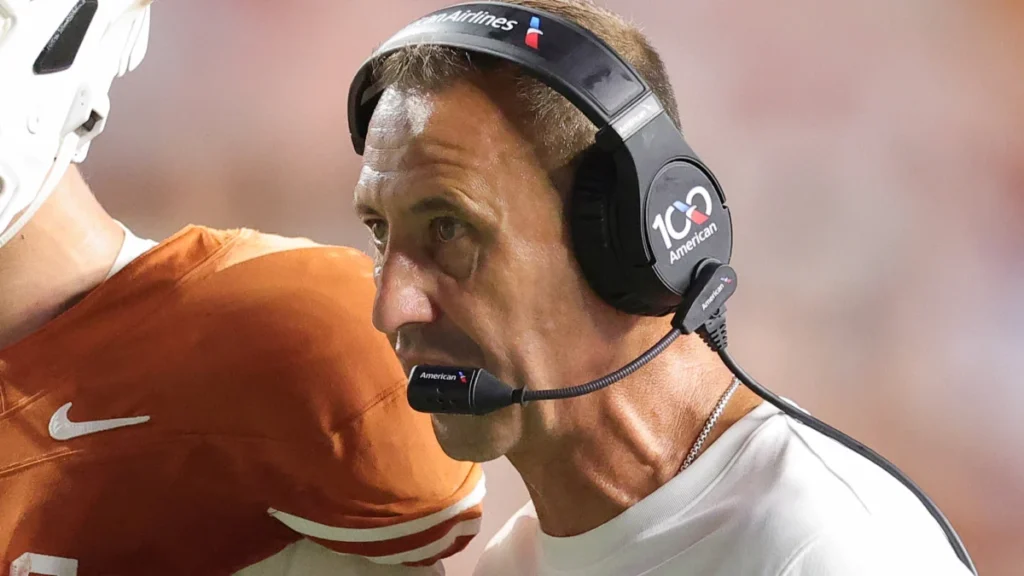

The college football landscape witnessed an extraordinary display of post-game volatility on the evening of September 12, 2026, when University of Texas head coach Steve Sarkisian cut short a scheduled sideline interview with ESPN reporter Holly Rowe. The incident occurred in the immediate aftermath of the Longhorns’ dramatic 24–23 victory over the top-ranked Ohio State Buckeyes at Darrell K Royal-Texas Memorial Stadium in Austin. As the stadium crowd reached a fever pitch, the brief and awkward interaction sparked a nationwide debate regarding the necessity of sideline media obligations, the pressures placed on collegiate coaches, and the evolving nature of post-game journalism.
A Chronology of the Evening’s Media Tensions
The friction between the Texas coaching staff and the ESPN broadcast team did not begin with the final whistle. Reports from the event suggest that tensions had been building throughout the contest. According to documentation from The Athletic, Sarkisian was slated to participate in a standard halftime interview with ESPN’s Laura Rutledge. That engagement was derailed by persistent technical malfunctions that prevented the broadcast from proceeding as planned.
During the broadcast, Rutledge noted that the head coach had remained patient throughout the delay, waiting for a signal that never arrived due to the equipment failure. However, when the post-game moment arrived—the culmination of what many analysts are calling the signature win of Sarkisian’s tenure—the coach appeared to have reached a threshold of exhaustion and adrenaline.
As the clock hit zero, Holly Rowe approached Sarkisian on the field. She managed to begin the inquiry, stating, "Coach, this is one of the most—" before Sarkisian interrupted her. The coach, visibly animated and focused on his players, shouted, "Let’s go, Texas fight! Let’s go, Texas fight! Hook ’em!" He immediately vacated the area, leaving the broadcast equipment and the reporter behind. Rowe, who has been a staple of collegiate sideline reporting for decades, was seen walking off the camera frame shortly thereafter, marking an abrupt end to the planned post-game segment.
The Anatomy of the Interaction: Perspectives from the Field
The incident immediately bifurcated the sports media community, with opinions varying wildly based on the priority placed on media accessibility versus the emotional reality of high-stakes athletics.
Madelyn Burke, an anchor for ESPN’s SportsCenter, was among the first to voice public criticism regarding the conduct. Utilizing social media to address the event, Burke labeled the departure as "rude," emphasizing that reporters like Rowe are seasoned professionals tasked with performing specific duties essential to the broadcast experience. The sentiment reflected a segment of the journalism community that views such interviews as vital conduits for fans to gain immediate insight into the emotional and strategic landscape of a high-profile game.
Conversely, Emmanuel Acho, a former Texas Longhorn standout and current analyst for Fox Sports, offered a more nuanced perspective. Having been present on the field during the celebration, Acho provided a "ground-level" view of the situation. He acknowledged the validity of both parties: the necessity of Rowe’s role in delivering content to the audience, and the human element of a head coach who had just secured a monumental victory against the No. 1 team in the nation.
Acho’s analysis suggests that the friction might have been avoided through a more fluid approach to live television. He posited that a seasoned reporter might have pivoted away from the coach if it became clear the emotional gravity of the moment demanded his immediate attention elsewhere. According to Acho, "Sark had a huge win. ESPN (thus Holly) had a huge win." The collision of these two objectives—the journalist’s mandate to report and the coach’s mandate to lead—created a friction point that was exacerbated by the high-octane atmosphere of the stadium.
Broader Implications for Sports Broadcasting
The incident has reignited a long-standing discussion among football fans regarding the utility and intrusion of sideline interviews. In the current era of sports media, where access is highly regulated and controlled by institutional media rights deals, the "sideline interview" has become a point of contention.
Many viewers expressed exhaustion with the format. On various public forums and social media platforms, long-time spectators argued that the post-game interview adds little value to the viewer’s experience. Common sentiments included claims that the interviews are "inane," "useless," or "performative," arguing that the adrenaline-fueled state of a coach mere seconds after a victory is rarely conducive to thoughtful or substantive tactical analysis.
The defense of the coach, meanwhile, rests on the assertion that the "job" of a head coach is to manage his team, celebrate with his players, and oversee the logistical conclusion of the game. Critics of the current media structure argue that these obligations often prioritize the demands of television networks over the practical realities of the sport.
Official Response and Technical Context
A spokesperson for the University of Texas addressed the incident by pointing to the aforementioned technical difficulties. By citing the earlier issues with the halftime interview, the university attempted to frame the post-game incident as a culmination of mounting frustration. While the technical failure was not the fault of the reporter, the university’s statement served to humanize the coach’s reaction, suggesting that the behavior was a byproduct of a logistical day rather than a personal slight against Rowe.
This technical context is crucial. In high-pressure sports broadcasting, the integration of wireless microphones, earpieces, and live transmission feeds is prone to interruption. When these systems fail repeatedly, it creates a "pressure cooker" environment for the interview subjects, who are often operating under strict time constraints imposed by the broadcast schedule.
Conclusion: The Future of Sideline Access
The fallout from the Texas-Ohio State game serves as a case study in the evolving relationship between major athletic programs and broadcast partners. As viewership habits shift and the demand for real-time engagement grows, the pressure on reporters to secure "the moment" has never been higher. However, as evidenced by the reaction to the Sarkisian-Rowe exchange, there is a limit to the audience’s appetite for these interactions when they appear to obstruct the natural conclusion of a sporting event.
Moving forward, the incident is likely to prompt discussions between universities and media conglomerates regarding the protocols for post-game media access. Whether this leads to a reduction in the number of sideline segments or a more flexible approach to the timing of these interviews remains to be seen. What is clear, however, is that the balance between the professional requirements of the press and the emotional spontaneity of collegiate athletes and coaches is a delicate one, and one that is increasingly subject to the scrutiny of an audience that values authenticity as much as it values information.
As the 2026 season progresses, both Texas and ESPN will likely seek to move past the incident, but the debate it catalyzed—over the role of the media in the immediate aftermath of a historic win—will undoubtedly persist. The event stands as a reminder that even in a world of high-definition broadcast precision, the human element of sport remains the most unpredictable variable.