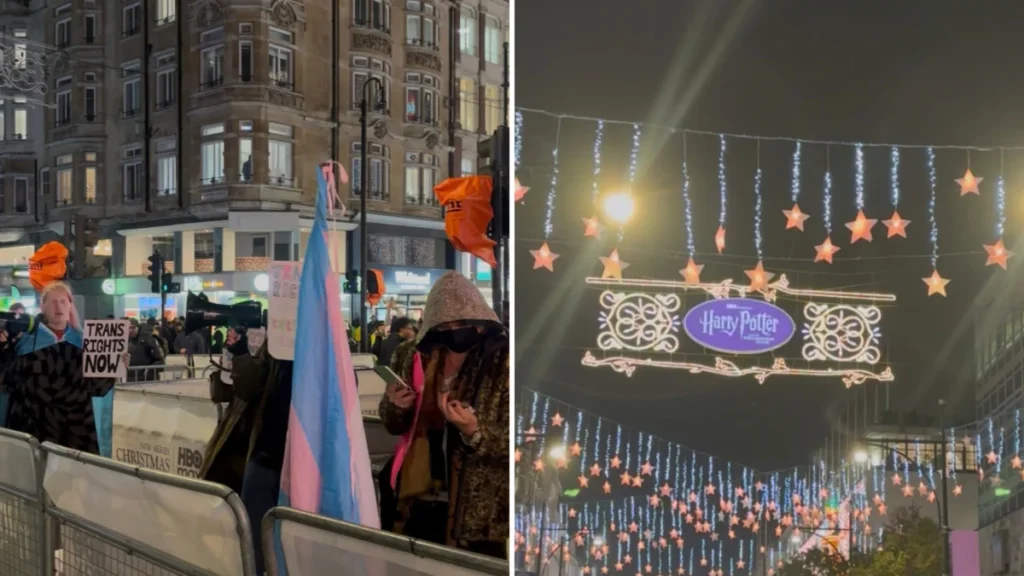

The annual illumination of Oxford Street, a cornerstone event in London’s festive calendar, took an unexpected turn on Monday, November 9, as a vocal group of trans rights activists staged a protest against the display’s central theme. This year, the iconic shopping district transformed into a winter wonderland decorated with installations inspired by J.K. Rowling’s Harry Potter series, a move intended to promote the upcoming HBO adaptation of Harry Potter and the Philosopher’s Stone. The presence of these displays, however, served as a lightning rod for protesters who argue that the franchise has become inextricably linked to the author’s controversial public stance on gender identity.
The Scope of the Demonstration
Hundreds of spectators had gathered on the thoroughfare, anticipating the festive reveal, when the demonstration commenced. Activists carried banners and waved trans pride flags, calling for a boycott of the franchise. The protest was not an isolated incident but part of a broader, sustained campaign by activists and organizations, including the Good Law Project (GLP), which has previously launched petitions arguing that the prominent display of Rowling’s intellectual property on public streets creates an environment that feels exclusionary and unsafe for trans individuals.

One protester, who identified as West, articulated the core grievance to reporters on the scene: "Harry Potter has no space in public life anymore. People should not support it, and they should not be allowed to co-opt one of our main streets in London at Christmas of all times." The protester further alleged that the commercial success of the franchise directly facilitates the author’s ability to fund initiatives they describe as harmful to the trans community.
A History of Cultural Contention
The tension surrounding the Harry Potter brand has been escalating since 2020, when J.K. Rowling first began publishing her views on sex and gender. Her assertions—which she defines as a defense of biological reality and women’s sex-based rights—have been labeled "anti-science" and "transphobic" by various advocacy groups and LGBTQ+ organizations. Conversely, the author has consistently rejected these characterizations, maintaining that she holds no animosity toward trans people and asserting her right to engage in public discourse regarding sex-based rights.
This ideological chasm has manifested in various public spheres:
- 2020–2022: The emergence of widespread calls for fans to separate the art from the artist, leading to significant debate within the gaming and literary communities.
- 2023: The release of the video game Hogwarts Legacy triggered massive online boycotts and protest campaigns, though the title ultimately achieved record-breaking commercial success.
- 2024–2025: As production for the new HBO series ramped up, casting decisions and promotional events became flashpoints for public demonstrations.
- November 2026: The Oxford Street lights switch-on represents the latest iteration of this conflict, moving from digital spaces and university campuses into the heart of London’s high-street retail landscape.
Economic and Logistical Realities
The organization responsible for the Oxford Street lights, the New West End Company, has remained largely silent regarding the protests. The event is a massive commercial undertaking, designed to drive footfall to the West End during the critical pre-Christmas retail period. Industry analysts suggest that major retail districts are increasingly caught in the "crossfire of culture wars," where corporate branding decisions are scrutinized under a lens of social responsibility.
In response to inquiries regarding the protest, the Mayor of London’s office issued a brief statement clarifying that it does not organize or oversee the Oxford Street Christmas light installations, effectively distancing the municipal government from the controversy surrounding the branding partnership. This highlights a growing trend where private commercial entities—in this case, those managing the shopping district—must navigate complex social pressures without the direct mediation of local government.
The HBO Series and Industry Fallout
The controversy has extended to the production of the forthcoming HBO series. The project, which is arguably one of the most high-profile television undertakings of the decade, has faced a unique set of personnel challenges. Actors associated with the show, including high-profile names like John Lithgow and Nick Frost, have found themselves in the difficult position of balancing professional obligations with the public outcry surrounding the show’s executive producer.

Reports indicate that several cast members have been subjected to significant online harassment, and in some instances, credible threats, as a result of their involvement in the project. This has forced production houses to implement heightened security measures and prompted some talent to distance themselves publicly from the author’s personal views to mitigate reputational damage.
Analyzing the Broader Social Implications
The protest on Oxford Street serves as a case study in the modern landscape of activism, where "brand association" is treated as an ethical endorsement. The argument presented by the protesters—that consumption of the Harry Potter franchise is an unethical act—reflects a shift toward "conspicuous non-consumption" as a form of political protest.
For the retail sector, this creates a volatile environment. The New West End Company and other commercial stakeholders rely on the broad, mass-market appeal of iconic properties to draw crowds. However, as properties like Harry Potter become polarized, the "mass-market" appeal begins to fragment. Retailers are now forced to calculate whether the marketing benefits of a high-profile brand outweigh the risk of alienating segments of the public or becoming a focal point for political demonstrations.

Furthermore, the language used by protesters highlights a specific concern regarding the "publicness" of the space. By stating that the street should be for everyone—trans and cisgender alike—the activists are asserting that the presence of the branding acts as an active exclusion. This challenges the traditional view of public space as a neutral ground, suggesting that for marginalized communities, the symbolic dominance of a brand perceived as hostile can fundamentally alter the experience of the environment.
Conclusion and Future Outlook
As the Christmas season approaches, the presence of these lights remains a point of contention. While the New West End Company has yet to issue a formal comment, the ongoing protests suggest that the controversy is unlikely to dissipate. The intersection of corporate marketing, high-stakes intellectual property, and deeply held social values ensures that the debate surrounding the Harry Potter franchise will continue to resonate far beyond the pages of the books or the screens of the streaming services.
Whether these protests will lead to a change in how commercial districts partner with controversial figures or if this represents the "new normal" for major public events remains to be seen. What is clear, however, is that the retail landscape of London has become a significant stage for broader societal arguments, transforming a traditional festive display into a reflection of the current cultural divide in the United Kingdom. As the city continues to navigate these tensions, the Harry Potter light display on Oxford Street will likely be remembered not just for its aesthetic impact, but as a defining moment in the modern history of public activism in London.