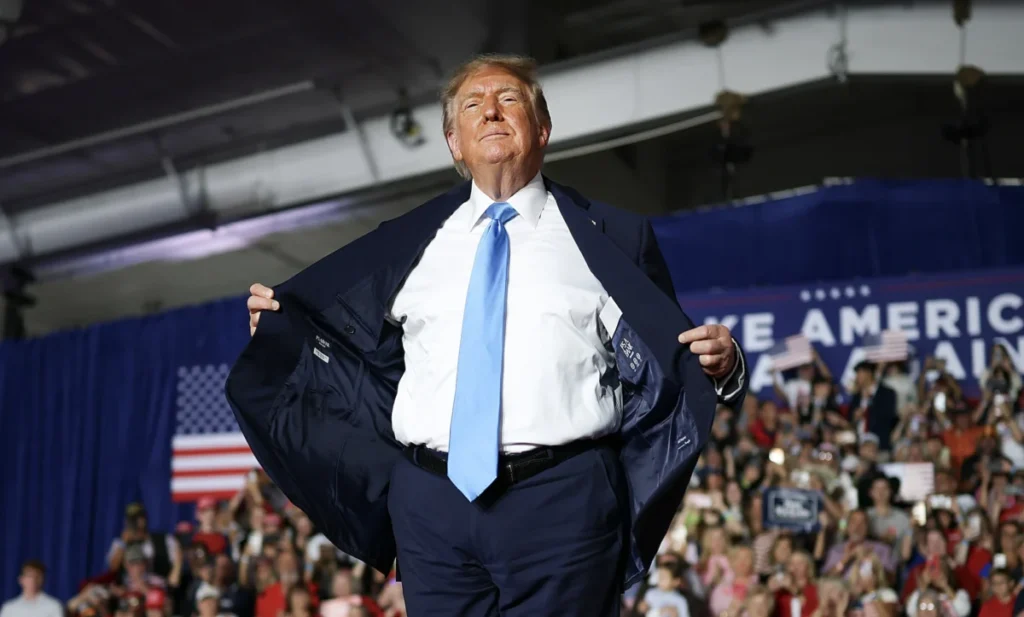

The intersection of high-stakes American politics and mass-market consumer behavior collided unexpectedly last month during a campaign rally in Grand Island, Nebraska, when a fleeting moment of wardrobe transparency involving President Donald Trump ignited a firestorm of social media discourse. As the President gestured to the crowd, the interior lining of his suit jacket became visible to the press corps, revealing a label that surprised political observers and fashion analysts alike: Jos. A. Bank. The incident, captured in high-resolution photography, has since prompted a rigorous debate regarding the authenticity of political branding, the economic realities of the modern garment industry, and the long-standing optics of power in the Oval Office.
A Chronology of the Controversy
The incident began on October 6, 2026, during a mid-term campaign appearance in Nebraska. As President Trump addressed supporters, photographers from major wire services captured candid images that showcased the interior of his tailored jacket. Within hours, the image—which clearly displayed the brand insignia of the mid-market retailer Jos. A. Bank—began to circulate on platforms such as X (formerly Twitter).
The revelation was particularly jarring for those familiar with the established lore of the President’s personal brand. In his 2004 book, Trump: Think Like a Billionaire, co-authored with Meredith McIver, the narrative surrounding the President’s aesthetic was firmly rooted in luxury. For years, the President had been widely associated with Brioni, an elite Italian house known for bespoke craftsmanship and premium price points. The discovery that the President was wearing a mass-produced, off-the-rack garment served as a catalyst for intense public scrutiny, drawing immediate comparisons to former President Joe Biden, who has historically been photographed patronizing the same retail chain in his home state of Delaware.
The Evolution of the "Presidential Suit"
Historically, the suits worn by American presidents have been carefully curated to signal strength, stability, and patriotism. From the mid-century tailoring of Brooks Brothers favored by John F. Kennedy to the modern, athletic cuts preferred by recent administrations, the suit serves as a primary visual communication tool.
The shift toward mass-market brands like Jos. A. Bank—a subsidiary of Tailored Brands, which also oversees Men’s Wearhouse—marks a departure from the traditional expectation of bespoke or high-end luxury attire associated with the office of the Chief Executive. According to a July 10, 2026, filing with the Securities and Exchange Commission (SEC), Tailored Brands explicitly confirmed its reliance on a global supply chain, with the vast majority of its manufacturing network concentrated in Asian markets. This globalized production model stands in stark contrast to the protectionist economic rhetoric often espoused by the President on the campaign trail.
Examining the Global Supply Chain Disconnect
The choice of a Jos. A. Bank suit by a politician who has centered his career on the slogan "America First" has provided critics with a focal point for accusations of hypocrisy. In his 2025 inauguration address, President Trump delivered a robust defense of domestic manufacturing, stating, "We must protect our borders from the ravages of other countries making our products, stealing our companies, and destroying our jobs. Protection will lead to great prosperity and strength."
Menswear experts, including industry analyst Derek Guy, were quick to point out the nuance of the brand’s manufacturing footprint. "Jos. A. Bank suits are all made overseas, typically in countries like China and Bangladesh," Guy noted in his analysis. "They do carry an associate label called Joseph Abboud, which is produced in the United States, yet the choice of the standard imported line raises questions about the prioritization of cost over domestic industry support."
This is not the first time the President’s business interests have faced scrutiny regarding their manufacturing origins. In 2004, the launch of the "Donald J. Trump Signature Collection," sold exclusively at Macy’s, was met with similar skepticism. Extensive reporting at the time, including investigations by ABC News, confirmed that the collection’s accessories—including silk neckties, dress shirts, and cufflink sets—carried "Made in China" labels. The persistence of these manufacturing choices, despite a platform built on the promise of revitalizing domestic manufacturing, continues to be a point of contention for labor advocates and political opponents.
Socio-Economic Implications and Public Perception
The viral reaction to the suit label reflects a broader societal interest in the disconnect between the "billionaire" persona and the "man of the people" marketing strategy. On social media, the commentary varied from lighthearted mockery to biting political critique. One user remarked, "Trump buying Jos. A. Bank suits instead of Brionis is a recession indicator," suggesting that the choice of attire may be a symbolic gesture intended to resonate with a working-class base that is sensitive to the current inflationary environment.
Conversely, others have interpreted the choice as a pragmatic, if unglamorous, decision. For many Americans, Jos. A. Bank represents the quintessential "value-oriented" professional attire. By wearing a brand that is accessible to the average voter, some political strategists might argue the President is attempting to project an image of fiscal restraint. However, the optics remain complicated by the President’s public claims regarding his personal net worth, estimated at roughly $7 billion.
Industry Analysis: Why Brands Matter in Politics
In the world of political branding, nothing is accidental. Every element of a candidate’s appearance, from the tie color to the brand of the suit, is a calculated decision designed to signal alignment with a specific demographic. When a leader appears in a mass-market brand, it can be read as a signal of solidarity with the middle class, or, as critics suggest, a contradiction of the high-luxury lifestyle they promote.
Furthermore, the logistical reality of the retail industry is such that most mid-tier American suits are no longer manufactured within the United States. To find a truly "Made in the USA" suit, a consumer must often look toward smaller, heritage-focused labels like J. Press or specific lines from Brooks Brothers. The fact that the President—who has the resources to source custom-made American apparel—opted for an imported, off-the-rack option suggests a preference for convenience or specific retail availability over the symbolic value of domestic production.
Data and Transparency in Government
The SEC filings related to Tailored Brands provide a clear window into the state of the menswear industry. The reliance on a "network of global suppliers, primarily in Asia" is standard for the industry, which has seen a steady decline in domestic manufacturing capacity over the last three decades. The transition from local tailors to globalized, mass-production centers has significantly altered the price point of formal wear, making high-quality suits more accessible to the public, but at the cost of local jobs.
The current controversy serves as a microcosm for the broader challenges of the American economy. As the President continues to push for protectionist trade policies, the reliance on foreign-made goods in his own personal life provides a ready-made target for political opponents who argue that his policies do not align with his actions.
Conclusion: A Lasting Impression
While the "suit scandal" may appear trivial in the context of global geopolitics and national security, it highlights the enduring power of visual symbols in American life. The image of the Jos. A. Bank label stitched into the lining of a presidential jacket will likely persist as a recurring anecdote in political satire and critique. It serves as a reminder that for a public figure, every detail—even those hidden on the inside of a coat—is subject to the intense glare of the public eye.
Whether this incident will have any long-term impact on the President’s polling numbers or his credibility on trade policy remains to be seen. What is clear, however, is that the American electorate remains highly attuned to the inconsistencies between political rhetoric and personal habit. As the campaign cycle continues to accelerate, the intersection of style and substance will undoubtedly remain a focal point for observers who view the wardrobe choices of national leaders as a mirror reflecting their broader priorities and values. For now, the debate over the President’s choice of suit serves as an unlikely, yet potent, case study in the modern era of political transparency.