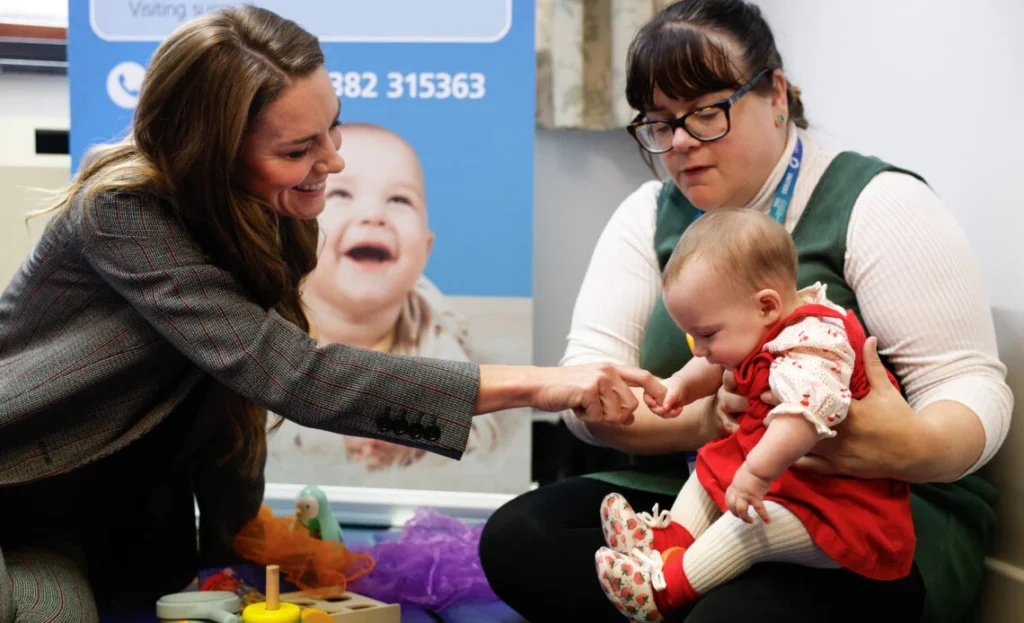

The Princess of Wales recently undertook a high-profile engagement in Bordon, Hampshire, to observe the practical application of a pioneering initiative designed to give infants a voice before they have developed the vocabulary to articulate their needs. The visit brought the Princess into direct contact with healthcare professionals, researchers, and young families who are utilizing the Alarm Distress Baby Scale (ADBB), an observational framework aimed at transforming early childhood intervention and support systems across the United Kingdom.
During her time in Hampshire, the Princess engaged deeply with health visitors and child development specialists who have been trained to administer the ADBB framework. The methodology relies on structured observation of an infant’s social behaviors, including eye contact, facial expressions, vocalizations, and motor responses, allowing trained practitioners to interpret subtle cues that indicate an infant’s emotional state, relational health, and developmental trajectory. By translating these non-verbal cues into actionable insights, health visitors can ensure that families receive tailored support precisely when it is required, mitigating potential developmental challenges at their earliest possible manifestation.
The integration of the ADBB scheme into the British healthcare landscape represents a significant milestone for the Royal Foundation Centre for Early Childhood, an organization established by the Prince and Princess of Wales to elevate the importance of the formative years in shaping lifelong health, resilience, and emotional well-being.
Chronology of the Initiative: From Nordic Inspiration to UK Implementation
The journey of bringing the Alarm Distress Baby Scale to the United Kingdom is rooted in international observation and strategic, multi-agency collaboration. The initiative first captured the attention of the Princess of Wales during an official solo working visit to Denmark, a nation widely recognized for its progressive family welfare policies, robust early childhood education infrastructure, and emphasis on preventative health measures.
While in Denmark, the Princess toured facilities utilizing the ADBB framework and witnessed firsthand how Scandinavian health professionals integrated the tool into routine postnatal care. Impressed by the precision and empathy the scale afforded practitioners, she sought to explore how a similar model could be adapted to fit the framework of the UK’s National Health Service and community health visiting services.
Upon her return, the Royal Foundation Centre for Early Childhood forged a strategic partnership with the Institute of Health Visiting (iHV). This collaboration set out to pilot the scheme across diverse regions in the UK, testing its feasibility, cultural adaptability, and clinical efficacy within British community healthcare settings.
The initial phase involved extensive training programs for health visitors, teaching them to identify signs of social withdrawal, distress, or relational disconnection in infants aged zero to two years. Following successful localized trials, the scheme has gradually expanded, with the Bordon visit serving as a comprehensive review of its current rollout and a testament to its integration into frontline healthcare practice.
A Hands-On Approach and Personal Reflections
Embodying her signature hands-on approach to early years advocacy, the Princess of Wales discarded formal detachment during her Bordon engagement, sitting comfortably on the floor with local parents, infants, and practitioners. Observers noted that the Princess appeared entirely in her element, interacting naturally with the babies and listening intently as parents shared their lived experiences of the ADBB assessment process.
For many participating families, the scheme has provided a profound sense of reassurance. Parents often struggle to decipher the causes of prolonged infant distress or withdrawal, which can lead to parental anxiety, postpartum mental health struggles, and strained family dynamics. By equipping health visitors with a standardized observational tool, families are offered a clear, objective channel through which their concerns are validated and addressed.
Concurrently with the Hampshire visit, a rare and deeply personal interview with the Princess was published in a special edition of Country Life magazine, which was guest-edited by the Prince of Wales. Within the pages of the publication, the Princess offered candid reflections on her recent health journey, noting that she had learned during the earliest stages of her medical diagnosis that treatment and recovery "wasn’t linear." Furthermore, she reiterated her long-standing advocacy for the therapeutic and restorative power of the natural world, emphasizing how immersion in nature has remained a vital anchor in maintaining her physical healing and emotional well-being.
Supporting Data and the Science of Early Childhood
The urgency behind initiatives such as the ADBB scheme is underpinned by a vast body of neuroscientific and developmental research. Neurological studies confirm that approximately 90% of a child’s brain development occurs before the age of five. During this critical window, relational experiences and secure attachments act as the primary architects of neural circuitry, influencing everything from stress regulation and emotional resilience to cognitive capacity and future social relationships.
Statistics from public health bodies indicate that early intervention yields exponentially better outcomes than remediation later in life. According to data compiled by early childhood advocates, unrecognized and unaddressed infant distress or relational misalignment can cascade into behavioral, emotional, and learning difficulties during school years, placing a sustained burden on educational, social, and healthcare systems.
The Alarm Distress Baby Scale, originally developed in Europe by international child psychiatry experts, provides a standardized metric to evaluate social withdrawal—a key indicator that an infant may be struggling to connect with their environment or caregivers. By scoring behaviors across specific domains such as eye contact, facial reactivity, and vocalizations, health visitors can objectively categorize the level of distress and intervene before temporary behavioral challenges solidify into chronic developmental roadblocks.
Official Responses and Stakeholder Perspectives
Leaders within the Institute of Health Visiting have lauded the partnership with the Royal Foundation, noting that the national rollout of the ADBB trial has revolutionized the confidence and capability of frontline health visitors.
"Health visitors are uniquely positioned as the eyes and ears of community healthcare for families with young children," stated a senior clinical advisor associated with the project. "However, historically, practitioners relied heavily on subjective impressions when assessing infant mental health and parent-infant bonding. The ADBB framework gives them a sophisticated, evidence-based lens through which to view infant behavior, ensuring that no child slips through the cracks simply because their distress is quiet rather than disruptive."
Representatives from local health trusts in Hampshire echoed these sentiments, emphasizing that the scheme fosters a collaborative partnership between parents and professionals. Rather than viewing assessments as punitive or judgmental, parents reportedly experience the ADBB observation as an empowering exercise that deepens their attunement to their baby’s unique language.
Broader Impact and Policy Implications
The expansion of the ADBB scheme under the patronage of the Princess of Wales carries profound implications for national public health strategy. As governments globally grapple with rising rates of pediatric mental health challenges and stretched social services, the emphasis is increasingly shifting toward preventative, upstream investments.
By championing early childhood development as a cornerstone of societal health, the Royal Foundation Centre for Early Childhood is helping to shift policy discourse from reactive crisis management to proactive foundation-building. The successful pilot and ongoing expansion of the ADBB trial in the UK serve as a potential blueprint for other nations seeking to modernize their maternal and infant healthcare services.
Furthermore, the integration of such tools addresses the holistic needs of families, acknowledging that maternal mental health, infant wellbeing, and parental confidence are inextricably linked. When health visitors are equipped to detect subtle signs of infant distress, they are simultaneously empowered to offer holistic support to parents who may be experiencing postpartum depression, isolation, or overwhelming stress.
As the initiative continues to scale nationally, the insights gathered from regions like Bordon will be instrumental in refining training modules and securing long-term commissioning support from health authorities. Through her sustained dedication, intellectual curiosity, and visible commitment to the youngest members of society, the Princess of Wales continues to elevate early childhood development from a niche policy discussion into a national priority, ensuring that future generations are given the strongest possible start in life.