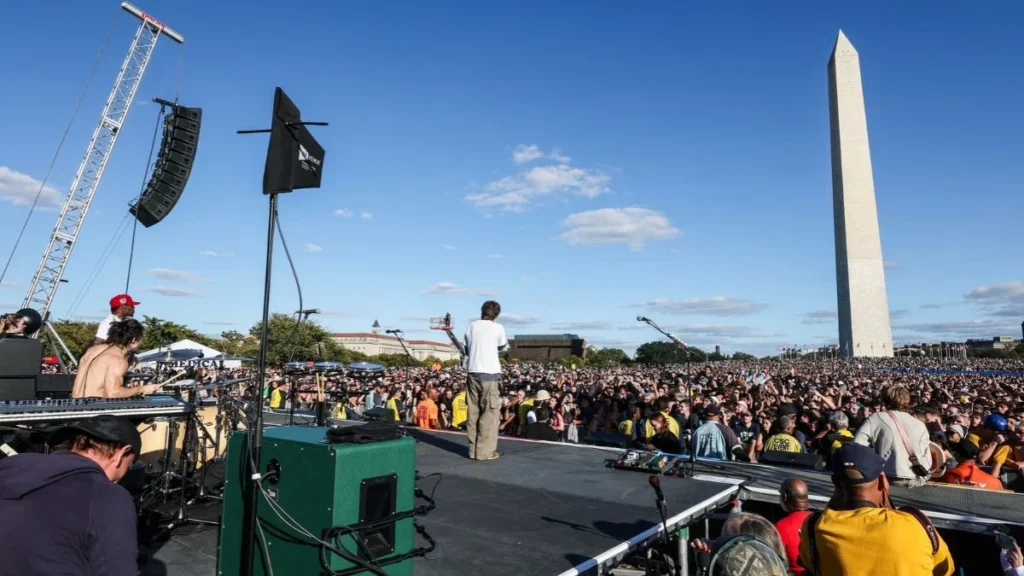

The iconic expanse of the National Mall in Washington, D.C., served as the stage for a historic musical event on Saturday, October 24, 2026, as Baltimore-based hardcore outfit Turnstile concluded their "NEVER ENOUGH TOUR" with a massive free benefit concert. Drawing an estimated crowd of 60,000 people to the shadows of the Washington Monument, the band successfully leveraged their platform to generate significant financial support for humanitarian relief efforts in Palestine, Sudan, and Lebanon. The event, which far exceeded its initial fundraising goals, underscores the band’s rising cultural influence and their commitment to utilizing their artistic reach for global advocacy.
A Triumphant Homecoming
For frontman Brendan Yates, who was raised in Burtonsville, Maryland, the concert represented a profound homecoming. The Washington, D.C., and Baltimore area has long served as the crucible for Turnstile’s sound, a region historically steeped in the ethos of the DIY hardcore scene. In an interview with The Washington Post ahead of the show, Yates acknowledged the weight of the moment, noting that the local music scene was the fundamental force that shaped the band’s identity and work ethic.
Despite battling a physical injury—having spent the previous day icing a strained ankle sustained during the grueling weeks of their North American tour—Yates delivered a high-octane, 75-minute performance. The setlist spanned the breadth of the band’s catalog, weaving together tracks from their earlier EPs with the anthemic, genre-defying compositions found on their critically acclaimed 2026 release, NEVER ENOUGH. The performance was noted for its technical precision and emotional resonance, serving as a masterclass in modern hardcore performance.
Humanitarian Impact and Financial Success
The primary objective of the concert was to provide critical funding for Human Concern International (HCI), an organization dedicated to delivering aid to regions facing severe humanitarian crises. When the show was first announced earlier in October, the organizers set a public fundraising goal of $100,000. Through a combination of individual donations, coordinated fundraising drives, and widespread public interest, that target was eclipsed within hours of the show’s conclusion. By Sunday morning, the total had surged to over $220,000, a testament to the mobilizing power of the band’s fan base.
The funds are earmarked for direct relief, including food, medical supplies, and shelter for civilians in Palestine, Sudan, and Lebanon. The success of this initiative highlights a growing trend in the music industry where artists utilize large-scale public gatherings not merely for entertainment, but as conduits for global philanthropy. By partnering with established humanitarian organizations, Turnstile ensured that the momentum generated by their music translated into tangible, measurable aid for some of the world’s most vulnerable populations.
Historical Precedents and Cultural Resonance
The choice of the Washington Monument as a venue carries significant historical weight. The National Mall has frequently served as a site for protest, celebration, and public discourse. For the punk and hardcore community, the location holds specific resonance; legendary acts like Fugazi famously performed free concerts near the monument in the 1990s, cementing the area as a symbol of accessible, independent music.
By choosing this site, Turnstile aligned themselves with a tradition of artists who view the performance space as a public forum. During the set, the atmosphere shifted from pure musical exhibition to a moment of unified advocacy. Midway through their performance, Yates paused to explicitly thank the attendees for their contributions and led the massive crowd in a chant of "Free Palestine! Free Sudan! Free Lebanon!" The scene served as a poignant reminder of the band’s alignment with contemporary social justice movements, mirroring the political activism that has long been a hallmark of the hardcore genre.
A Banner Year for a Meteoric Rise
The Washington Monument concert stands as the crowning achievement in what has been an extraordinary year for Turnstile. The band’s trajectory throughout 2026 has been marked by a series of unprecedented milestones that have propelled them from the underground to the mainstream.
In February, the group secured their first two Grammy Awards, including the prestigious "Best Rock Album" for NEVER ENOUGH. This win served as an industry-wide acknowledgement of the band’s ability to bridge the gap between aggressive, underground hardcore and radio-friendly, melodic sensibilities. Their momentum continued into October, when they made their highly anticipated debut on Saturday Night Live. The SNL performance, which reached millions of viewers, served as a launchpad for the final leg of their tour, culminating in the D.C. spectacle.
The band’s ability to maintain this level of creative output while navigating the pressures of global touring and public scrutiny is rare in the modern music landscape. As they look toward their upcoming performance at Camp Flog Gnaw in Los Angeles and their plans for the 2027 festival circuit, Turnstile has firmly established themselves as one of the most vital and culturally significant rock bands of the decade.
Operational Analysis: The Mechanics of the Benefit
The logistical success of the Washington Monument show cannot be overstated. Managing a crowd of 60,000 in a public space requires extensive coordination with local authorities, public safety officials, and logistical support teams. The fact that the concert proceeded without significant incident, while achieving its humanitarian goals, speaks to the professional maturity of the band’s management and their capacity to execute high-stakes events.
From an analytical standpoint, the success of this event provides a blueprint for future large-scale benefits. By integrating donation portals directly into the concert’s marketing and ticketing infrastructure, the organizers reduced the friction between attendance and contribution. The use of digital platforms to track the $220,000 goal in real-time created a feedback loop that kept the audience engaged throughout the lead-up to the event and the day of the performance.
Broader Implications for the Music Industry
The convergence of music, philanthropy, and public activism displayed by Turnstile is indicative of a shift in how fans interact with their favorite artists. In an era where digital consumption of music has diminished the traditional relationship between artist and listener, live events like the Washington Monument concert restore a sense of communal purpose.
Furthermore, the band’s explicit engagement with complex geopolitical issues demonstrates that artists are increasingly willing to risk polarizing their audience in favor of their personal principles. This "values-based" approach to branding—where a band’s moral stance is inseparable from its artistic output—appears to be resonating with a demographic that prioritizes social responsibility as much as musical quality. As other artists observe the success of this model, it is likely that we will see an increase in major touring acts adopting similar strategies, potentially transforming the landscape of modern touring to include more frequent, high-impact humanitarian interventions.
Looking Ahead
As the dust settles on the Washington Monument, the impact of the weekend’s events continues to reverberate. The $220,000 raised will provide immediate relief, but the symbolic victory of the event—bringing together 60,000 people in a peaceful, politically engaged environment—may prove to be the more lasting legacy.
Turnstile is currently slated to appear at Camp Flog Gnaw in Los Angeles this November, an event that will likely see a continuation of the energy and focus they displayed in Washington. Following that, the band is expected to take a short hiatus before returning to the global festival circuit in 2027. If their performance at the Washington Monument is any indication, the band’s trajectory shows no signs of slowing down, as they continue to challenge the boundaries of what a modern rock band can achieve both in the studio and on the world stage.
The Setlist: A Reflective Journey
The 19-song setlist, which featured "BIRDS," "REAL THING," "MYSTERY," "HOLIDAY," and "BLACKOUT," among others, was curated to highlight the evolution of the band’s sound. It served as a narrative arc, beginning with their more aggressive, rhythmic foundations and moving toward the sophisticated, layered compositions that have come to define their recent work. The finale, "T.L.C. (TURNSTILE LOVE CONNECTION)," was a fitting conclusion to a night defined by the very theme of connection—between the band and their audience, and between the music and the world at large.
The legacy of this event will likely be studied by music industry analysts as a case study in effective advocacy. By balancing their artistic integrity with a clear humanitarian objective, Turnstile has set a new standard for what a hometown performance can accomplish. They have successfully proven that, in the right hands, music remains one of the most powerful tools for global solidarity.