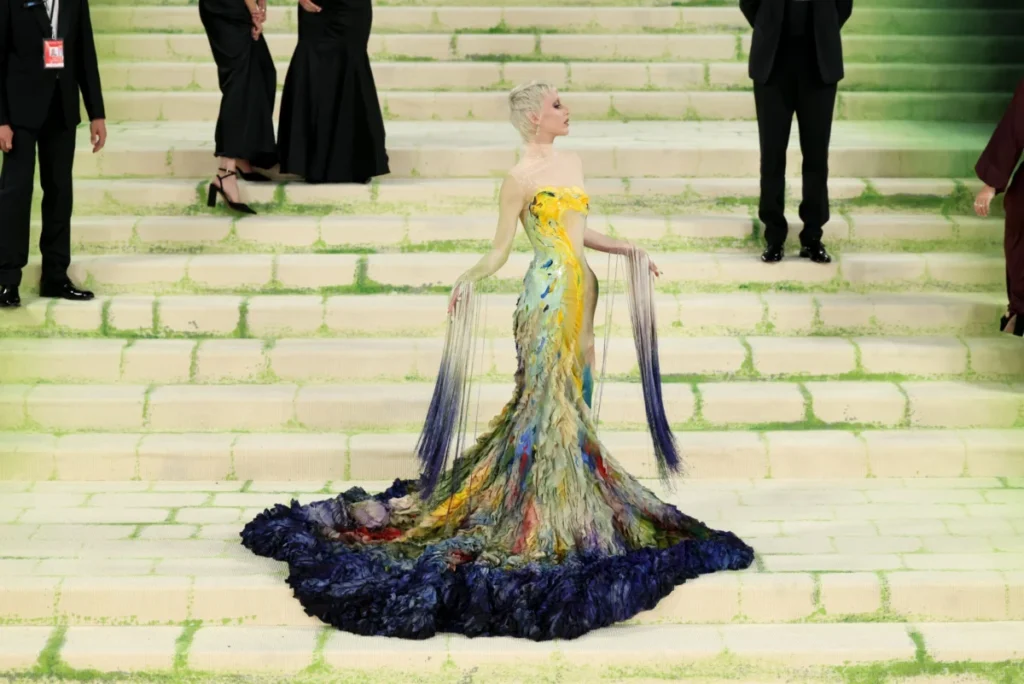

The 2026 Met Gala has redefined the boundaries between the gallery wall and the red carpet, manifesting Oscar Wilde’s famous observation that life imitates art more than art imitates life. This year’s event celebrated the Costume Institute’s landmark exhibition, "Costume Art," with a theme titled "Fashion is Art." The gala, a cornerstone of the New York social and cultural calendar, served as both a high-profile fundraiser and a profound exploration of how centuries of painterly masterpieces and sculptural silhouettes continue to inform contemporary design. As guests ascended the iconic steps of the Metropolitan Museum of Art, the evening transitioned from a mere fashion display into a living tableau of art history, bridging the gap between ancient aesthetics and modern craftsmanship.

The Exhibition: A New Vision for the Costume Institute
At the heart of the festivities is the "Costume Art" exhibition, a monumental undertaking curated by Andrew Bolton. Featuring approximately 400 works drawn from across the Met’s encyclopedic collections, the show argues that depictions of the dressed body are the unique thread uniting visual art across millennia and continents. Bolton’s curatorial vision moves beyond a chronological history of clothing, instead organizing the exhibition into thematic categories based on body types prevalent in art: the "Classical Body," the "Naked Body," and the "Aging Body."

The exhibition also serves as the formal inauguration of the museum’s nearly 12,000-square-foot Condé M. Nast Galleries. Designed by the architecture firm Peterson Rich Office, the new space provides a neutral, expansive environment that allows the intricate details of the garments to take center stage. The architectural design emphasizes clean lines and flexible lighting, catering to the diverse range of materials—from ancient textiles to 3D-printed polymers—found within the collection.

The Red Carpet as a Living Gallery
The 2026 gala witnessed a sophisticated interpretation of the "Fashion is Art" theme, with attendees and designers looking toward specific masterpieces for inspiration. While some guests, such as the musician Bad Bunny, offered literal and avant-garde interpretations of the body-type themes, others utilized the red carpet to pay direct homage to iconic works of art.

One of the evening’s most discussed pairings was actor Colman Domingo, whose ensemble drew striking parallels to Pablo Picasso’s Harlequin and His Companion. The geometric precision and moody palette of the outfit mirrored the melancholic harlequins of Picasso’s Rose Period, showcasing how 20th-century cubism can be translated into modern masculine tailoring. Similarly, Naomi Watts appeared in a gown that evoked the lush, botanical complexity of Margareta Haverman’s 18th-century masterpiece, A Vase of Flowers. The intricate floral embroidery on Watts’s garment functioned as a sartorial extension of the Dutch Golden Age, emphasizing the timeless appeal of still-life aesthetics in couture.

The dialogue between art and fashion continued with Chloe Malle, whose attire bore an uncanny resemblance to Frederic Leighton’s Flaming June. The vibrant orange hues and fluid drapery captured the essence of the Victorian era’s obsession with Hellenic grace. Meanwhile, athlete Eileen Gu leaned into contemporary sculpture, referencing Kohei Nawa’s PixCell-Deer#44. Her look utilized reflective, bead-like textures to mimic the cell-like structures of Nawa’s work, representing the "Classical Body" through a futuristic lens.

Other notable mentions included Suleika Jaouad, whose textured, metallic gown referenced the monumental tapestry-like sculptures of El Anatsui, specifically Earth’s Skin. Hunter Schafer opted for a look inspired by Gustav Klimt’s portrait of Mäda Primavesi, utilizing the artist’s signature decorative patterns and soft color palette to embody the "Classical Body" with a touch of Viennese Secessionism. In a more minimalist turn, Rose of BLACKPINK donned a silhouette reminiscent of Georges Braque’s À tire d’aile, proving that even the abstract lines of mid-century modernism have a place in the high-fashion lexicon.

Chronology and the Evolution of the Met Gala
The 2026 theme marks a significant point in the timeline of the Met Gala, which has evolved from a local midnight supper into a global media phenomenon. Established in 1948 by fashion publicist Eleanor Lambert, the gala was originally intended to raise money for the newly founded Costume Institute. For decades, it remained an elegant, albeit traditional, affair for New York society.

The modern era of the gala began in 1995 when Anna Wintour, Editor-in-Chief of Vogue, took over as chair. Under her leadership, the event transformed into a platform where the worlds of film, music, business, and fashion collide. The 2026 "Fashion is Art" theme is seen by historians as a return to the museum’s core identity, following years of more pop-culture-oriented themes. By centering the event on the museum’s own encyclopedic collections, the Costume Institute has reaffirmed its status as a serious academic and artistic entity within the broader Metropolitan Museum of Art.

Economic Impact and Institutional Support
Beyond the glamour, the Met Gala remains the primary source of annual funding for the Costume Institute’s exhibitions, acquisitions, and capital improvements. While the museum does not publicly disclose the exact total raised during the 2026 event, historical data suggests that the gala consistently generates upwards of $15 million to $20 million. These funds are critical, as the Costume Institute is the only one of the Met’s 17 curatorial departments that must fund its own activities.

The inauguration of the Condé M. Nast Galleries, funded in part by previous gala proceeds and a significant gift from the Condé Nast corporation, represents a major institutional milestone. The expansion allows the museum to display a larger portion of its 33,000-piece collection, much of which requires specialized climate control and lighting due to the fragility of historical textiles.

Official Responses and Curatorial Perspectives
Andrew Bolton, the Wendy Yu Curator in Charge of the Costume Institute, emphasized that the goal of "Costume Art" was to challenge the perception of fashion as a secondary art form. In a press statement leading up to the gala, Bolton noted, "For too long, the dressed body has been viewed through the lens of social history or vanity. By placing these garments alongside the Met’s greatest paintings and sculptures, we are forcing a confrontation with the reality that fashion is a primary vehicle for human expression and artistic innovation."

Architects from Peterson Rich Office also commented on the significance of the new gallery space. "Our objective was to create a ‘quiet’ architecture," said a representative for the firm. "The Condé M. Nast Galleries are designed to be a canvas. In an exhibition like ‘Costume Art,’ where the objects are so visually dense and historically significant, the architecture must provide a sense of clarity and breath."

Broader Impact and Implications for the Fashion Industry
The success of the 2026 Met Gala and the "Costume Art" exhibition is expected to have a lasting impact on the fashion industry, particularly regarding the trend of "archival fashion." In recent years, both designers and celebrities have increasingly turned to fashion archives to source vintage pieces that carry historical weight. The 2026 theme has codified this practice, suggesting that a garment’s value lies not just in its brand name, but in its relationship to the broader history of art.

Furthermore, the exhibition’s focus on the "Aging Body" and the "Naked Body" reflects a growing industry-wide dialogue concerning inclusivity and the biological realities of the human form. By showcasing how artists across centuries have grappled with the physical changes of the body, the Met is encouraging contemporary designers to move beyond the narrow standards of beauty that have long dominated the runway.

As the "Costume Art" exhibition opens to the public, it stands as a testament to the enduring power of the dressed body. The 2026 Met Gala did more than just showcase beautiful clothing; it provided a rigorous, intellectual framework for understanding fashion as a legitimate and vital branch of the fine arts. In doing so, it has ensured that the conversation between the canvas and the couture will continue for generations to come.