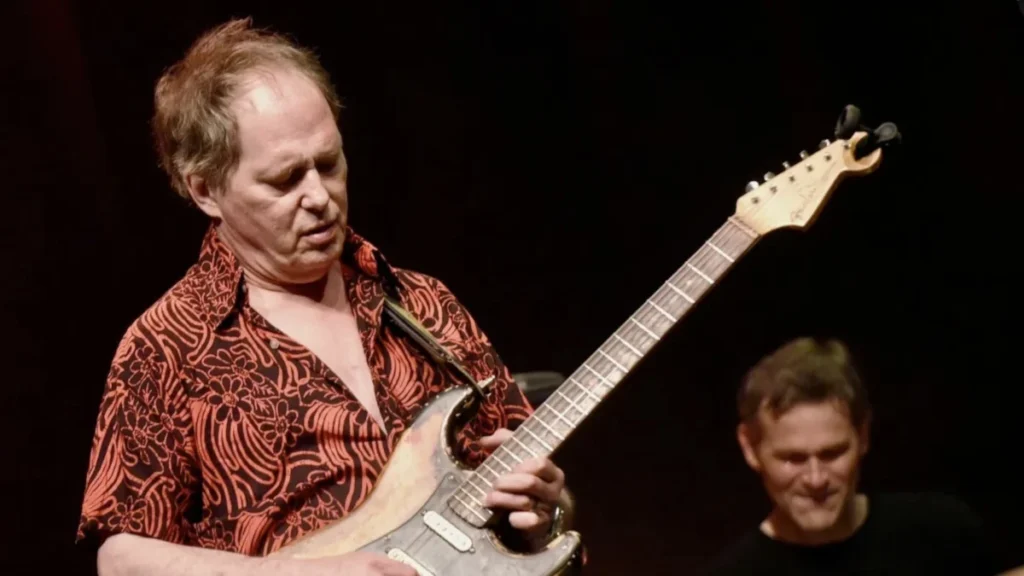

Richard Lloyd, the pioneering guitarist whose intricate, angular fretwork redefined the sonic boundaries of 1970s punk and laid the foundational blueprint for post-punk, has passed away at the age of 75. His death was confirmed on Saturday morning at his residence in Chattanooga, Tennessee. The cause of death followed a brave, public battle with cholangiocarcinoma, a rare and aggressive form of bile duct cancer, which the musician had disclosed to his supporters and fans in August of this year.
Lloyd’s passing marks the end of an era for the New York City underground music scene. As a co-founding member of Television, he was a pivotal architect of the sound that emerged from the grimy, neon-lit corridors of CBGB, transforming the rudimentary, high-velocity thrash of early punk into a sophisticated, cerebral art form.
A Life Defined by the Guitar
Born in Pittsburgh, Pennsylvania, Lloyd’s journey to becoming one of the most influential guitarists of his generation began as a teenager. His early musical education was unconventional; he spent formative years studying under Velvert Turner, a musician who claimed to be a direct protégé of Jimi Hendrix. While historians and musicologists have often debated the veracity of the Hendrix-Turner connection, the influence of that lineage on Lloyd was undeniable. He carried the lore of the guitar hero with him, often recounting colorful anecdotes, including a legendary, albeit painful, backstage encounter where he claimed to have been punched by Hendrix himself after a youthful, clumsy critique of the guitar icon’s gear.
This "understudy" narrative served as a cornerstone of Lloyd’s identity as a musician. He did not merely play the instrument; he interrogated it. By the time he arrived in New York City in the early 1970s, he had developed a vocabulary of harmonic dissonance and rhythmic complexity that set him apart from his contemporaries.
The Television Era and the Birth of a Scene
In 1973, Lloyd joined forces with Tom Verlaine, Richard Hell, and Billy Ficca to form Television. While the band’s initial lineup underwent shifts—notably with Hell’s departure in 1975 and the arrival of Fred Smith—the core creative partnership between Lloyd and Verlaine remained the band’s heartbeat.
Television’s contribution to the music landscape cannot be overstated. At a time when the burgeoning punk movement was characterized by three-chord simplicity, Television introduced a layered, almost architectural approach to songwriting. The title track of their 1977 debut, Marquee Moon, remains a magnum opus of the era. Lloyd’s interplay with Verlaine, characterized by an eschewing of standard power chords in favor of weaving, melodic counterpoints, provided a template for generations of musicians. Bands ranging from the jangle-pop sensibilities of R.E.M. to the dissonant, high-energy math-rock of Fugazi and the indie-pioneer sensibilities of The Pixies have cited Television as a primary influence.
The Architect of CBGB
Beyond his technical prowess, Lloyd maintained a deep, personal connection to the history of CBGB. He was more than a performer at the legendary Bowery club; he was a catalyst for its cultural ascent. In various retrospectives, Lloyd claimed credit for facilitating the club’s pivot toward becoming the epicenter of the punk explosion. By working closely with management to curate a specific roster of bands, he helped create a ecosystem where acts like The Ramones, Blondie, Talking Heads, and Patti Smith could flourish.
"CBGBs is the most famous rock ‘n’ roll club to have ever existed and I created it," Lloyd asserted in a 2007 interview. "I was the invisible force behind it." While his claim to be the sole architect of the club’s fame was met with varying degrees of nuance by historical chroniclers, it is undisputed that his presence helped galvanize the community. He viewed the scene as a collective, a three-year-long communal experiment that provided a creative sanctuary for artists who otherwise might have been relegated to the mundane constraints of the workforce.
Solo Career and Legacy
Following the initial dissolution of Television in 1978, Lloyd embarked on a prolific solo career that spanned five decades. His 1986 solo effort, Field of Fire, and the subsequent 1987 release, Real Time, received critical acclaim, highlighting his ability to translate his signature guitar style into diverse, power-pop-infused contexts.
His reputation as a "guitarist’s guitarist" made him a sought-after collaborator. Perhaps most notably, he became a key fixture in the work of Matthew Sweet, providing the crystalline, sharp-edged guitar leads that helped define the 1991 classic Girlfriend. His ability to navigate both the avant-garde sensibilities of the New York underground and the polished, melodic requirements of power-pop solidified his status as a versatile and enduring talent.
Throughout his later years, Lloyd remained active, touring and recording, culminating in his final studio album, The Countdown, released in 2018. Despite his profound impact, Lloyd often maintained a self-deprecating perspective on his career. He frequently described his life as a musician as a consequence of refusing to conform to traditional societal expectations. In a 2000 interview, he reflected on this trajectory with characteristic wit: "I lived in absolute terror of growing up, and I found the one thing that you could actually do and do well, and it prevented you from growing up."
Implications and Industry Impact
The death of Richard Lloyd marks the passing of one of the final remaining titans of the original CBGB class. As the music industry reflects on his life, the analysis of his influence centers on his role as a bridge between the raw, visceral energy of 1970s punk and the sophisticated melodicism of what would become alternative rock.
Music critics and historians have already begun to re-examine the technical contributions Lloyd made to the guitar lexicon. His use of harmonic complexity within a punk framework provided a roadmap for later bands to explore "art-punk" and "post-punk" aesthetics. Without the structural contributions Lloyd made to the interplay between guitars, the soundscapes of the late 80s and 90s would undoubtedly have been significantly different.
Industry peers and fellow musicians have noted his professionalism and his commitment to his craft. While he was never a household name in the vein of his idol Hendrix, his footprint is deeply embedded in the DNA of modern rock music. The loss of such an artist serves as a poignant reminder of the fragility of the pioneers who, in the mid-1970s, turned a small, dark club in Manhattan into the epicenter of a global musical revolution.
Chronology of a Career
- 1951: Born in Pittsburgh, Pennsylvania.
- 1973: Joins forces with Tom Verlaine, Richard Hell, and Billy Ficca to form Television in New York City.
- 1974: Plays a pivotal role in the early booking and development of CBGB as a venue for emerging punk acts.
- 1977: Television releases the landmark debut album Marquee Moon, widely considered a foundational text of post-punk.
- 1978: Television disbands after the release of Adventure.
- 1986: Releases his first major solo album, Field of Fire.
- 1991: Collaborates on Matthew Sweet’s critically acclaimed album Girlfriend.
- 1992-2007: Performs periodically with the reunited Television.
- 2007: Officially departs from Television to focus entirely on solo work and outside collaborations.
- 2018: Releases his final studio album, The Countdown.
- 2026 (August): Announces his diagnosis with cholangiocarcinoma.
- 2026 (November): Passes away at his home in Chattanooga, Tennessee, at the age of 75.
Richard Lloyd’s legacy remains secure, not only through his recorded works but through the thousands of guitarists who picked up the instrument and attempted to emulate the sharp, melodic intelligence he brought to every note he played. He leaves behind a body of work that continues to challenge, inspire, and define the evolution of rock music.