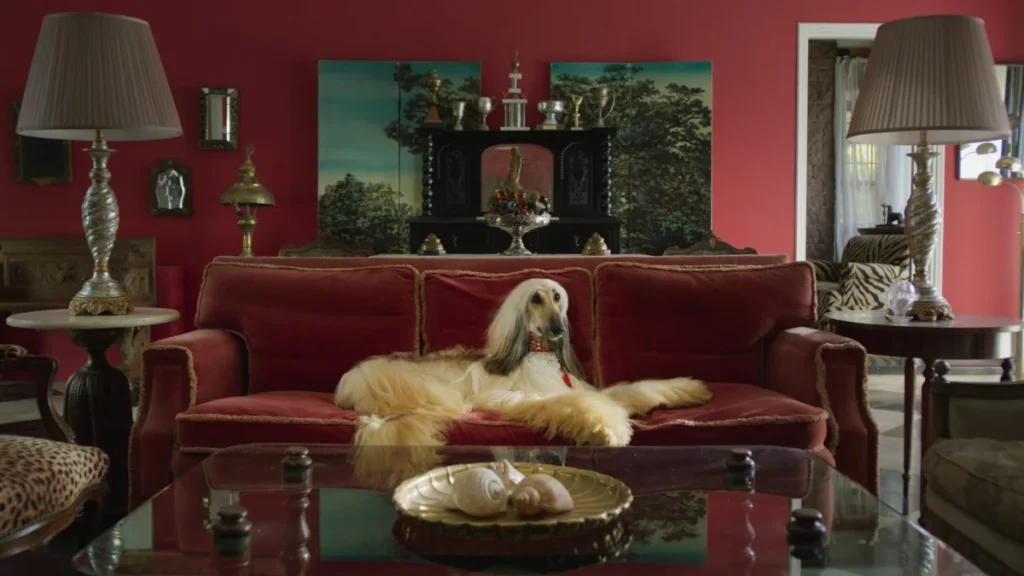

The 70th edition of the BFI London Film Festival serves as the global launching pad for Prince, the highly anticipated solo feature-length directorial debut of Uruguayan filmmaker Federico Borgia. Described by festival organizers as a "kitsch comedy about avarice and love," the film merges dark humor, absurdism, and social critique against the sun-bleached, fading luxury of Punta del Este, an upscale resort city on the Uruguayan coast. Handled internationally by sales agency Alpha Violet, the Uruguayan-Argentine co-production examines class divides, domestic entanglement, and inheritance through an unconventional lens: an award-winning Afghan hound named Prince.
The narrative engine of the film kicks off with a bizarre premise. Jaime, portrayed by acclaimed Uruguayan actor Roberto Suárez, is a former lover turned live-in butler to Isabel, an affluent Argentine woman played by Maitina De Marco. Over the course of two decades, the pair has inhabited an expansive coastal villa, maintaining a domestic routine centered almost entirely on Isabel’s prized Afghan hound. When Isabel dies unexpectedly following a slip into her swimming pool, her reading of the will delivers a shocking condition: her entire luxury estate is bequeathed directly to Prince, with Jaime legally appointed as the dog’s guardian. Consequently, Isabel’s estranged human relatives are barred from claiming the property until the animal passes away.
What follows is a cinematic battle royal. When Isabel’s estranged son and granddaughter move into the villa with the explicit intent of orchestrating the dog’s demise or ousting Jaime, the estate transforms into a pressure cooker. Caught in the crossfire of this vicious custody battle, Jaime must not only protect Prince but also confront his own estranged son, Diego—played by Esteban Bigliardi—and a personal history he has long sought to avoid.
Background, Inspiration, and Personal Roots
The genesis of Prince can be traced directly to Federico Borgia’s personal life and his relocation from Montevideo to Punta del Este. The filmmaker notes that the coastal town provided a fascinating sociological study, functioning as a space where starkly different socio-economic strata inevitably collide.
"It was very much influenced because I moved from Montevideo to Punta del Este. It’s a touristic coast town where social classes mix up—there’s this working class and this class that pays for services," Borgia explains. "There is this mix of glamor and decadence that started surrounding me, and I started a game of observation. I started looking at people in different places and writing down things I saw and then started an imaginative game of questions about what was behind what I was seeing."
While the architectural and social backdrop of the film draws from Borgia’s adult observations of seaside wealth and service economies, the seed for the dog-centric plot was planted much earlier in his life. At the age of ten, Borgia received a dog as a gift. Trips to the local groomer exposed him to a subculture of canine pageantry that left a lasting impression.

"I remember going, with my mother, to this dog groomer. He didn’t participate in dog shows, but at this grooming place, I saw these pictures of contests with these guys in suits posing. They looked like lawyers, but with a dog," Borgia recalls. Over time, these disparate memories coalesced into the framework of an inheritance satire.
Crafting the Characters and the Cast
Central to the film’s psychological depth is the ambiguous and often uncomfortable relationship between Jaime and Isabel. Borgia consciously avoided traditional narrative archetypes, opting instead for a character whose professional and romantic boundaries were hopelessly blurred.
"He’s a worker who met this lady in some kind of service relationship, and then he became her lover, and that started this undefined point between being a lover, partner, butler," Borgia notes. "It’s really undefined as you start discovering, and then all the other relationships and bonds and all the problems that come with them and family come into the film."
To bring these complex dynamics to life, the production utilized a two-pronged casting strategy: pursuing established theater and film veterans whom Borgia deeply admired alongside fresh faces discovered through regional open castings in Argentina and Uruguay.
Roberto Suárez was the director’s first choice for the lead role of Jaime. "Roberto Suárez, who plays Jaime, is someone I have wanted to work with for a long time, and he accepted really fast," Borgia says, praising not only Suárez’s onscreen presence but also his contributions as a theater creator who actively shaped the script during development. "He was reading different versions of the script and throwing out ideas, and they were always brilliant ideas. He’s also a great person."
Working with an Unconventional Animal Actor
Selecting an Afghan hound for the lead animal role was driven entirely by aesthetic considerations rather than practical obedience. Known for their striking, regal appearance and cascading coats, Afghan hounds notoriously rank near the bottom of canine trainability indexes, trailing far behind working breeds like Border Collies and German Shepherds.
"I actually started investigating on the internet how to train a dog," Borgia admits. "And the Afghan hound was really low on the list of trainable dogs, well below the Border Collie, the German Shepherd and others."

Despite these internet warnings, the production found a breakthrough when they encountered an owner who lived with eight Afghan hounds. Among them was an unusually calm, socialized dog that defied the breed’s aloof reputation. According to Borgia, this particular canine actor was "like a Labrador in the body of an Afghan."
Remarkably, the dog performer caused virtually zero disruptions throughout principal photography. "The dog was always perfect. We never had a problem with the dog," Borgia recalls, citing only one minor incident involving a accidental swim. "Just one time, he fell into the pool, and we had to dry his hair for two or three hours."
Broader Implications and Universal Themes
Although Prince is deeply rooted in the specific architectural and social realities of coastal South America—drawing on Borgia’s previous directorial work on films like Clever (2015) and The Champion of the World (2019), both co-directed with Guillermo Madeiro—the director believes the underlying themes possess global resonance. The mechanics of familial greed, the friction between classes, and the absurdity of wealth distribution are issues that transcend geographic borders.
"The story itself is universal, but the most important thing for me was the characters and their relationship, and the tone of the film," Borgia states. "I felt I could make it different. The original thing is how an author can make the premise of a film different."
As Prince prepares for its international exhibition at the BFI London Film Festival, the director remains philosophical about the grueling filmmaking process, even as he contemplates his future in the industry. Asked what lies ahead for his career, Borgia expresses a familiar creative ambivalence.
"I want to talk about it, but I have no clue," he says. "Every time I finish a film, I really don’t know if I’m going to make another one. Or at least that’s how I feel. But I know I will because it’s like an addiction. You know you’re going to fall into it again."
With Alpha Violet managing international sales, Prince is positioned to travel well beyond the festival circuit, bringing its distinct brand of Uruguayan-Argentine dark comedy and canine absurdity to global art-house audiences.