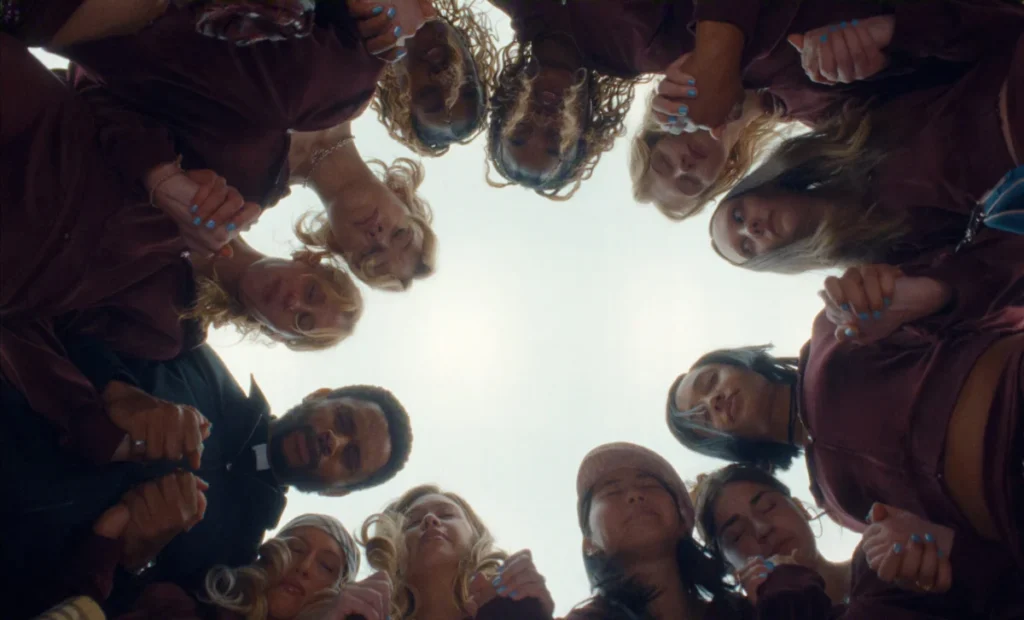

The landscape of contemporary television has long been fascinated by the combustible intersection of adolescence, religious iconography, and psychological horror. From the frostbitten survivalism and occult undertones of Showtime’s Yellowjackets to the telekinetic wrath of Stephen King’s Carrie, creators continually return to the crucible of teenage girlhood as a source of both primal terror and profound cultural anxiety. Netflix’s latest eight-episode drama, The Body, attempts to claim its own stake in this crowded genre. Set against the rigid backdrop of an all-female Catholic high school in the mid-2000s, the series trades heavily in nostalgic aesthetics, teenage angst, and supernatural ambiguity. However, despite a generous eight-hour runtime and an ambitious conceptual framework, the drama ultimately struggles to synthesize its myriad influences into a cohesive, impactful narrative.
Scheduled to premiere on Wednesday, November 11, on Netflix, The Body is created by Quinn Shephard, whose previous work on Under the Bridge demonstrated an aptitude for dark, character-driven storytelling. The series boasts an ensemble cast featuring Kristina Bogic, Geena Meszaros, Sara Boustany, Jackson Kelly, Nnamdi Asomugha, Sofia Wylie, Shirley Chen, Orlando Norman, Louisa Krause, and a notable, if brief, appearance by reality television personality Gabby Windey. Despite the creative pedigree and a sharp eye for period-accurate production design, the series delivers a viewing experience that can best be described as neither heavenly nor hellish—a modest, albeit uneven, addition to the streaming giant’s catalog.
Main Facts and Narrative Premise
The narrative unfolds within the cloistered halls of St. Marks Catholic High School, an institution where the female student body balances the performative piety expected of them by day with the covert rebelliousness of weekend parties, illicit substances, and shifting social hierarchies. The central conflict of the series is catalyzed by a seemingly harmless invocation of Satan during a weekend gathering, sealed with the consumption of MDMA. What begins as teenage posturing rapidly devolves into a cascade of unexplained phenomena, threatening to engulf the surrounding community in a wave of mass hysteria.
The immediate catalyst for the plot’s descent into psychological and supernatural chaos is the all-female dance troupe known as the Lions. In the fall of 2004, the Lions find themselves in a precarious position. Just weeks before regional competitions, the team suffers a debilitating injury, sidelining a key member and throwing their competitive prospects into jeopardy. Enter Grace, portrayed by Sofia Wylie, a newcomer whose pristine, goody-two-shoes reputation sparks immediate division among co-captains Elise (Sara Boustany) and Anya (Kristina Bogic) regarding her ability to fit in with the group’s hardened dynamic.
The situation escalates dramatically following a Halloween hazing ritual that goes disastrously awry. The initiation of a new member unleashes a series of strange visions and hard-to-explain occurrences, laying the groundwork for a community-wide crisis. As the boundaries between divine intervention, demonic possession, and plain psychological breakdown begin to blur, the town of St. Marks finds itself teetering on the precipice of collective panic.
Chronology and Setting: The Nostalgia of 2004
A defining characteristic of The Body is its rigorous commitment to the aesthetic and cultural landscape of the autumn of 2004. Even without explicit title cards, the era is meticulously carbon-dated by costume designer Mirren Gordon-Crozier through an array of velour tracksuits, Motorola flip phones, and coveted Balenciaga handbags.
This temporal placement is not merely superficial; it functions as a thematic anchor for the series. Throughout the background of the narrative, television screens flicker with the shifting media diet of the mid-2000s, oscillating between the hyper-sexualized vapidity of reality programming like The Simple Life and the stark, jingoistic violence of the unfolding Iraq War. Even Donald Trump makes a fleeting appearance on screen in his capacity as the host of The Apprentice.
However, critics of the series have noted that these historical markers frequently register as decorative rather than substantive. While the 2004 setting provides a potent cocktail of early-aughts nostalgia, the show struggles to leverage this period background to make deeper thematic statements about the trajectory of contemporary culture, leaving the references feeling occasionally disconnected from the emotional core of the narrative.
Character Dynamics and Standout Performances
At the heart of the St. Marks social ecosystem is Lisbeth, portrayed by Geena Meszaros, who emerges as the series’ most formidable and compelling antagonist. A recent transfer student living in a shabby, Church-funded home with her strict fundamentalist mother, Catherine (Louisa Krause), Lisbeth is an immediate outsider. Her painfully awkward affect and stark appearance—achieved by a conventionally attractive actor bleaching her eyebrows into oblivion—mark her as an improbable candidate for integration into the Lions’ social circle.
Taking pity on the isolated newcomer, the kind-hearted Anya impulsively invites Lisbeth to a party. This act of charity proves to be a catalyst for disaster. Once granted access to the inner circle, Lisbeth sheds her kicked-puppy demeanor to reveal a calculating, deeply unsettling presence. Meszaros delivers a standout performance, imbuing Lisbeth with a skin-crawling energy that lingers even during mundane interactions, utilizing a cloying singsong voice and erratic gestures that lend her one-dimensional coldness the weight of an elemental force.
Surrounding Meszaros is an ensemble cast that frequently grapples with underwritten material. Kristina Bogic and Sara Boustany exhibit a compelling, palpable chemistry as best friends whose bond flirts with romantic tension, complicated by the pervasive fear of navigating queer identity within a rigid religious culture. Meanwhile, Jackson Kelly provides a grounding, emotionally resonant performance as Lisbeth’s younger brother, Leo, whose wide-eyed sincerity serves as a stark moral counterweight to the surrounding cruelty and sin. Gabby Windey rounds out the notable appearances in a glorified cameo as Shauna, the indifferent and ineffectual coach of the Lions dance troupe.
Critical Analysis and Narrative Shortcomings
Despite the strength of its individual performances and the atmospheric ambition of its creator, The Body ultimately stumbles in its execution. The primary critique leveled against the Netflix drama concerns its writing, which struggles to flesh out its large ensemble beyond basic narrative and thematic archetypes. While the characters remain easily digestible for viewers—functioning adequately even within the distracted framework of modern multi-screen viewing habits—they lack the multi-dimensional depth required to foster genuine emotional investment.
Furthermore, the series is marked by a series of missed narrative opportunities. Promising plotlines, such as an evolving dynamic between the prickly Elise and the pure-hearted Leo, are introduced only to be abruptly discarded once they have served an immediate functional purpose. Similarly, the investigative efforts of Father Franklin (Nnamdi Asomugha)—the school priest and uncle to Grace—generate dramatic tension but yield precious little insight into how a man of the cloth processes a crisis that challenges the foundations of his faith.
The series also flirts with compelling thematic territory without possessing the narrative courage to fully explore it. The aesthetic of The Body continuously investigates the porous boundary between religious iconography and sexual imagery, highlighted overtly by the "slutty angel" and "slutty God" Halloween costumes worn by the students, and more subtly by classical art depicting saints experiencing spiritual ecstasy through physical rapture. Yet, rather than pushing these motifs into genuinely provocative or transgressive spaces, the series remains content merely to acknowledge their existence.
Broader Impact and Implications for Streaming Dramas
The release of The Body highlights a recurring trend within the contemporary streaming ecosystem: the commissioning of high-concept, atmospheric genre pieces that prioritize stylistic ambition over narrative rigor. By blending the psychological thriller elements of Carrie with the ensemble-driven hysteria of Yellowjackets, Netflix aims to capture the cultural conversation surrounding adolescent trauma and female rage.
However, the series serves as a cautionary tale regarding the limitations of extended runtimes. Across eight hours, the premise is stretched thin, forcing viewers to weigh moments of stylistic brilliance against structural inertia. The tension between the sacred and the profane, the mundane and the miraculous, remains a potent vehicle for storytelling, but as The Body demonstrates, translating that tension into lasting transcendence requires a narrative discipline that matches its visual flair.
Ultimately, the series remains firmly anchored in the imperfections of the material world. For audiences seeking a deep exploration of faith, hysteria, and teenage cruelty, The Body offers fleeting moments of atmospheric grace, but falls short of the profound revelation promised by its premise.