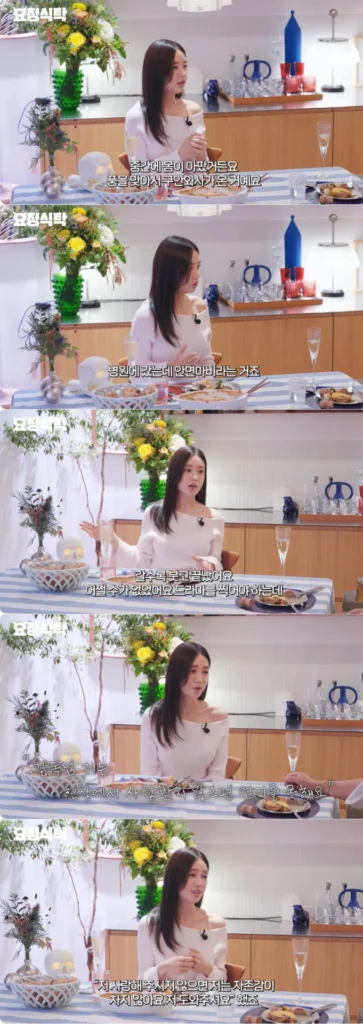

The demanding nature of the South Korean entertainment industry often remains hidden behind the glamorous facades presented on screen. Recently, acclaimed actress Ahn Eun Jin offered a rare and candid glimpse into the immense physical and psychological tolls exacted by her profession. Appearing on the September 13 episode of the popular YouTube talk show Fairy Jae Hyung, hosted by veteran singer Jung Jae-hyung, Ahn detailed a harrowing series of professional and personal obstacles she faced at the height of her career. Her revelations brought to light the intense scrutiny of public casting controversies, the sudden onset of debilitating medical conditions during active production schedules, and the grueling intersection of mental health struggles and tight commercial deadlines.
The Crucible of Public Scrutiny: Overcoming Initial Miscasting Controversies
Ahn Eun Jin’s journey to becoming one of South Korea’s most sought-after leading actresses has not been without significant friction. Early in her career-defining run on the MBC historical drama My Dearest, the production faced immediate public skepticism. Viewers and online commentators raised vocal concerns regarding her casting, questioning whether she possessed the star power or suitability required to carry a major historical romance alongside co-star Namkoong Min.
In the competitive landscape of Korean television dramas, where ratings and public opinion are monitored in real-time, such online backlash can severely impact an actor’s confidence. During her appearance on Fairy Jae Hyung, Ahn reflected on this turbulent period with a mixture of professional grace and retrospective vulnerability.
"Looking back, it’s clear that it was tough," Ahn confessed during the interview. "At the time, I tried to power through somehow, but now that I think about it, I realize how hard it really was."
Despite the initial wave of criticism, My Dearest eventually achieved syndromic popularity, anchoring itself as a cultural phenomenon and earning critical acclaim. Ahn’s nuanced portrayal ultimately silenced skeptics, transforming initial controversy into widespread industry recognition and cementing her status as a premier television lead. However, the emotional toll of carrying such a heavy burden under the microscope of public opinion left lasting psychological impressions.
Medical Emergencies on Set: The Onset of Facial Nerve Palsy
While navigating public pressure is an inherent risk of celebrity, physical health crises present an entirely different dimension of difficulty. Ahn revealed that her health vulnerabilities peaked during the production of the JTBC drama The Good Bad Mother, in which she starred alongside Ra Mi-ran and Lee Do-hyun.
Midway through filming, the actress suffered a severe physical setback brought on by exhaustion and exposure to cold temperatures. What initially seemed like a minor ailment quickly escalated into a diagnosed case of facial nerve palsy, a condition that temporarily disrupts the function of the facial nerve, causing weakness or paralysis on one side of the face.

Ahn recounted the terrifying moment she first realized something was profoundly wrong. "When I was shooting The Good Bad Mother, it was tough because I became ill midway. I caught a chill and developed facial nerve palsy. On the day of shooting, while washing my face and brushing my teeth, water leaked from one side of my mouth. I didn’t know what was happening. I didn’t even realize it was facial nerve palsy at first."
As the hours progressed on set, her symptoms worsened. Recognizing that her physical control was deteriorating, she immediately informed the director and sought urgent medical evaluation. Doctors confirmed the diagnosis of facial paralysis. Initially harboring naive optimism, Ahn believed a few days of strict rest would resolve the issue. Instead, the condition progressed rapidly, plunging her into a deep psychological downturn.
Navigating Treatment, Severe Steroid Side Effects, and Relentless Shooting Schedules
The intersection of severe medical intervention and an unyielding production timeline created a compounding crisis for the actress. With broadcasting deadlines looming, halting production entirely was not a viable option for the studio, placing immense pressure on Ahn to continue working through her affliction.
To combat the nerve inflammation, medical professionals administered a aggressive regimen combining traditional Eastern medicine, acupuncture, and heavy doses of systemic corticosteroids. While these powerful drugs were necessary to attempt to halt the paralysis, they introduced a punishing array of physical side effects that compounded her distress.
"Since I didn’t know about the condition, I thought a few days of rest would fix it, but it only got worse. I was very depressed and sad at that time," Ahn shared. She detailed the physical modifications required on set to accommodate her temporary disability: "Because of the delayed movement on one side of my face, we only filmed the profile shots. I went to both Western and traditional medicine, received acupuncture, and was given strong steroids. That bought me a month."
Despite these aggressive treatments, her condition deteriorated daily, fueling a cycle of depression and professional insecurity. The side effects of the high-dosage steroids proved particularly grueling for an actress whose profession relies heavily on physical presentation.
"Since there was no improvement day by day and I kept getting worse, I was depressed," she explained. "The steroid side effects caused swelling—my face would puff up even after a walk, and my knees swelled too. It was hard to stay positive then. So gradually, the swelling worsened and that’s how the drama ended. I had to keep filming, so there was no choice."
Vulnerability as a Professional Strategy: Seeking Support on Set
Faced with physical disfigurement, mobility restrictions, and mounting psychological distress, Ahn realized that traditional stoicism would no longer suffice. Rather than attempting to conceal her insecurities, she adopted a strategy of radical transparency with the production team of The Good Bad Mother.

In a revelation that visibly surprised host Jung Jae-hyung, Ahn explained how she reached out directly to the series director for emotional fortification. Recognizing that her self-esteem had hit rock bottom, she explicitly requested a supportive environment to maintain her performance quality.
"I felt very insecure and scared. Could I act well on set? I agonized over it a lot but ultimately thought the best approach is always straightforward," Ahn stated. "I believed the only answer was to expose myself completely and honestly face it. So I told the director, ‘Director, I can’t act well unless I’m loved on set. If I’m not loved, my self-esteem won’t grow. Please help me.’"
In response to this candid appeal, the director stepped in to provide personalized mentorship, assisting the actress in navigating her script analysis and intensive readings despite her medical limitations. This collaborative safety net allowed Ahn to complete her obligations without compromising the integrity of her character’s emotional arc in the series.
Broader Industry Implications: The Hidden Toll on South Korean Actors
Ahn Eun Jin’s disclosures on Fairy Jae Hyung have ignited broader conversations within the South Korean entertainment industry regarding the welfare of actors and the systemic pressures of drama production. Historically, the Korean broadcasting ecosystem has operated on rigorous, fast-paced shooting schedules—often referred to as live-shoot or semi-live-shoot systems—where scripts are written, revised, and filmed concurrently with broadcast dates.
While this format allows for dynamic storytelling responsive to viewer feedback, it places an extraordinary physical and psychological burden on cast and crew members. Medical emergencies, sudden injuries, and severe exhaustion are frequently managed on the fly, with actors pressured to perform through significant health crises to avoid costly production delays.
Industry analysts and mental health advocates have increasingly pointed to testimonies like Ahn’s as evidence of the urgent need for structural reform in production guidelines. Protecting performers from the compounding pressures of public vitriol, mandatory physical perfection, and grueling work hours remains a critical challenge for production houses, talent agencies, and broadcasting networks alike.
By speaking openly about her battles with miscasting controversies, facial paralysis, steroid-induced physical changes, and clinical depression, Ahn Eun Jin has shattered the illusion of effortless perfection that often surrounds K-drama stars. Her resilience not only highlights the profound dedication required to sustain a career at the highest levels of Korean television but also serves as an important reminder of the human cost behind critically acclaimed performances.