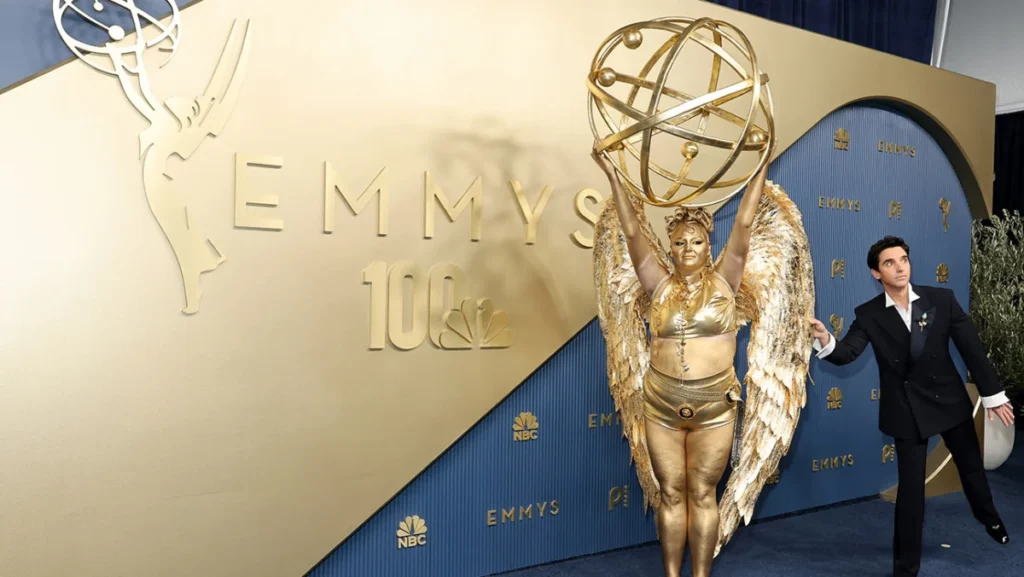

The 76th Primetime Emmy Awards arrived in Los Angeles with its customary glitz, glamour, and high-fashion risk-taking, but it was Hacks breakout star Megan Stalter who completely stole the pre-show spotlight. True to her reputation for avant-garde, self-aware red carpet interventions, Stalter arrived at the Peacock Theater not merely to attend television’s biggest night, but to physically embody the ultimate prize of the evening: the Emmy statuette itself.
Nominated for her breakout performance as the endearingly chaotic assistant Kayla Schaeffer in HBO Max’s critically acclaimed comedy series Hacks, Stalter pushed comedic performance art and red carpet couture into uncharted territory. With her skin painted a luminous, metallic gold from head to toe, matching golden tresses, towering gold heels, and sweeping golden wings, the actress delivered a masterclass in committed thematic dressing that instantly dominated social media feeds and entertainment headlines worldwide.
The Metamorphosis: A Golden Vision on the Carpet
Arriving alongside Hacks co-creator and executive producer Paul W. Downs, Stalter immediately drew gasps and applause from photographers and press corps stationed along the carpet. Rather than opting for a traditional designer gown, the comedian committed entirely to the bit. Her entire body was gilded in shimmering bronze and gold pigments, paired with intricate golden jewelry that echoed the Art Deco lines of the legendary television trophy.
In a moment that quickly went viral, Stalter paused for photographers to physically re-create the iconic pose of the Emmy statuette, holding an imaginary sphere aloft as Downs dutifully assisted with her dramatic, oversized golden wings. When pressed by reporters during the preshow broadcasts about the provenance of her look, Stalter maintained her signature deadpan comedic delivery. Asked by bewildered red carpet hosts if she was wearing Versace, and later who her mysterious designer might be, she deflected with trademark wit.
"This is a remake because, well, let’s say I’m not a size three," Stalter quipped, refusing to break character or confirm whether a traditional fashion house was behind the body paint and sculptural elements.
A History of Sartorial Subversion
Stalter’s literal translation of the Emmy award is merely the latest chapter in an increasingly legendary catalog of red carpet conceptual art. Over the past few seasons, the actress and comedian has consistently used high-profile industry events to subvert traditional red carpet expectations, frequently leaning into ironic, highly specific, and meme-worthy attire.
Earlier this year at the Critics Choice Awards, Stalter and Hacks co-creator Paul W. Downs turned heads by stepping out in matching vibrant orange ensembles that playfully parodied coordinated couple looks worn previously by Timothée Chalamet and Kylie Jenner. At the MTV Video Music Awards, she memorably walked the carpet dressed as a giant, functioning coffee cup. Her penchant for absurd branding continued at the Las Culturistas Culture Awards, where she arrived disguised as a classic Diet Coke can, and at the Critics Choice Association Celebration of LGBTQ+ Cinema & Television, where she proudly donned a pageant queen sash bearing the bold, satirical declaration: "BEST GAY ACTOR."
Industry observers note that Stalter’s choices serve a dual purpose: they function as brilliant marketing for her comedic brand while playfully skewering the rigid, often monotonous sartorial standards traditionally imposed on women in Hollywood. By turning herself into the physical embodiment of the trophy before the ceremony even commenced, Stalter effectively upstaged the traditional fashion discourse, proving that humor and high-concept performance art can easily rival million-dollar haute couture.
The Broader Context of the 76th Primetime Emmy Awards
Stalter’s dazzling arrival served as a vibrant preamble to a historic night for television. The 76th Primetime Emmy Awards, broadcast live on NBC and streaming simultaneously on Peacock from the Peacock Theater in downtown Los Angeles, was hosted by the legendary Mariska Hargitay.
The ceremony arrived during a particularly competitive era for television, characterized by the convergence of traditional network prestige and streaming dominance. Hacks, the critically adored dark comedy following the complex professional and personal dynamic between a legendary Las Vegas comedian (played by Jean Smart) and her entitled, Gen-Z writer (played by Hannah Einbinder), entered the evening as a dominant force in the comedy categories. Stalter’s role as the relentlessly inept yet strangely endearing agent Kayla has earned her widespread critical praise, cementing her status as one of modern comedy’s most unpredictable and magnetic screen presences.
The evening’s broader fashion landscape on the red carpet reflected a growing industry appetite for bold self-expression, architectural silhouettes, and metallic tones. However, none of the evening’s traditional couture installations managed to rival the sheer commitment of Stalter’s head-to-toe metallic transformation.
Cultural Implications of Comedy on the Red Carpet
The intersection of comedy and fashion has evolved significantly over the past decade. Historically, red carpets were treated as hyper-serious zones reserved exclusively for traditional elegance, high-end design houses, and public relations-vetted styling. Celebrities who stepped outside these rigid boundaries frequently faced critical backlash from traditional fashion police.
However, in the post-pandemic entertainment landscape, audiences have increasingly gravitated toward authenticity, humor, and self-awareness. Performers like Megan Stalter, alongside contemporaries such as Bowen Yang and Quinta Brunson, have redefined the red carpet as an extension of their comedic portfolios. By treating her appearance as performance art, Stalter subverts the pressure of consumerist perfection, transforming a stressful corporate Hollywood obligation into an interactive piece of pop culture history.
Furthermore, Stalter’s body-positive quip regarding her size during her red carpet interview highlights a subtle critique of the fashion industry’s historic exclusion of diverse body types. By stepping out painted gold rather than squeezing into sample sizes designed for traditional runway models, Stalter reclaimed the narrative around red carpet presentation on her own terms.
Looking Ahead: The Legacy of Stalter’s Emmy Look
As the ceremony commenced and winners began to claim their statuettes, the internet continued to process the sheer audacity of Stalter’s gold-plated arrival. Memes comparing her to various golden objects, Oscar and Emmy statuettes, and ancient mythological deities flooded digital platforms within minutes of her appearance.
Whether or not Stalter walked away from the Peacock Theater later that evening with a physical Emmy of her own, she had already secured a permanent spot in the annals of Emmy fashion history. By turning herself into the prize, Megan Stalter proved that the most valuable commodity in modern Hollywood is not a gold-plated piece of resin, but the ability to capture the world’s undivided attention through sheer, unadulterated creativity.