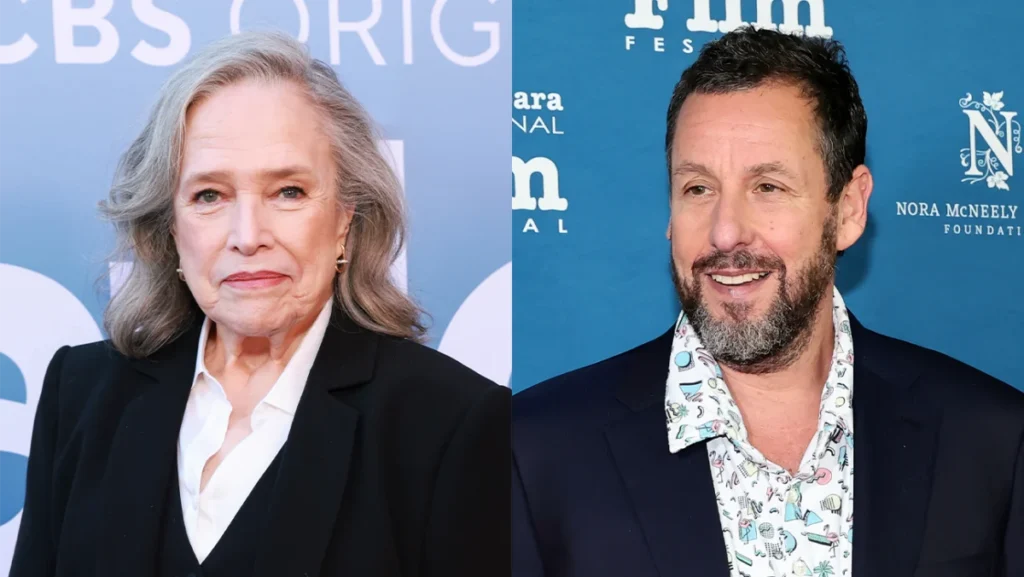

In a candid reflection on a career spanning decades and marked by critical acclaim, Academy Award and Emmy-winning actress Kathy Bates recently unveiled the surprising circumstances behind her involvement in two vastly different yet commercially successful projects: Adam Sandler’s 1998 sports comedy The Waterboy and the acclaimed CBS legal drama Matlock. Bates admitted to initially discarding the script for the former due to an unfamiliarity with Sandler’s burgeoning comedic brand and nearly passing on the latter, underscoring the often-unpredictable nature of casting and career-defining decisions in Hollywood. Her revelations offer a fascinating glimpse into the subjective process of script evaluation and the pivotal role that trusted personal connections can play in shaping an actor’s trajectory.
The Unlikely Path to Mama Boucher: A Dive into The Waterboy
The anecdote surrounding The Waterboy stands out as a testament to serendipity and the influence of cultural phenomena. Bates, known for her powerful dramatic performances in films like Misery (for which she won an Oscar), Fried Green Tomatoes, and Titanic, recalled her initial reaction upon receiving the script for the sports comedy. "I didn’t know who Adam Sandler was and I got a script," Bates recounted during a recent video interview with The Hollywood Reporter. Her initial assessment, after reading merely twelve pages, was dismissive. "It was a football script, and I was like, ‘Oh, let’s give me a football.’ Twelve pages I read and I thought, ‘Oh man, I can’t do this thing. This is ridiculous.’" Consequently, the script found its way into her wastebasket.
This initial dismissal, however, was swiftly intercepted by a crucial intervention. Her niece, who also works with Bates, retrieved the discarded screenplay. Upon learning that the project involved "some kid Adam Sandler," her niece reportedly exclaimed, "Adam Sandler! You don’t know the Hanukkah song?" This seemingly innocuous question proved to be a pivotal moment, connecting Bates to a comedic phenomenon she had, until then, overlooked.
Adam Sandler’s Ascendance and "The Chanukah Song" Context
To fully appreciate the context of Bates’ initial unfamiliarity, it is important to contextualize Adam Sandler’s career trajectory in the mid-to-late 1990s. While Bates had long established herself as a formidable dramatic actress, Sandler was then a rapidly rising comedic star, particularly beloved by a younger demographic. His tenure on NBC’s Saturday Night Live from 1990 to 1995 had made him a household name for a generation. It was during his time on SNL that Sandler debuted "The Chanukah Song" in 1994, a novelty song that became an instant cultural touchstone. The humorous, celebrity-laden lyrics celebrated Jewish identity during the holiday season and resonated widely, further cementing Sandler’s unique brand of musical comedy.
By 1998, when The Waterboy was released, Sandler had already transitioned successfully into film with hits like Billy Madison (1995) and Happy Gilmore (1996), which, despite often receiving mixed critical reviews, were massive box office successes, grossing $26.4 million and $41.2 million domestically, respectively. His films cultivated a loyal fanbase attracted to his blend of slapstick humor, relatable underdog protagonists, and often absurd, over-the-top scenarios. His comedic style, however, was a departure from the more traditional, character-driven narratives that often attracted an actress of Bates’ caliber.
The Genesis of The Waterboy and its Impact
The Waterboy, directed by Frank Coraci and co-written by Sandler and Tim Herlihy, capitalized on Sandler’s established comedic persona. The film centered on Bobby Boucher, a socially awkward, dim-witted 31-year-old water boy from rural Louisiana who discovers a talent for football after years of being sheltered and home-schooled by his overprotective mother, Mama Boucher. The role of Mama Boucher was crucial, requiring an actress who could imbue the character with a peculiar blend of fierce devotion, religious fervor, and almost cartoonish eccentricity.
Once persuaded by her niece to give the script a second chance, Bates reconsidered. "So I took another look at it, and I thought, well, I’ll do this for Linda [her niece]," Bates shared. What followed was a highly enjoyable and creatively fulfilling experience. "Turns out we had the most fun. He’s brilliant. He’s a genius," Bates enthused about Sandler. "I dove in the deep end and just had a great time. Just screwed around. And I loved working with him. That’s when he first started really getting known and people really flocking to see him."
The film, released on November 6, 1998, became a colossal commercial success. The Waterboy grossed over $186 million worldwide against a production budget of approximately $20 million, making it Sandler’s highest-grossing film to date at the time and a significant milestone in his career. Bates’ performance as Mama Boucher was widely praised, often highlighted by critics as a standout element that grounded the film’s comedic absurdity. Her ability to fully commit to the character, from the thick Louisiana accent to the unwavering, almost fanatical devotion to her son and her unique interpretation of Christian dogma, showcased her remarkable versatility. The character, with her memorable catchphrases like "Water sucks, it really really sucks!" and "You can do it!", became iconic, further solidifying Bates’ reputation for stealing scenes in even the most unexpected roles.
The Matlock Miracle: A Late-Career Renaissance
Beyond The Waterboy, Bates also revealed a similar moment of hesitation with her current acclaimed project, the CBS legal drama Matlock. This instance, however, stemmed less from unfamiliarity with a co-star and more from a period of professional disillusionment and a misjudgment of the script’s depth.
Navigating the Challenges of a Veteran Career
"Matlock is a miracle for me," Bates declared, reflecting on the show’s significance in her life. Her remarks underscore the often-unspoken challenges faced by veteran actors in Hollywood, particularly as they age. Bates, who will turn 78 in 2026, articulated a period of profound disappointment prior to Matlock. "I had one foot out the door. A film that I did not too long before just was such a heartbreaking disappointment. You know, at my age, I’m going to be 80 in two years, I just thought, this is not working out, it’s not giving me any happiness." While she did not specify the particular film, her statement paints a vivid picture of the emotional toll that unsuccessful projects can take, even on an actress of her stature. This sentiment resonates with many in the industry, where creative endeavors are deeply personal and the pursuit of meaningful work can become paramount.
The original Matlock, starring Andy Griffith as the titular defense attorney, was a beloved procedural drama that aired from 1986 to 1995. The concept of a reboot or reimagining carries both the promise of a built-in audience and the challenge of living up to a cherished predecessor. Bates’ initial encounter with the script for the new Matlock mirrored her Waterboy experience – a quick read leading to a dismissive conclusion. "Then I got the script for Matlock. And at first I was reading, and I was talking to my friend in New York, Billy. I said, ‘Ah, this is just a procedural.’"
The Power of a Second Look and Meaningful Storytelling
Once again, a trusted confidant intervened. Her friend, Billy, challenged her initial assessment, urging her to complete the script. "He said, ‘Did you read it? Did you finish it?’ He said, ‘Read it to the end.’" This encouragement proved crucial. "So, I read and, of course, it’s got this great twist at the end. And I thought, ‘OK, now we’re talking.’" Bates emphasized her desire for substantive storytelling: "I wanted it to be about something. I didn’t want it just to be a case of the week. And the fact that there’s this woman who’s got a real mission and something in the real world that people are struggling with."
The new Matlock series, developed by Jennie Snyder Urman, reimagines the classic premise with Bates in the lead role as Madeline Matlock. This iteration centers on Matlock, a brilliant but unassuming septuagenarian who, after years away from the spotlight, re-enters the workforce at a prestigious law firm. Utilizing her shrewd intellect and unconventional tactics, she takes on challenging cases and works to expose corporate and systemic wrongdoing. The "great twist" Bates referred to likely pertains to the show’s deeper thematic elements and the character’s personal motivations, which extend beyond simply solving weekly legal puzzles.
Industry Implications and the Value of Stable Work
The series premiered to a positive reception, largely due to Bates’ captivating performance and the show’s ability to blend traditional procedural elements with contemporary social commentary. The network’s confidence in the show was underscored by its recent renewal for a third season, a significant achievement in the highly competitive landscape of network television.
Bates’ gratitude for Matlock extends beyond personal fulfillment, touching upon broader industry concerns. "I’m especially grateful for the show because times are hard. A lot of people in this industry are out of work," she acknowledged, referencing the recent periods of strikes and economic uncertainty that have impacted many entertainment professionals. "And so a big part of our joy is that we have a place to go every day. We have something wonderful to make." Her statement highlights the importance of consistent employment and creative opportunities, particularly for an industry often characterized by its transient nature. For veteran actors, a successful series can offer not only artistic challenge but also a stable platform to continue their craft and mentor younger talent.
Broader Implications: Instinct, Collaboration, and Enduring Legacy
Kathy Bates’ candid admissions provide valuable insights into the intricacies of artistic collaboration and career longevity in Hollywood. Both instances—her initial rejection of The Waterboy and Matlock—underscore several key themes:
- The Subjectivity of Script Evaluation: What might appear "ridiculous" or "just a procedural" on a superficial read can, upon deeper engagement, reveal layers of character, plot, and thematic resonance. This highlights the challenge for writers and casting directors to convey a project’s full potential from the outset.
- The Role of External Influence: The interventions of Bates’ niece and friend were not merely coincidental; they were critical junctures that altered her professional path. This speaks to the importance of trusted advisors and the value of diverse perspectives in creative decision-making, even for established professionals.
- Adaptability and Versatility: Bates’ willingness to reconsider and ultimately embrace roles outside her perceived comfort zone, from a comedic foil to a reinvented legal eagle, showcases her exceptional adaptability. Her ability to inhabit such diverse characters with conviction is a hallmark of her enduring appeal and a testament to her acting prowess.
- Career Longevity and Reinvention: For an actress of Bates’ experience, finding projects that offer both creative challenge and personal satisfaction is crucial. Matlock represents a late-career triumph, providing her with a platform to explore complex themes and deliver a nuanced performance, while also offering the stability she appreciates in a challenging industry climate.
Kathy Bates’ journey with The Waterboy and Matlock serves as a compelling narrative about how unforeseen opportunities, coupled with a willingness to reconsider initial judgments and lean on trusted counsel, can lead to some of the most memorable and successful chapters in a distinguished career. Her story is a powerful reminder that in the unpredictable world of entertainment, sometimes the greatest successes emerge from the most unexpected places.