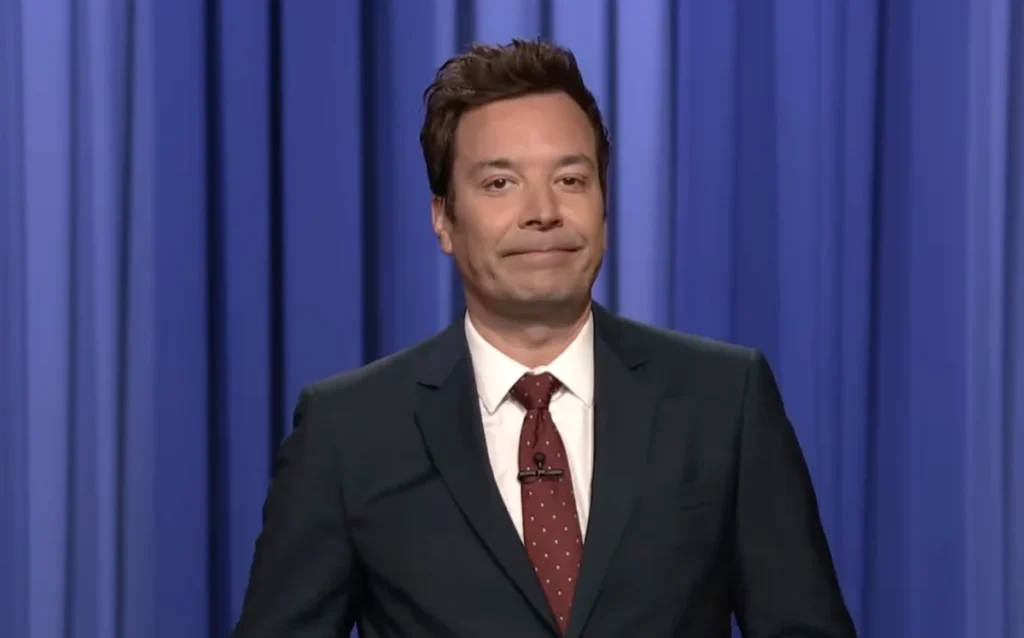

The discourse surrounding the future of artificial intelligence reached the stage of late-night television on Monday, September 14, as Jimmy Fallon, host of The Tonight Show, delivered a pointed comedic critique of President Donald Trump’s recent assertions regarding his ability to manage the risks associated with the rapidly evolving technology. The segment followed a series of statements from the President on the social media platform Truth Social, in which he claimed that the primary "guardrails" necessary to regulate AI were simply a "strong and smart (High IQ!) president," asserting that the United States currently possesses such leadership.
The President’s Stance on AI Regulation
President Trump’s recent commentary on artificial intelligence has framed the technology as a matter of national competitiveness rather than a potential existential threat. In his social media communications, the President emphasized that the United States should prioritize dominance in AI capabilities, suggesting that existing federal oversight and executive leadership are sufficient to mitigate any associated dangers. This perspective stands in stark contrast to the growing chorus of industry experts, researchers, and tech CEOs who have recently called for more stringent regulatory frameworks and international cooperation to prevent catastrophic outcomes.
During his monologue, Fallon seized upon the President’s phrasing, specifically mocking the reliance on "High IQ" leadership as a technical control mechanism. Fallon humorously suggested that the President’s confidence in his own cognitive abilities—frequently referenced by Trump in relation to cognitive screening tests—was insufficient to oversee the complexities of neural networks, machine learning, or large language models. The comedian further engaged in a satirical impersonation, suggesting that the President might attempt to rebrand the entire field of Artificial Intelligence as "American Intelligence" to align with his broader nationalist policy rhetoric.
The Growing Anxiety Within the Tech Industry
The public debate over AI safety has intensified significantly in recent weeks, fueled by high-profile departures from major AI research laboratories. One of the most notable catalysts for this renewed sense of urgency was the resignation of Jacob Coxon, a researcher formerly affiliated with Anthropic, an AI safety and research company. Coxon’s public exit included warnings that current development trajectories for frontier models could potentially lead to risks of human extinction by the end of the decade.
This warning prompted a formal response from Anthropic CEO Dario Amodei, who published a 4,000-word essay titled "We Must Pace the Frontier." In the document, Amodei argued for a controlled deceleration in the development of AI capabilities, suggesting that the industry must be more deliberate in its deployment of powerful models. Amodei’s position has garnered significant attention, receiving public backing from other industry leaders, including OpenAI CEO Sam Altman, Google DeepMind co-founder Demis Hassabis, and SpaceX and Tesla CEO Elon Musk. These figures, despite their competitive business interests, have increasingly aligned on the necessity of "wise use of the time we gain" to ensure that safety research keeps pace with raw computational power.
Historical Context and the Evolution of AI Policy
To understand the current tension, one must look at the timeline of AI policy in the United States over the past decade. Initial government efforts, such as the 2019 Executive Order on Maintaining American Leadership in Artificial Intelligence, were focused almost exclusively on maintaining a competitive advantage against international rivals, particularly China. The focus was on infrastructure, workforce development, and R&D funding.

However, the rapid commercialization of generative AI—triggered by the public release of tools like ChatGPT in late 2022—shifted the conversation toward safety, bias, and control. By late 2023 and early 2024, the debate transitioned from purely economic concerns to existential ones. President Trump’s recent remarks indicate a desire to return the narrative to a focus on American strength, potentially signaling a deregulatory approach should his administration continue to shape policy in this sector.
Analysis of the "Guardrails" Debate
The concept of "guardrails" in AI refers to the technical and policy-based constraints placed on models to ensure they do not produce harmful content, violate privacy, or act outside of their intended parameters. Critics of the administration’s hands-off approach argue that AI development is inherently global and decentralized. Because the technology is software-based and relies on massive datasets that can be accessed globally, domestic "High IQ" leadership—as described by the President—may have limited efficacy in curbing the development of models created in jurisdictions outside of U.S. oversight.
Furthermore, the integration of AI into military and government infrastructure necessitates a robust, objective framework that goes beyond political posturing. The "Very Negative Force Force" joke made by Fallon highlights the public’s growing skepticism toward political attempts to manage highly technical problems through branding and rhetoric rather than substantive policy. The reliance on AI-generated imagery—which the President has used to depict himself in various heroic roles—serves as a case study for the challenges of misinformation. The ease with which such images can be generated underscores the very problem that experts fear: the erosion of objective truth.
Implications for Future Governance
The divergence between the executive branch’s current rhetoric and the scientific community’s consensus poses several risks for future policy:
- Regulatory Fragmentation: If the U.S. government maintains that current leadership is sufficient, it may find itself out of step with international efforts, such as the European Union’s AI Act, which seeks to establish comprehensive legal frameworks for AI deployment.
- Public Trust: When political leaders trivialize complex technological risks, it may hinder the public’s ability to demand accountability from tech corporations.
- Economic Competitiveness: By ignoring the calls for safety standards from industry leaders, the U.S. risks a scenario where domestic companies are either hampered by the lack of clear guidelines or are allowed to develop technologies that create long-term systemic risks to the economy and national security.
Conclusion
Jimmy Fallon’s satirical take on the President’s approach to artificial intelligence serves as a reflection of the broader public confusion surrounding the technology. While the segment was intended for entertainment, it underscored a very real and significant divide in how the country’s leadership and its scientific elite view the future. As the technical capabilities of AI continue to grow at an exponential rate, the debate over who—or what—is best equipped to provide the necessary "guardrails" will likely become a central issue in the coming years.
As the industry grapples with the transition from the "discovery" phase of AI to the "deployment and integration" phase, the need for clear, evidence-based policy becomes paramount. Whether the path forward involves a government-led approach, industry self-regulation, or a combination of both remains to be seen. What is clear, however, is that the era of treating artificial intelligence as a peripheral issue has passed. The technological, ethical, and societal implications are now firmly embedded in the national consciousness, and the discourse will likely only grow in intensity as the decade progresses toward the thresholds mentioned by experts like those at Anthropic.
The juxtaposition of Fallon’s comedy with the sober warnings of AI researchers highlights the surreal nature of the current moment. We are currently witnessing a period where the potential to fundamentally alter the human experience is being discussed in the same breath as memes and late-night punchlines. This collision of entertainment, politics, and existential science is a hallmark of the 21st-century information age, where the line between serious policy discourse and public commentary continues to blur.